Eczema is common, and on Black skin it is more common and more severe
Atopic dermatitis, the most common form of eczema, is a chronic condition in which the skin barrier does not hold moisture well, becomes inflamed, and itches. It is not contagious and not caused by poor hygiene.
The burden is not spread evenly. A retrospective cohort study published in Pediatric Dermatology found atopic dermatitis prevalence of 37.0 percent among Black children, compared with 17.9 percent among white children. A clinical review in Cutis on atopic dermatitis in adolescents with skin of color states that "Black children are at 6-times greater risk for severe AD than white children."
Genetics are not the main story. A 2021 analysis in the Journal of Allergy and Clinical Immunology argued that socioeconomic, environmental, and health-care factors, not innate biological differences, drive most racial and ethnic disparities in atopic dermatitis prevalence and severity. A Pediatric Dermatology study linked living in highly segregated communities to more severe atopic dermatitis in African American children, pointing to structural conditions rather than skin type.
This article is for managing your own or your child's eczema.
How eczema looks on Black skin
On lighter skin, eczema is taught as a red, oozing rash. On darker skin, that redness is muted or absent, which is one reason the disease gets under-treated.
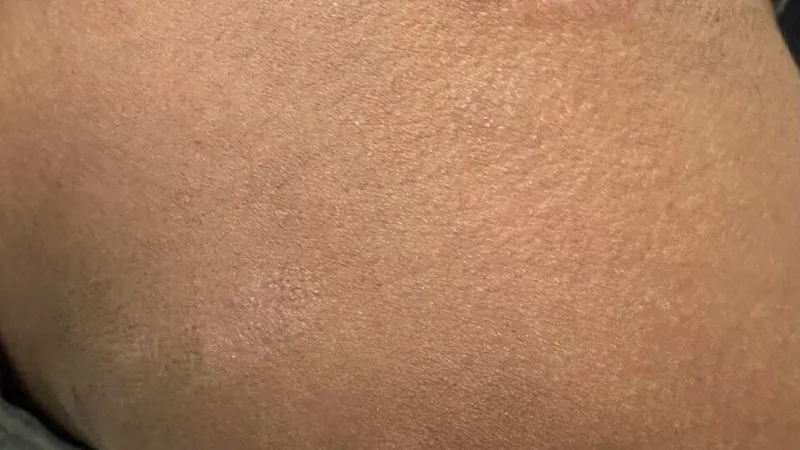
The American Academy of Dermatology describes atopic dermatitis on darker skin tones as producing "dark brown, purple, or grayish areas of skin" and "small, rough bumps," with redness that "may not be as visible." In older children and teens, the AAD notes the bumps "tend to be gray to violet-brown in color." Black patients also more often show follicular accentuation, meaning small bumps centered on hair follicles, and the skin can feel dry, thickened, and intensely itchy.
That follicular pattern has a name: papular eczema. A Pediatric Dermatology review of atopic dermatitis in African American children describes lesions clustering as small, firm papules around hair follicles rather than one flat, red patch, often on the trunk and extensor surfaces (the outside of elbows and knees) rather than only the creased skin the textbook picture emphasizes. A 2023 Journal of Clinical Medicine review confirms it: African patients more often show "perifollicular accentuation and distinct papules on the extensor surfaces." In babies, that same bumpy, papular look often appears on the cheeks, scalp, and extensor surfaces before settling into the elbow- and knee-crease pattern later, and it is easy to mistake for ordinary dry skin.
A practical consequence: a clinician trained mostly on red rashes may judge a Black patient's eczema as milder than it is, because the visual cue they were taught to look for is missing. Dry, itchy, bumpy, discolored skin is active eczema even without obvious redness. Say so plainly at the visit, and point to the texture and the itch rather than the color.
If the dryness reads more as ashy, flaky skin than as an itchy rash, that may be a different problem or an overlapping one. Our guide to dry, ashy skin on Black skin: causes and treatment covers how to tell them apart.
Why standard eczema scoring underestimates it on Black skin
The tools clinicians use to score eczema severity, EASI and SCORAD, lean heavily on how red the skin looks, a problem when redness itself is harder to see. A study of Black and white children in London scored severity with SCORAD and found no significantly higher risk of severe disease in Black children when erythema was scored normally. Once adjusted for erythema, that flipped: Black children turned out nearly six times more likely to have severe disease. The study's own conclusion: "erythema can be a misleading indicator of severity in black children," risking severe cases left undetected.
That is not an isolated finding. A 2015 analysis in the International Journal of Women's Dermatology tested EASI and SCORAD for reliability across skin tones and found both had poor inter-rater reliability in highly pigmented skin, meaning different clinicians scoring the same patient disagreed with each other more often, largely because of how differently they perceived erythema.
Common skin conditions are treated in primary care, and community health centers charge on a sliding scale that is often $0. Our directory of free and charitable clinics lists centers by state. A same-day telehealth visit is self-pay and cannot be billed to Medicaid or commercial insurance, so the clinic route usually costs less. If you need a prescription sooner than the next appointment:

Prescription skincare from a licensed clinician.
- Online visit and a treatment plan for your skin
- From $59 a month, shown before you book
 with Sesame Care
Affiliate link, we may earn a commission at no extra cost to you.
The daily routine that works
The treatment that controls most eczema is not a single product. It is a daily habit built on two steps, and it is the same foundation regardless of skin tone.
Moisturize, generously and often. Moisturizers relieve dry, cracked skin, reduce inflammation, and lengthen the time between flares by helping rebuild a skin barrier that cannot hold onto water on its own; the American Academy of Dermatology calls them foundational to atopic dermatitis care. The National Eczema Association recommends thick emollients, medical moisturizers heavier than typical lotions and often built on ceramides and other barrier lipids. Apply moisturizer at least twice a day, and again within minutes of bathing while skin is still damp to seal water in. Fragrance-free is the rule; fragrance is a common irritant.
Cleanse gently. Use a mild, fragrance-free, low-pH cleanser and lukewarm (not hot) water. Harsh soaps strip the barrier and provoke flares.
These two steps do most of the work in mild disease and form the base on top of which every prescription treatment sits.
The prescription ladder: what to add when moisturizing is not enough
When the daily routine is not controlling flares, the next layer is prescription anti-inflammatory medicine, and the options have expanded well beyond steroids in the past decade.
Topical corticosteroids are the first-line prescription treatment. The American Academy of Dermatology's 2023 guidelines for adults strongly recommend them as "commonly used as the first-line treatment for patients with atopic dermatitis in all skin regions." Used correctly, in the strength and for the duration a clinician directs, they are effective and safe. The concern about steroids thinning skin is real only with prolonged use of stronger steroids on delicate areas, which is exactly why clinicians match potency to body site.
Topical calcineurin inhibitors, tacrolimus ointment and pimecrolimus cream, are also strongly recommended by the AAD and reduce inflammation and itching without the skin-thinning risk of steroids. That makes them useful for the face, eyelids, and skin folds, and for long-term maintenance. This matters on Black skin, where the resulting pigment change is a bigger concern; the National Eczema Association notes calcineurin inhibitors can treat sensitive areas without the risk of additional pigment changes.
Two newer nonsteroidal options fill the gap before a systemic drug. Crisaborole, a topical medicine that blocks an inflammatory enzyme called PDE4, was proven in two Journal of the American Academy of Dermatology phase 3 trials and is approved for mild-to-moderate eczema in patients as young as three months. Ruxolitinib cream, a topical JAK inhibitor, improved itch and clearance in two more phase 3 trials in the same journal; it is approved for short-term or non-continuous use when topical prescription treatment has not adequately controlled the disease. Neither carries a skin-thinning risk.
Dupilumab is the option for moderate-to-severe disease that topicals cannot control: a biologic injected under the skin that blocks two inflammatory proteins, interleukin-4 and interleukin-13. The National Eczema Association describes it as FDA-approved for adults and children six months and up with moderate-to-severe atopic dermatitis that "cannot be controlled by topical medications alone." It is not a first step; it is a prescription a dermatologist or allergist manages.
Triggers, including hair and scalp care
Eczema flares when something irritates the skin or the immune system. The National Eczema Association frames daily management as good skin-care habits plus avoiding triggers: fragrance in soaps, lotions, and detergents; harsh surfactants; sweat; dry winter air; wool and other scratchy fabrics; stress. There is no universal trigger list, so track flares against what changed in the days before, then remove suspects one at a time. Fragrance-free swaps across soap, moisturizer, and laundry detergent are the highest-yield first change.
Hair and scalp products deserve the same scrutiny. A 2024 Cureus review on hair product allergy found fragrance in most shampoos and conditioners tested, and flagged cocamidopropyl betaine, a foaming agent from coconut oil common in shampoo, as a frequent cause of scalp and hairline allergic reactions. Hair oils, edge control, and gels applied at the hairline and nape can trap product against skin that is already barrier-compromised, the same way fragrance in lotion does elsewhere. If eczema keeps flaring along the hairline, behind the ears, or at the nape, switch to fragrance-free shampoo and keep heavier styling products off the scalp. Greasy or yellow scale, rather than dry and flaky, points more toward seborrheic dermatitis and is worth a separate conversation with a dermatologist.
The marks left behind: post-inflammatory pigment change
After a flare settles, Black skin often holds onto a mark where the eczema was, darker (hyperpigmentation) or lighter (hypopigmentation) than the surrounding skin. A comparative practice survey in Cutis lists post-inflammatory pigment change among the most common skin-of-color complaints dermatologists see, and eczema is a frequent cause. The inflammation drives pigment-producing cells to over- or under-produce melanin, and the discoloration can linger for months after the eczema is gone.
For many Black patients these marks are a bigger daily concern than the eczema. There is no shortcut: the most effective way to limit pigment change is to treat flares early and well, because the less inflammation, the less the pigment shift. Sun exposure can darken the patches further, so daily sun protection on involved areas helps. If the marks are extensive or slow to fade, our guide to dark spots and hyperpigmentation on Black skin covers what the evidence supports.
What eczema on Black skin gets mistaken for
Eczema on Black skin is regularly recorded as something else. The three most common substitutions are psoriasis, which also looks violaceous rather than red on darker skin; tinea, a fungal infection that shares the ring-like scaling; and plain dry skin, which is what chronic flexural itch gets called when nobody looks closely. Each of those carries a different treatment, so a wrong label costs months. If a moisturizing routine has not touched the itch in several weeks, that is the point to ask for a dermatology referral and to ask directly whether psoriasis and tinea have been ruled out.
When to see a dermatologist
Self-care controls mild eczema. See a clinician, ideally a dermatologist, when:
- The daily moisturizing routine is not controlling the itch or the flares.
- The skin is cracked, weeping, crusted, or has yellow scabs, which can signal infection.
- The eczema covers large areas, disrupts sleep, or affects daily life.
- Pigment changes after flares are extensive or persistent.
- A child's eczema is moderate to severe, where prescription treatment and possibly dupilumab are on the table.
Because eczema can look milder than it is on darker skin, and standard scoring tools can compound that, a clinician experienced with skin of color is worth seeking out. You can search for dermatologists and other clinicians in our provider directory.
Frequently asked questions
What does eczema look like on Black skin? ▼
Instead of the red, weeping rash of most textbooks, eczema on Black skin often looks dark brown, purple, or grayish, easy to miss if you are looking for red. A common pattern is small, firm bumps clustered around hair follicles, called follicular or papular eczema, often on the trunk and outer arms and legs as much as the elbow and knee creases. The skin is dry, thickened, and intensely itchy; texture and itch are the more reliable signs.
Is eczema really more common in Black children? ▼
Yes. A Pediatric Dermatology cohort study found a 37.0 percent prevalence among Black children versus 17.9 percent among white children, and a Cutis review reports Black children carry a six-times greater risk of severe disease. The drivers are largely socioeconomic and environmental rather than genetic.
Why do doctors sometimes call my eczema mild when it does not feel mild? ▼
The scoring tools clinicians use lean heavily on redness, harder to see on darker skin. A study of Black and white children in London found that once erythema was factored out of the score, Black children turned out nearly six times more likely to have severe disease, not less. If your eczema is scored mild but the itch or area affected feels severe, say so, and ask the clinician to weigh those factors too.
Will steroid creams thin or lighten my skin, and are there non-steroid options? ▼
Topical corticosteroids are the strongly recommended first-line treatment when used at the right strength and duration for the body site; the thinning risk applies mainly to prolonged use of stronger steroids on delicate areas, which clinicians avoid by matching potency to site. Steroid-free options exist too: topical calcineurin inhibitors, crisaborole, and ruxolitinib cream all treat eczema without a skin-thinning risk. For moderate-to-severe disease none of those control, dupilumab is an injectable biologic FDA-approved down to age six months.
How do I get rid of the dark marks left after a flare? ▼
Those marks are post-inflammatory pigment change, and they can outlast the eczema by months. There is no quick fix. The most effective approach is preventing them by treating flares early, since less inflammation means less pigment shift, plus sun protection on the involved skin.
Does eczema look different on a baby, or on the scalp? ▼
In infants, eczema often shows up first on the cheeks, scalp, and outer arms and legs, with the same bumpy, papular pattern common in Black children, before settling into the elbow- and knee-crease pattern seen later. On the scalp, hair products can add their own fragrance and buildup on top of the eczema; fragrance-free shampoo and keeping oils and gels off the scalp helps. Greasy, yellow scale points more toward seborrheic dermatitis and deserves its own conversation with a dermatologist.