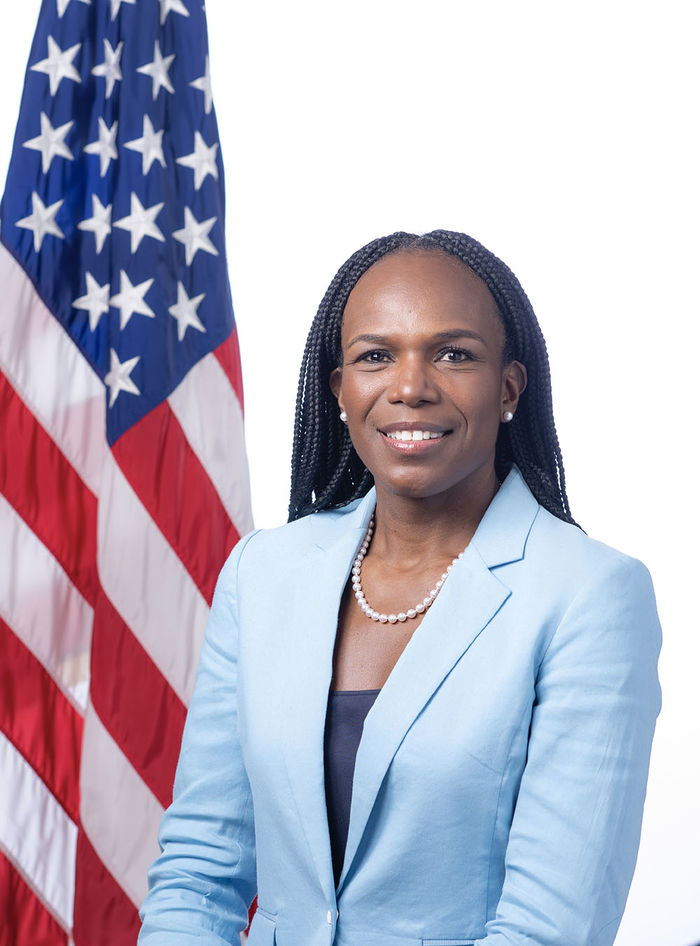
In April 2020, when the COVID-19 testing infrastructure in Philadelphia was leaving Black neighborhoods uncovered, Dr. Ala Stanford rented a van, recruited a few colleagues, and started showing up in church parking lots with nasal swabs. Within months the operation she founded, the Black Doctors COVID-19 Consortium, had tested tens of thousands of Philadelphians and built one of the most-replicated community-health-response models of the pandemic.
Five years later, Stanford has done a tour through the federal government (HHS Region 3 Director from 2021 to 2024) and landed at the University of Pennsylvania, where she directs community outreach for the Penn Institute for RNA Innovation. The throughline across the arc is the same: when the medical system does not show up for Black communities, she builds the infrastructure that does.
Who she is
Stanford is a board-certified pediatric surgeon. She trained at Pennsylvania State University College of Medicine, completed her general surgery and pediatric surgery training in Philadelphia, and ran R.E.A.L. Concierge Medicine, her own practice, before COVID. The pivot from private surgical practice to public-health organizer was not a planned career move. It was the response to what she could see was failing in real time, on her own block.
The honors stack since 2020 reads like a list of late-career awards on someone who is mid-career: the Philadelphia Award (2021), CNN Heroes Top 10 (2021), USA Today's Women of the Year (2022), Time 100 Most Influential People (2021). The point of naming them is not the awards themselves. It is that the federal-government, mainstream-media, and academic-medicine systems all looked at the same career arc and recognized it for the same reason. The work was real and it worked.
What BDCC actually did
The Black Doctors COVID-19 Consortium ran free testing and later free vaccination clinics out of Black churches, community centers, and parking lots in Philadelphia and the broader Delaware Valley. By February 2021 the operation had vaccinated nearly 4,000 people. By later in 2021 the testing-and-vaccination total ran into the tens of thousands. The model the BDCC built (trusted Black clinicians + community spaces + free at the point of contact + no insurance friction) became the template referenced in CDC briefings and replicated by community-health organizations across the country.
The reason BDCC mattered, statistically, is the gap it filled. Through the first year of the pandemic, Black Americans had COVID-19 mortality rates roughly double those of white Americans, with the largest gaps in cities where formal testing access was most uneven. Philadelphia's Black neighborhoods were on the wrong side of that distribution; BDCC moved testing access into them physically, before the city's official infrastructure caught up.
It is one of the cleanest case studies of what a Black-led, community-trusted health response looks like when the disparity numbers are running in real time. The CDC and the academic public-health literature both cite the BDCC model as a working example of culturally adapted infrastructure.
What she did at HHS
From 2021 to 2024, Stanford served as the Regional Director for HHS Region 3 (Pennsylvania, Delaware, Maryland, Virginia, West Virginia, and DC). The role coordinates HHS programs across the region: Medicaid implementation, Title X family-planning, public-health response, federal grant flow to state health departments. It is a senior federal post, and she was the first Black woman to hold the Region 3 directorship.
The HHS tour ended with the 2024 administration transition. The work she did during it (she has spoken on the record about pushing federal-grant flow toward community-led, Black-led health organizations) is the kind of structural-policy work most readers do not see; the visible BDCC-era pandemic response is the more public chapter, but the federal chapter is where the infrastructure she built in Philadelphia got tested at scale.
Community health centers test and treat COVID on a sliding scale, often for less than a telehealth visit's own fee. Our directory of free and charitable clinics lists centers by state. A same-day telehealth visit is self-pay and is not billed to Medicaid, so check the clinic route first. If you want a telehealth visit sooner:

Sesame Care
A same-day online visit with a licensed clinician for COVID symptoms, testing guidance, and treatment options. Prices are shown before you book; visits start at $34 and vary by clinician and location (checked August 2026).
See a clinician todayAffiliate link, we may earn a commission at no extra cost to you.
What she is doing now
Stanford is currently a Professor of Practice in the Department of Biology at the University of Pennsylvania and directs Community Outreach for the Penn Institute for RNA Innovation. The Institute focuses on RNA-based therapeutics (the same biological platform that mRNA vaccines are built on) and her remit there is the community-engagement layer: making sure the next generation of RNA medicines actually reaches Black patients, who were under-represented in mRNA vaccine trial cohorts and remain under-represented in most US clinical trials.
That is the through-line worth tracking. BDCC was about getting the existing technology to Black patients during a pandemic. The Penn Institute work is about making sure the next generation of biomedical innovation does not start from a Black-under-representation baseline.
How to follow her work
BDCC continues to operate as a 501(c)(3) nonprofit at blackdoctorsconsortium.com; the site lists current testing and vaccination services plus community-health partnerships in the Delaware Valley.
Stanford's primary social channels are Instagram and X under variations of @aladstan and @drala_stanford; her posting cadence centers on Penn Institute work, BDCC events, and policy commentary on Black-community health response. Her Wikipedia page collects the verifiable awards, affiliations, and historical record.
What you can take from this
Three concrete moves.
First, if you live in the Delaware Valley, BDCC is still operating; check the site for current testing, vaccination, and community-health services. The model is also one of the most replicated US community-health responses; if your city has a similar Black-led health network, that organization probably traces back to or alongside BDCC as the proof-of-concept.
Second, the structural lesson Stanford has been making on the record for five years is that Black-community health infrastructure works when it is built by Black clinicians, in Black community spaces, free at the point of contact. If you are a clinician or organizer thinking about the next chapter of community-health response (climate-related health, the next pandemic, structural-disease outreach), her model is the working template.
Third, RNA-platform medicine is the next decade of clinical innovation. Black under-representation in trial cohorts is the standing equity problem the Penn Institute is trying to solve. Our piece on finding a Black doctor covers the workforce numbers; the Penn Institute work is the trial-recruitment-side companion. Both are needed.
Citations
Black Doctors COVID-19 Consortium. blackdoctorsconsortium.com.
Penn Institute for RNA Innovation. med.upenn.edu/rna.
U.S. Department of Health and Human Services Region 3. Stanford served as Regional Director, 2021 to 2024.
Time 100 Most Influential People (2021). Recognition of Stanford for BDCC pandemic response.