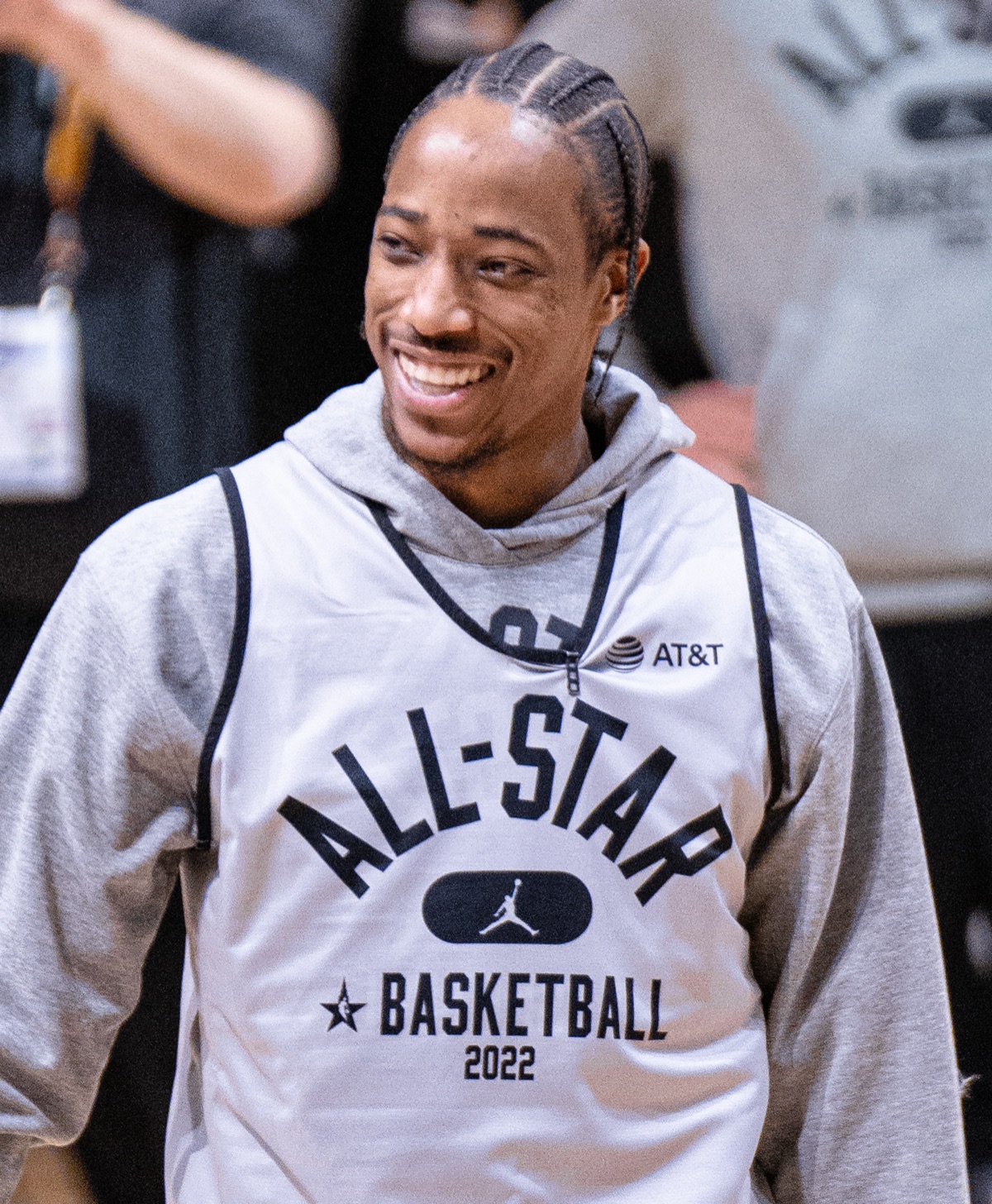
In February 2018, DeMar DeRozan posted on Twitter that he was struggling with depression. He was a four-time NBA All-Star at the time, in his ninth season as a starter. The post was three sentences. It changed how a generation of Black men, and the league they played in, talked about mental health.
Eight years later, DeRozan is still playing in the NBA, still talking about depression, and now also a Harmony Books author. Above the Noise: My Story of Chasing Calm came out in 2024 and walks through the depression in his own words: where it came from, what it cost him, what helps. The book is the durable artifact. The cultural lift, around Black men talking about mental health out loud, started with that 2018 post.
What changed because of it
The cleanest measurable consequence is policy. After DeRozan's 2018 disclosure, and Kevin Love's roughly contemporaneous Players' Tribune essay on his own panic attacks, the NBA required every team to employ at least one full-time licensed mental health professional on staff. Not optional. Not a contractor. Full-time. The league also added confidential clinician access for players and structured mental-health protocols into the collective bargaining agreement.
That policy change is what 'a mental health disclosure mattered' looks like in concrete-institutional terms. Before 2018, mental health support in the NBA was uneven across teams, optional, often off the books. After 2018, it is a structural requirement. The infrastructure is now there for the next player who needs it.
The cultural consequence is harder to measure but harder to overstate. Black-men-talking-about-depression did not become normal in 2018; it remains hard. But the line between 'I have to look fine all the time' and 'I am working through something' moved, and DeRozan's post is one of the events most-cited as the moving force.
Why the Black-men context matters specifically
The treatment-access numbers tell the structural story. Per the National Institute of Mental Health's 2022 data on adults with any mental illness, 56.1 percent of white adults received mental health treatment in the past year. The corresponding rate for Black or African American adults was 37.9 percent. That is an 18-percentage-point gap, sitting on top of similar prevalence rates between groups (NIMH Mental Illness Statistics).
The gap narrows for serious mental illness specifically (68.6 percent of white adults vs 62.3 percent of Black adults received treatment), but it does not close. And inside the Black-adult bucket, Black men are the slice with the lowest treatment-receipt rates of any race-and-gender combination NIMH tracks. The reasons trace through the same three-layer structural-racism framework Camara Jones laid out in 2000: institutional (clinician supply, insurance coverage), personally mediated (clinician bias in symptom assessment), internalized (the cultural narrative of Black men handling things alone).
This is the gap DeRozan's 2018 post and his 2024 book sit on top of. They do not close it. They make a culturally specific intervention on the internalized layer: the most visible Black men in US sports talking about depression on the record, in their own voice, without softening it.
What the book actually argues
Above the Noise: My Story of Chasing Calm is structured as a memoir, not a self-help book. DeRozan walks through his upbringing in Compton, his college recruitment to USC, the Toronto Raptors years, the depression that surfaced in 2018, the family pieces that surfaced underneath it, the work he has done to manage it since. The therapeutic framework is unsensational: he names therapy directly, names medication when relevant, names the clinicians who helped him.
Community mental health centers see patients on a sliding scale, and they take patients a private practice would turn away over insurance. If you're in crisis right now, our crisis resources page lists free, immediate options. Our directory of free and charitable clinics lists centers by state. A paid online mental health platform is not billed to Medicaid, so check the community mental health center in your county first. If you want to start with a paid platform today:

Talk to a licensed therapist online.
- Sessions by video, phone or chat
- 20% off your first month
- Start from home, on your schedule
 with BetterHelp
Affiliate link, we may earn a commission at no extra cost to you.
The editorial register matters because it is the register that lands with Black men readers. The book does not lecture. It does not treat depression as an enlightenment journey. It treats it as a thing he has, a thing he works on, a thing that is not going to disappear and that he has to keep showing up to. That register is the one that maps onto how a Black man at his job, on his block, in his family, can think about his own mental health without having to hand his identity over to a wellness-industry framework that does not feel built for him.
How to follow his work
The book is the durable artifact: Above the Noise: My Story of Chasing Calm, Harmony Books, 2024. Hardcover and audiobook (audiobook narrated by DeRozan).
DeRozan's primary social channels are Instagram (@demar_derozan) and X (@DeMar_DeRozan). His posts are mostly basketball, family, and the foundation work; the mental-health posts surface around mental-health-awareness-month cadence and around Above the Noise events.
The DeMar DeRozan Foundation focuses on Compton youth programs and mental-health-aware athletics. The foundation site lists current programs and partner organizations.
What you can take from this
Three concrete moves.
First, if you are a Black man carrying depression or anxiety symptoms you have not addressed, the NIMH 18-percentage-point treatment gap is a structural fact, not your fact. Therapy is the single most effective first-line intervention for moderate-to-severe symptoms in the peer-reviewed literature, and culturally adapted therapy in particular has the strongest outcome evidence (Hall et al., 2016; PMID 27993346). Our piece on finding a Black therapist covers three directories and three first-session questions.
Second, if you are a parent, partner, friend, or coach to a Black man who is not talking about it, DeRozan's book is a useful gift specifically because it is in his own register. The act of giving someone the book is also the act of saying, "I see this is a thing, and I am not asking you to fix it on your own."
Third, if you employ Black men, the structural lesson the NBA learned in 2018 generalizes. Mental-health support that is voluntary, contractor-based, or off-the-books does not get used at the rates needed to close the treatment gap. The NBA model of full-time clinician staffing plus protocolized confidential access is the working template; some version of it scales.
Citations
DeRozan D. Above the Noise: My Story of Chasing Calm. New York: Harmony Books; 2024.
National Institute of Mental Health. Mental Illness Statistics: Treatment Receipt by Race/Ethnicity (2022). nimh.nih.gov.
Hall GCN, Ibaraki AY, Huang ER, Marti CN, Stice E. A Meta-Analysis of Cultural Adaptations of Psychological Interventions. Behav Ther. 2016;47(6):993-1014. PMID 27993346.