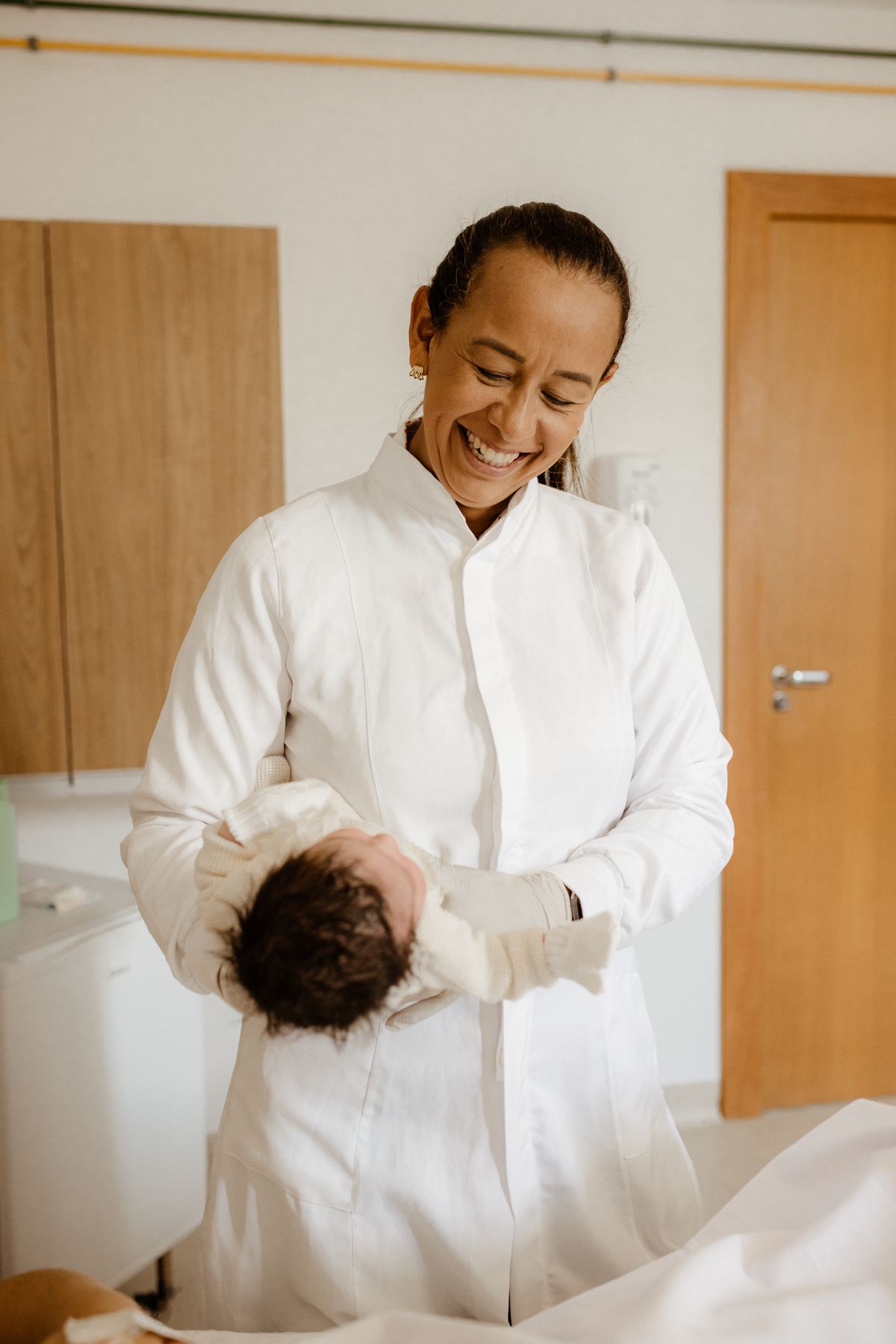
In a 2007 randomized trial of 1,047 young pregnant women, 80 percent of whom were African-American, group prenatal care produced a 33 percent reduction in preterm birth compared with standard one-on-one prenatal care. The effect was stronger in the African-American subgroup: 10.0 percent vs 15.8 percent preterm birth rate, a 37 percent reduction that the researchers reported as statistically significant (Ickovics et al., Obstetrics and Gynecology 2007; PMID 17666608).
The strongest peer-reviewed evidence on an obstetric intervention that moved Black-specific outcomes is about a care model called CenteringPregnancy. It is not about the clinician's race. That distinction matters when reading "find a Black OB-GYN" advice.
The peer-reviewed evidence is about the care model
CenteringPregnancy is a structured group prenatal care program in which 8 to 12 pregnant women at similar gestational ages meet for ten 90-minute sessions across pregnancy, each combining a clinical assessment with a facilitated group discussion. The Ickovics 2007 trial randomized 1,047 women aged 14 to 25 to CenteringPregnancy or standard one-on-one care across two academic prenatal clinics (PMID 17666608).
The 33 percent overall reduction in preterm birth held with no differences in age, parity, education, or income between the two arms. The African-American subgroup result (a 37 percent reduction in preterm birth) is the cleanest peer-reviewed evidence we have that a specific obstetric care model can move Black-specific preterm birth outcomes. Facilitators in the trial were not racially matched to participants; the effect held regardless of facilitator race. Asking whether a practice offers group prenatal care is a higher-yield first question than asking about the clinician's race.
What the obstetric race-concordance literature actually says
The most-cited obstetric race-concordance study is a 2020 PNAS paper by Brad Greenwood, Rachel Hardeman (now professor of health policy and management at the University of Minnesota School of Public Health), and colleagues that analyzed 1.8 million Florida hospital births from 1992 through 2015 and reported lower in-hospital mortality for Black newborns under Black physicians (PMID 32817561).
A 2024 PNAS replication by George Borjas and Robert VerBruggen used the same Florida dataset and reported the concordance effect "is near zero and statistically insignificant" once very-low birth weight (under 1,500 grams) was added as a control (PMID 39284046). Very-low birth weight is a strong predictor of neonatal mortality and was not in the original specifications. Our piece on the Greenwood-Borjas exchange covers the methodological back-and-forth.
The honest read for an adult Black patient choosing an OB-GYN or midwife in 2026: the defensible peer-reviewed claim is not "a Black clinician will improve your birth outcome." The defensible claim is that group prenatal care did so in a Black-majority RCT, and you can ask any clinician of any race whether they offer it. The same Greenwood paper also reported no significant improvement in maternal mortality under concordance; our companion piece on the Black-white maternal mortality gap covers the federal data behind that disparity.
Where the two findings come together: Beloved Birth Black Centering
A 2025 paper in the Journal of Midwifery and Women's Health describes Beloved Birth Black Centering, a community-centered antiracist perinatal program in Alameda County, California, created by and for Black people (De Ornelas et al., JMWH 2025; PMID 40396192). The model bundles five evidence-informed strategies into a single program (midwifery-led group perinatal care, racially-concordant care, wrap-around support, childbirth education, and doula services), called "the Gold-Package of Black Love" in the paper. It is a program description, not a randomized trial; the paper reports no effect sizes. The bundle is useful as a template for what to ask a candidate practice about, even where a Beloved Birth-style program does not exist locally.
Three directories that surface Black OB-GYNs and Black midwives
For midwives: the National Black Midwives Alliance directory indexes Black midwives directly.
Whatever brought you to this page, community health centers see patients regardless of insurance and charge on a sliding scale that is often $0. Our directory of free and charitable clinics lists centers by state. A same-day telehealth visit is self-pay and is not billed to Medicaid, so if you have Medicaid the clinic route will usually cost less. If you would rather see a clinician online today:

See a doctor online today.
- Same-day video visits from $34
- Price shown before you book
- No insurance needed
 with Sesame Care
Affiliate link, we may earn a commission at no extra cost to you.
For doulas: the Mama Glow doula directory, founded by Latham Thomas, indexes trained Mama Glow doulas including a network of Black doulas across the US.
For OB-GYNs specifically: the Black Health directory lists OB-GYNs and maternal-fetal medicine specialists who self-identify as Black, each with a license checked against the NPI Registry or a state license board. The American College of Obstetricians and Gynecologists Find an OB-GYN tool covers the broader US OB-GYN workforce by geography and insurance but does not index clinician race. Our piece on why finding a Black doctor is harder than it should be covers the workforce numbers behind the search difficulty.
Dr. Joia Crear-Perry, MD, is founder and director of the National Birth Equity Collaborative and a co-founder of the Black Mamas Matter Alliance; her organization publishes practice guides and policy briefs that connect individual-clinician questions to the systemic factors driving the disparity.
Three questions to ask any candidate clinician
These three operationalize the peer-reviewed evidence above:
1. "Does your practice offer group prenatal care, such as CenteringPregnancy or a comparable group-care model?" Asks the Ickovics 2007 mechanism directly. A practice that offers group care is offering the only Black-majority RCT-supported perinatal intervention in the consumer-facing record.
2. "What training or practice focus do you have in culturally adapted perinatal care for Black patients?" Asks the cultural-adaptation-as-mechanism finding from the broader concordance literature. The answer surfaces whether the clinician has done the training that the Beloved Birth model bundles into its program.
3. "How do you integrate doulas into your care model?" Asks the third leg of the Beloved Birth bundle. Doula integration has its own evidence base; our piece on what a doula does for Black families covers the Bohren 2017 Cochrane continuous-support evidence.
A clinician's race is something the directories surface; the training-and-care-model answers are something only the candidate clinician gives. Both criteria are legitimate. The second is the one the peer-reviewed evidence supports as the outcome predictor.
What you can do this week
First, search at least one of the directories above for clinicians within 25 miles who match your insurance.
Second, before booking the first appointment, email or call the practice with the three questions above. How the practice answers tells you what its care model actually is, regardless of who the clinician is.
Third, if no nearby practice offers group prenatal care or culturally adapted services, search for a Black-identified community-based program. Beloved Birth Black Centering operates in Alameda County, California; Healthy Start sites and Black Infant Health programs operate in participating states and counties. Availability is geographically uneven; the search is worth running once before settling on a standard practice.
Citations
Ickovics JR, Kershaw TS, Westdahl C, Magriples U, Massey Z, Reynolds H, Rising SS. Group prenatal care and perinatal outcomes: a randomized controlled trial. Obstet Gynecol 2007;110(2 Pt 1):330 to 339. PMID 17666608.
Greenwood BN, Hardeman RR, Huang L, Sojourner A. Physician-patient racial concordance and disparities in birthing mortality for newborns. Proc Natl Acad Sci USA 2020;117(35):21194 to 21200. PMID 32817561.
Borjas GJ, VerBruggen R. Physician-patient racial concordance and newborn mortality. Proc Natl Acad Sci USA 2024. PMID 39284046.
De Ornelas M, Harley KG, Davis D, Gruver A, Cruz Santana D, Hayes K, Tesfalul M, Wren J. A Community-Centered and Antiracist Model of Whole-Person Perinatal Care: Beloved Birth Black Centering. Journal of Midwifery and Women's Health 2025;70(3):468 to 475. PMID 40396192.