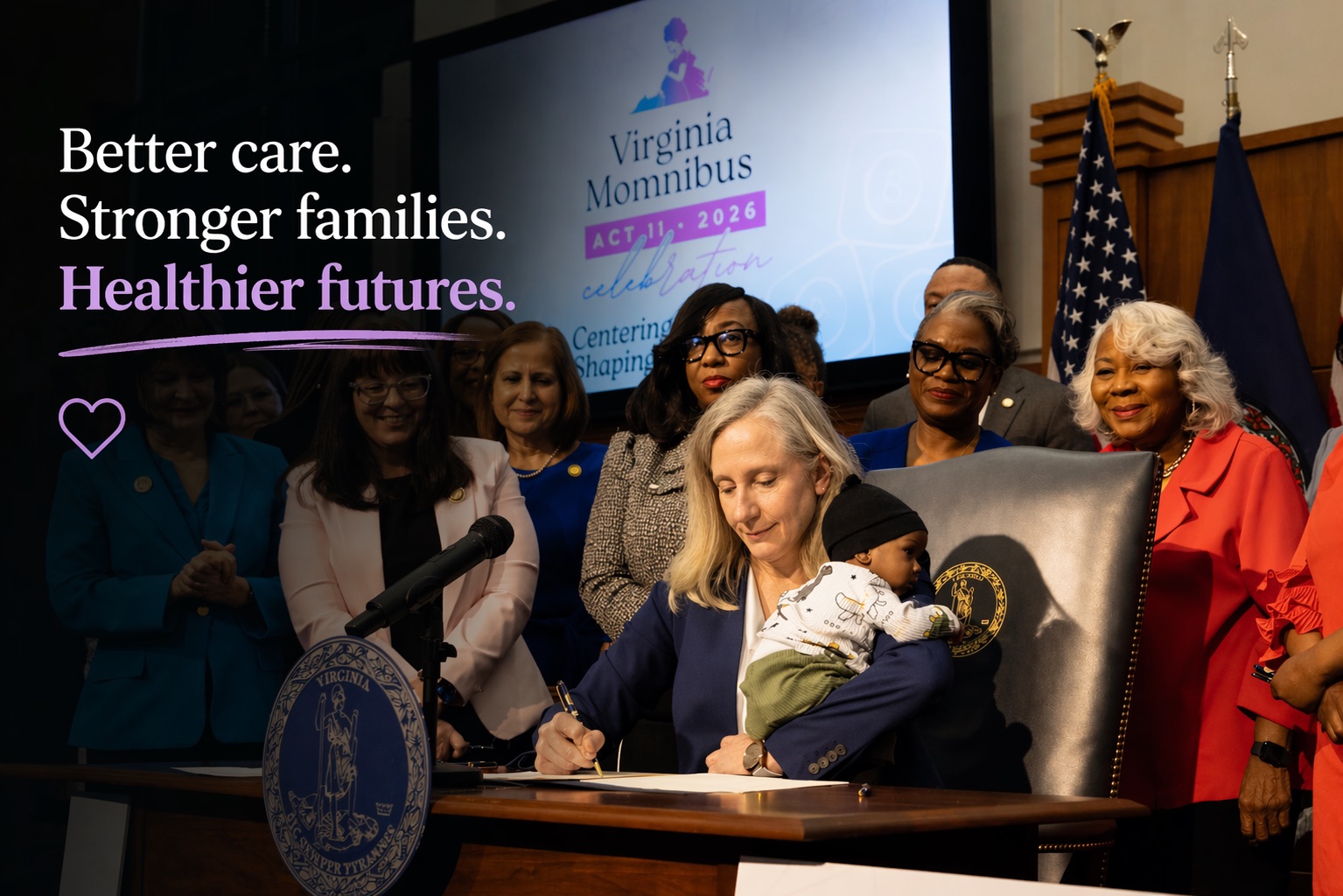
Governor Abigail Spanberger signed four maternal-health bills into Virginia law on April 22, 2026 in Richmond: HB1400 on maternal mental-health screenings, HB1403 on severe-maternal-morbidity reporting, HB425 on Medicaid-funded remote monitoring for high-risk pregnant women, and HB1353 on a statewide maternal-health safety initiative (Governor Spanberger press release, April 22, 2026). In 2023, the Black non-Hispanic maternal mortality rate in the United States was 50.3 deaths per 100,000 live births, compared with 14.5 for non-Hispanic white women, per Hoyert, NCHS Data Brief 2025. The Virginia package names that gap explicitly as the reason for the legislation.
The four bills are referred to collectively as Momnibus Act II. Governor Spanberger's statement: "We are taking decisive action to make sure more women across Virginia can get the care they need." Senator L. Louise Lucas, co-chair of the Virginia Black Maternal Health Caucus, said in the same release: "Too many mothers, especially Black mothers, are facing life-threatening childbirth."
What each of the four bills does
HB1400 (patron: Delegate Margaret Franklin). Increases access to maternal mental-healthcare screenings. Black women experience postpartum depression at 2 to 3 times the rate of white women and are half as likely to be screened, diagnosed, or treated per the peer-reviewed record. The bill's operational details, including screening-point requirements and reimbursement mechanisms, are pending direct pulls from the Virginia Legislative Information System (lis.virginia.gov).
HB1403 (patron: Delegate Margaret Franklin). Directs the Virginia Department of Health to develop a Severe Maternal Morbidity (SMM) reporting system. SMM tracking is the standard surveillance mechanism for preventable near-miss maternal complications. States with active SMM reporting systems have clearer data on which hospitals and which populations drive the severe-complication count, which is the evidence base for targeted quality-improvement work.
HB425 (patron: Delegate Destiny LeVere Bolling). Expands Medicaid reimbursement for remote monitoring of high-risk pregnant women. Remote monitoring is the intervention category that includes blood-pressure cuffs, continuous glucose monitors, and telehealth-mediated clinical contacts between scheduled prenatal visits. For Black women, who are overrepresented in high-risk pregnancy categories and who face the widest maternal mortality gap, Medicaid coverage of these devices is an access-gate question.
HB1353 (patron: Delegate Laura Jane Cohen). Directs the Commissioner of Health to assess a statewide maternal-health safety initiative. Safety-initiative frameworks in peer states include the Alliance for Innovation on Maternal Health (AIM) hospital-level bundles and state-led hemorrhage / hypertension / mental-health protocols. The bill does not name a specific framework; the Commissioner's assessment will determine Virginia's structure.
The Black Maternal Health Caucus frame
The release explicitly frames the package as an output of the Virginia Black Maternal Health Caucus, co-chaired by Senator L. Louise Lucas and Speaker of the House Don Scott. The caucus is the legislative structure through which the four bills moved. Senator Lucas's quote names Black mothers specifically as the population facing "life-threatening childbirth," which grounds the package in the disparity framing rather than a generic maternal-health framing.
Delegate Destiny LeVere Bolling, patron of HB425 on Medicaid remote monitoring, is the newest caucus-adjacent voice in the patron list and has moved the bill that carries the most concrete reader-relevant change: if a Black woman in Virginia with a high-risk pregnancy is now eligible for Medicaid-reimbursed blood-pressure monitoring or continuous glucose monitoring between visits, HB425 is the statute that makes that possible.
Whatever brought you to this page, community health centers see patients regardless of insurance and charge on a sliding scale that is often $0. Our directory of free and charitable clinics lists centers by state. A same-day telehealth visit is self-pay and is not billed to Medicaid, so if you have Medicaid the clinic route will usually cost less. If you would rather see a clinician online today:

See a doctor online today.
- Same-day video visits from $34
- Price shown before you book
- No insurance needed
 with Sesame Care
Affiliate link, we may earn a commission at no extra cost to you.
What the Virginia record shows about the gap
The Virginia maternal mortality rate is "one of the highest in the nation," per the Governor's release, without a specific number cited. Virginia Department of Health surveillance releases are the primary source for the state-level breakdown; we will update this piece when the VDH 2023 or 2024 maternal-mortality series is pulled directly. Per the 2017-2019 CDC Pregnancy Mortality Surveillance System, the national Black-non-Hispanic maternal mortality ratio was 39.9 per 100,000 live births, approximately 2.6 times the rate for white non-Hispanic women. The 2023 NCHS brief cited above pushes the Black ratio higher to 50.3 per 100,000.
Roughly 4 in 5 US maternal deaths are classified as preventable per CDC. The four Momnibus Act II bills each target a distinct preventable pathway: mental-health screening (Meltzer-Brody 2018, Deligiannidis 2023), SMM tracking (AIM bundle evidence), remote monitoring for high-risk pregnancy (tele-BP and CGM literature), and quality-improvement frameworks (AIM state-level data).
What Black birthing people in Virginia should know today
Three specific actions while bill implementation rolls out:
1. Medicaid postpartum coverage. If you delivered or plan to deliver in Virginia and are on Medicaid, confirm with your Medicaid managed care organization whether your coverage runs 12 months postpartum. If HB425 changes your remote-monitoring eligibility, your MCO should be able to confirm the specific device categories now covered.
2. Maternal mental-health screening. HB1400 increases access; the specific screening-point and reimbursement-mechanism changes are pending in the bill text. In the meantime, the Edinburgh Postnatal Depression Scale is the validated screening instrument; bring a completed EPDS to your postpartum visit rather than waiting to be handed one.
3. Warning-sign protocols. The CDC's Hear Her campaign lists the urgent symptoms warranting same-day clinical contact in pregnancy and postpartum. Our companion piece on pregnancy complication warning signs is in the queue for publish 2026-06-19.
Where this fits in the broader Black-maternal-health legislative landscape
The federal Black Maternal Health Momnibus Act (the "original" Momnibus), reintroduced March 2026 by Senator Cory Booker, Representative Lauren Underwood, and Representative Alma Adams, is a 14-bill federal package still in committee. Virginia's Momnibus Act II is a state-level implementation that does not wait for federal passage. Other states with active Momnibus-style packages include Illinois (implemented 2021), New York (partially implemented), and California (partially implemented). The federal framework is the reference architecture; the states are where implementation actually happens.
The Virginia package is consequential because Virginia sits in a mid-range maternal-mortality bracket among US states; the four bills collectively target the specific preventable-death pathways that drive the disparity. When the federal Momnibus moves in committee, we will cover the state-versus-federal implementation gap directly.
Update plan
We will update this piece when the Virginia Legislative Information System returns direct bill text for HB1400, HB1403, HB425, and HB1353; when the Virginia Department of Health 2023 or 2024 maternal-mortality series is pulled directly; when implementation timelines and dollar amounts for each of the four bills are published; and when named Black perinatal clinicians at UVA, VCU, or a Richmond-area clinical institution are reached for on-the-record voices.