The honest numbers
- PFB affects an estimated 45% to 83% of Black men who shave, compared with much lower rates in men with straight hair. (Sharma, Dalia, Patel. Journal of the American Board of Family Medicine, January 2022; Kundu and Patterson. American Family Physician, June 2013)
- Black service members make up roughly 18% of the active-duty U.S. military force but hold approximately 65% of medical shaving waivers in branches that track the data. (Welch, Gibson, Usatine, Heath. Cutis, October 2025)
- Reported PFB cases in the military rose from roughly 50 cases in 2000 to 2,404 cases in 2022, a 4,708% increase. (Military Times, September 14, 2023)
- Post-inflammatory hyperpigmentation (PIH), which PFB routinely causes, affects more than 65% of Black Americans and is listed as the third most common dermatological complaint in Black patients. (Skin of Color Society, PIH patient education)
- Black people have the greatest risk of keloid formation of any population. Black patients are estimated to be 15 times more likely to form keloids than white patients. (AAD, Keloid scars overview; Sangha. Journal of Clinical and Aesthetic Dermatology, September 2021)
What PFB actually is
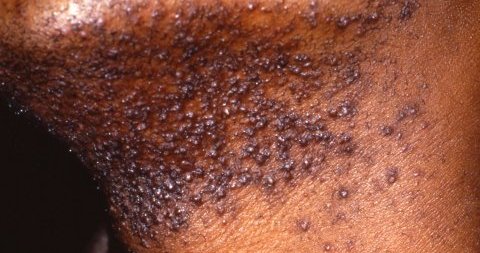
PFB is a chronic inflammatory condition caused by the way tightly coiled hair behaves after shaving. Two mechanisms are at work. First, when hair is cut very close, the sharpened, curved tip retracts below the skin surface and pierces the follicle wall from inside (transfollicular penetration). Second, when hair grows longer between shaves, the tight curl can loop back and re-enter the skin from outside the follicle (extrafollicular penetration). Both cause the skin to mount an inflammatory response around a foreign body: the hair itself. The result is the characteristic painful papules (bumps), pustules (pus-filled bumps), and, if the process repeats over months or years, permanent scarring, raised scars (keloids), and dark spots (PIH).
The condition is not about poor hygiene or shaving carelessly. Follicle shape is genetic, and tight curl patterns are far more common in men of African descent. Blaming technique only goes so far.
Sources: Skin of Color Society, Pseudofolliculitis Barbae patient education; Welch, Usatine, Heath. Cutis, April 2025
What actually treats it
Stop shaving (at least temporarily). The single most effective intervention is growing a beard. The AAD states that stopping shaving entirely should clear most bumps within three months, often with meaningful improvement within one month. If full beard growth is not an option, switching to hair clippers and leaving hair at 1-2 mm length prevents the close cut that drives both re-entry mechanisms. (AAD, Razor bump remedies for men with darker skin tones)
Shaving technique and tools (if you must shave). When stopping is not an option, the AAD recommends:
- Use a single-blade razor or an electric razor. Multi-blade razors cut hair below the skin surface, increasing the chance of re-entry.
- Prepare the skin first. Soften facial hair with a warm, damp washcloth for several minutes, or shave at the end of a shower. Apply a moisturizing shaving cream; never dry shave.
- Shave with the grain. Going against hair growth direction causes sharper cuts and more irritation. Short strokes, no going over an area more than twice.
- Do not pull the skin taut while shaving. Skin tension encourages the close cut that leads to transfollicular penetration.
- Replace single-blade razors after 5 to 7 shaves. A dull blade drags and requires more pressure.
- Apply a cool compress after shaving, then a soothing, non-comedogenic aftershave.
Sources: AAD, Razor bump remedies; AAD, How to prevent razor bumps; Skin of Color Society, Pseudofolliculitis Barbae
Topical medications
Several topical agents have evidence for reducing PFB lesions:
- Topical retinoids (tretinoin, adapalene). Retinoids reduce follicular hyperkeratosis, the excess keratin buildup that traps hairs. Tretinoin 0.025% or adapalene 0.1% applied at night is a common starting point. They also help fade PIH over time. (Welch, Usatine, Heath. Cutis, April 2025; Kundu and Patterson. American Family Physician, June 2013)
- Glycolic acid. A randomized study found more than a 60% reduction in PFB lesions versus placebo. Available OTC at lower concentrations; higher-concentration peels (20-70%) can be administered in a dermatology office. (Kligman and Stoudemayer, Journal of the American Academy of Dermatology, 1993)
- Topical antibiotics (clindamycin, erythromycin). When PFB involves active pustules suggesting secondary bacterial infection, topical clindamycin 1% or erythromycin can reduce inflammation. (Welch, Usatine, Heath. Cutis, April 2025)
- Eflornithine cream (Vaniqa, 13.9%). Eflornithine slows facial hair growth by inhibiting an enzyme required for hair follicle cell division. A randomized controlled trial showed that topical eflornithine combined with Nd:YAG laser produced greater improvement in inflammatory papules than laser alone. (PubMed, topical eflornithine + Nd:YAG laser RCT, 2021)
- Mild topical corticosteroids (short-course only). A low-potency steroid like hydrocortisone 2.5% applied once or twice daily for no more than two to three days can reduce acute inflammation after a bad shave. Not a long-term option; prolonged use causes skin thinning.
Common skin conditions are treated in primary care, and community health centers charge on a sliding scale that is often $0. Our directory of free and charitable clinics lists centers by state. A same-day telehealth visit is self-pay and cannot be billed to Medicaid or commercial insurance, so the clinic route usually costs less. If you need a prescription sooner than the next appointment:
Prescription skincare from a licensed clinician.
- Online visit and a treatment plan for your skin
- From $59 a month, shown before you book
 with Sesame Care
Affiliate link, we may earn a commission at no extra cost to you.
Laser hair removal (Nd:YAG)
For persistent or severe PFB that does not respond to technique modifications and topicals, laser hair removal is the most definitive treatment. The critical caveat for Black skin: not all lasers are safe for darker Fitzpatrick skin types (IV-VI). Lasers that target melanin broadly in the skin can cause permanent dyspigmentation in darker complexions.
The long-pulsed Nd:YAG laser (1064 nm) is the preferred modality for darker skin types. Its longer wavelength penetrates deeper into the follicle with minimal interaction with epidermal melanin, allowing safe and effective treatment. FDA-approved for permanent hair reduction in all Fitzpatrick types I-VI. A side-by-side interventional study of 26 patients with skin types IV, V, and VI showed a 61% reduction in papule counts on the laser-treated side. (Ross et al. Journal of the National Medical Association, October 2002; Welch, Usatine, Heath. Cutis, April 2025)
Laser hair removal is often coded as cosmetic and not covered by insurance. Some military health systems (TRICARE) have covered it for service members with documented treatment-resistant PFB; a dermatologist can help document medical necessity.
When to see a dermatologist, and which one
See a dermatologist when:
- PFB is causing visible scarring or raised keloid scars
- Dark spots from PFB are persistent and spreading
- Technique changes have not improved things after 8-12 weeks
- PFB is affecting work, self-image, or mental health
- You are in a uniformed profession and need medical documentation for an accommodation request
The bigger point: not every dermatologist is trained on Black skin. Decades of dermatology education used lighter skin as the default, which means some providers underestimate PFB severity, may not recognize PIH patterns correctly, or may use laser settings appropriate for lighter skin that can cause permanent damage in darker complexions.
The Skin of Color Society is the leading professional organization for dermatologists specializing in skin of color. Their public Find-a-Doctor directory is searchable by location and includes providers with documented expertise in Black skin.
Internal links:
Keloids: what to know
A keloid is a type of raised scar that grows beyond the boundaries of the original wound. Unlike regular scars, keloids do not stop growing on their own. They can form after any skin injury: a cut, a shave wound, an acne lesion, a piercing, or a surgical incision.
Black patients have the greatest keloid risk of any population. Incidence among people of African descent reaches as high as 16%; estimates suggest Black patients are roughly 15 times more likely to form keloids than white patients. Keloid tendency is strongly genetic, with one-third to one-half of affected individuals having a first-degree blood relative who also forms keloids. (AAD, Keloid scars overview; Sangha. Journal of Clinical and Aesthetic Dermatology, September 2021)
Keloids form because of an error in the scar remodeling process, not because of anything you did wrong. They are not contagious, not cancerous, and not a personal failing.
Prevention first. The AAD recommends avoiding unnecessary procedures on high-risk skin sites (chest, shoulders, earlobes, jawline, upper back) if you have a personal or family history of keloids. For unavoidable wounds, apply silicone gel or silicone sheets as soon as the wound has scabbed. (AAD, How to prevent keloid scars)
Intralesional corticosteroid injections. Triamcinolone acetonide (10-40 mg/cc), injected directly into the keloid by a dermatologist, is typically the first-line treatment. Studies report 50-100% regression, though recurrence within five years is common. (Sangha. Journal of Clinical and Aesthetic Dermatology, September 2021; AAD, Keloid treatment)
Silicone sheets and gels. Applied consistently to existing keloids, silicone products can help flatten and soften the scar over time. (AAD, Keloid treatment)
Cryotherapy. Freezing can reduce the size and hardness of smaller keloids. Important caution for darker skin: the AAD warns that cryotherapy can cause permanent light spots on brown or Black skin. (AAD, Keloid treatment)
Surgical excision. Keloids return after surgery alone in nearly 100% of cases. Surgery is used as part of a combined approach, typically followed by adjunct radiation therapy. Excision plus radiation reduces recurrence to roughly 22%. (Sangha. Journal of Clinical and Aesthetic Dermatology, September 2021)
The key message: keloid treatment usually requires multiple modalities and ongoing management. A dermatologist who treats Black patients regularly will understand the skin-tone-specific risks of cryotherapy and pigment-targeting lasers.
Post-inflammatory hyperpigmentation (PIH)
Every time PFB, a keloid, or any skin inflammation heals, it can leave behind a dark spot. That is post-inflammatory hyperpigmentation. In darker skin, melanocytes produce more pigment in response to inflammation and the excess accumulates in the upper layers of skin, often persisting for months or years after the original lesion is gone.
The Skin of Color Society notes that more than 65% of Black Americans experience PIH symptoms, and it is one of the most frequent reasons Black patients visit a dermatologist. PFB itself causes PIH in roughly 90% of cases. (Skin of Color Society, PIH patient education; Davis and Callender. Journal of Clinical and Aesthetic Dermatology, 2010)
PIH is treatable. The key word is patience: even with consistent treatment, it takes months to see meaningful fading.
Sun protection is not optional. UV exposure deepens existing PIH and generates new spots. A broad-spectrum SPF 30 or higher sunscreen applied daily is a prerequisite for any PIH treatment to work. Mineral sunscreens formulated for darker skin tones (tinted to avoid white cast) are the most practical option.
Hydroquinone. Considered the gold standard for PIH treatment. Hydroquinone 4% applied once or twice daily for three to six months has strong RCT evidence. Available OTC at 2% in the United States; higher concentrations require a prescription. Use is typically time-limited (three to six months). (Davis and Callender. Journal of Clinical and Aesthetic Dermatology, 2010)
Topical retinoids. Tretinoin and adapalene speed skin cell turnover, pushing pigmented cells toward the surface and helping fade dark spots over time. Also address the PFB that caused the PIH in the first place. (Davis and Callender. Journal of Clinical and Aesthetic Dermatology, 2010)
Azelaic acid. Directly inhibits tyrosinase, the enzyme that drives melanin production. Effective at 20% cream with moderate evidence; a useful alternative for patients who cannot tolerate hydroquinone or retinoids. (Davis and Callender. Journal of Clinical and Aesthetic Dermatology, 2010)
Chemical peels. Glycolic acid and salicylic acid peels administered in a dermatology office accelerate cell turnover and fade PIH faster than topicals alone. These should be done by a provider experienced with darker skin: improperly administered peels can cause a PIH flare rather than improvement. (Davis and Callender. Journal of Clinical and Aesthetic Dermatology, 2010)
Laser therapy. Nd:YAG fractional photothermolysis and other energy-based devices can improve PIH but carry real risk of worsening pigmentation in darker skin if settings are wrong. This is a procedure to have only with a dermatologist who has documented experience treating Fitzpatrick type IV-VI skin. The Skin of Color Society directory is the right place to find that provider.
Traction alopecia and CCCA: a brief note
These are two distinct scalp conditions more common in Black patients that deserve at least a mention in any Black-skin dermatology guide, because the same dermatologists who treat PFB and keloids are the right people to see for them.
Traction alopecia results from hairstyles that pull repeatedly at the hair follicle: tight cornrows, braids, locs, buns, ponytails, and weaves on relaxed hair. Early traction alopecia is reversible if caught quickly; prolonged traction causes permanent scarring of the follicle. The AAD recommends loosening braids around the hairline, wearing braids for no longer than 6-8 weeks at a stretch, and switching styles regularly. (AAD, Hairstyles that pull can lead to hair loss)
Central centrifugal cicatricial alopecia (CCCA) is the most common type of scarring hair loss in African American women and involves permanent follicle destruction starting at the crown and spreading outward. While much less common in men, it does occur. CCCA requires prescription treatment from a dermatologist; over-the-counter hair loss products do not address it. If you notice a patch of thinning starting at the crown of your scalp, see a dermatologist rather than waiting. (AAD, CCCA overview; AAD, CCCA treatment)
What to ask your dermatologist
- Have you treated many Black patients with PFB and darker Fitzpatrick skin types? You want a provider who can answer yes with specifics, not reassurance.
- If you recommend laser, which laser will you use, and what experience do you have with it on skin like mine? The answer should reference the Nd:YAG for darker skin.
- If I need to shave for work, what documentation can you provide to support a workplace accommodation? A dermatologist familiar with PFB should know how to write a medical letter supporting a shaving waiver.
- What is the full treatment plan, and over what timeline should I expect results? PFB, keloids, and PIH are all chronic conditions with months-long treatment timelines. You want a plan, not a single prescription.
- Are there out-of-pocket costs I should anticipate? Laser hair removal for PFB is often coded as cosmetic. Ask upfront so there are no surprises.
- Should I stop shaving entirely, and if so, for how long? If your dermatologist recommends stopping, they can also document that recommendation in writing for your employer.
- What should I stop doing right now? The answer may include depilatories, multi-blade razors, or specific products. Get a clear list.