Among Black adults age 20 and older, 56.8% of men and 61.0% of women have high blood pressure or take medication for it, measured in the federal NHANES survey covering 2017 through March 2020. It also arrives early: in the CARDIA cohort, 75.5% of Black men and 75.7% of Black women had developed hypertension by age 55. Heart disease is the leading cause of death for the Black population, and high blood pressure is the second leading cause of kidney failure in the United States after diabetes. A reading taken twice a year in an exam room cannot manage a condition that runs every hour of every day. Readings you take at home can, and the 2025 American Heart Association and American College of Cardiology guideline treats out-of-office measurement as central to diagnosis and treatment.
Step 1: Buy a monitor that has actually been tested
Most cuffs sold online have never been validated against a reference standard. The American Medical Association runs the US Blood Pressure Validated Device Listing at validatebp.org, where an independent review committee checks each manufacturer's validation testing before a device is listed. The site groups devices by how they are used, including a Home category, so you can look up a model before you pay for it.
Buy an automatic, cuff-style, upper-arm monitor. The AHA states plainly that wrist and finger monitors are not recommended because they give less reliable readings. Its 2019 scientific statement explains why: a wrist sensor reads correctly only when it sits directly over the radial artery, wrist devices drift out of that position, and the number runs high or low whenever the wrist is below or above heart level.
Step 2: Measure your arm before you pick the cuff
Cuff size is the step almost everyone skips, and it changes the number more than anything else you can control. In the Cuff(SZ) randomized crossover trial at Johns Hopkins, 195 adults (68% of them Black) had their pressure taken with a correctly sized cuff and with a standard regular cuff, in random order. On arms needing an extra-large cuff, the regular cuff read 19.5 mm Hg higher on systolic pressure. On arms needing a large cuff it read 4.8 mm Hg higher, and on arms needing a small cuff it read 3.6 mm Hg lower. The authors called the effect strikingly inaccurate.
That is the difference between a normal reading and a diagnosis, or between a controlled reading and a second medication you do not need. Measure your own arm first. Wrap a flexible tape around your bare upper arm at the midpoint between the tip of your shoulder and the point of your elbow, snug but not tight, and write the number down in centimeters. The sizes used in the trial match the ranges printed on US adult cuffs:
- Small: 20 to 25 cm
- Regular: 25.1 to 32 cm
- Large: 32.1 to 40 cm
- Extra-large: 40.1 to 55 cm
Many monitors ship with a regular cuff only. If your arm is above 32 cm, buy the model that includes the larger cuff or order that cuff separately, and check the size range printed on the cuff itself.
Step 3: The technique that makes the reading real
Every item on this list changes the number. The AHA publishes it as preparation, not as a suggestion.
- No caffeine, smoking, or exercise for 30 minutes before.
- Empty your bladder.
- Sit quietly for at least 5 minutes. No phone, no talking, during the rest or the reading.
- Sit in a chair with your back supported and both feet flat on the floor, legs uncrossed.
- Bare skin. Take your arm out of the sleeve rather than rolling fabric up under the cuff.
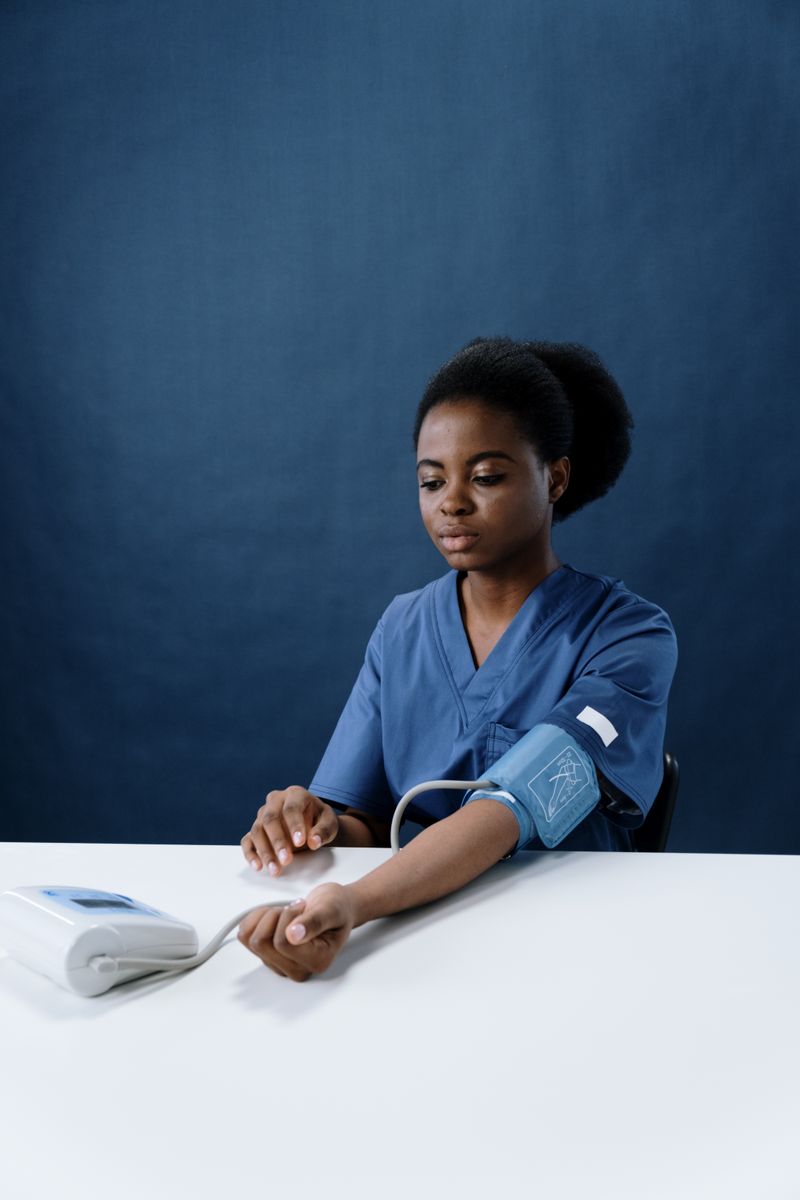
- Rest your arm on a table so the middle of the cuff sits at heart level. If the arm hangs down, the reading runs high.
- Put the bottom edge of the cuff just above the bend of your elbow, snug enough that one finger slides easily under the top and bottom edges.
- Take 2 readings 1 minute apart and record both.
- Measure at the same times every day.
Step 4: Seven days of readings, then throw out day one
One reading is a snapshot. A diagnosis needs a set. The AHA's 2019 statement describes the standard home protocol as 2 measurements in the morning and 2 at night over a preferred period of 7 days, which comes to 28 scheduled readings. First-day numbers are often elevated, and the statement notes that several guidelines recommend excluding day one; if you do, the minimum stretch becomes 4 days and the preferred one 8. Average the rest. Log every reading with the date and time, or use a monitor that stores them, and bring the whole record to your appointment.
Community health centers are primary care: they see patients regardless of insurance, charge on a sliding scale that is often $0, and can manage a condition like blood pressure or diabetes long-term. Our directory of free and charitable clinics lists verified centers by state. A same-day telehealth visit is self-pay and is not billed to Medicaid, so an ongoing clinic relationship usually costs less over a year. If you want a telehealth visit sooner:

Sesame Care
A same-day online primary care visit with a licensed clinician. Prices are shown before you book; visits start at $34 and vary by clinician and location (checked August 2026).
See a clinician todayAffiliate link, we may earn a commission at no extra cost to you.
What the numbers mean
The 2025 AHA/ACC guideline retired and replaced the 2017 guideline and kept 130/80 mm Hg as the line. The categories are:
- Normal: under 120 systolic and under 80 diastolic
- Elevated: 120 to 129 systolic and under 80 diastolic
- Stage 1 high blood pressure: 130 to 139 systolic or 80 to 89 diastolic
- Stage 2 high blood pressure: 140 or higher systolic or 90 or higher diastolic
The treatment target is under 130/80 mm Hg for most adults, with encouragement to get as close to 120/80 as possible. One high reading is not a diagnosis, and only a clinician can make one. A week of readings averaging above 130/80 is a conversation you need to have.
Why home numbers change the treatment plan
Two things happen in exam rooms that home readings catch. White-coat hypertension is a high reading at the office and a normal one everywhere else. The CDC notes that as many as 1 in 3 people with a high office reading may read normal outside it. Treating that person harder does nothing for their heart and can drop their pressure too low.
Masked hypertension is the opposite and the more dangerous one: normal at the office, high the rest of the time. The Jackson Heart Study, a cohort of Black adults in Mississippi, ran 24-hour monitoring on 738 participants whose clinic readings were under 140/90. Some form of masked hypertension was present in 52.2% of them. Over a median 8.2 years, cardiovascular events occurred at 13.5 per 1,000 person-years in those participants and 3.9 per 1,000 person-years in the rest, a 2.49-fold adjusted risk. A separate Jackson Heart Study analysis found it in 12.9% of participants whose clinic pressure was fully normal, tracking with thicker heart muscle on imaging.
Neither pattern is visible without out-of-office readings. The cuff on your kitchen table is the only way your clinician sees the 23 hours a day you are not in the room. If your readings stay high on your current prescription, the drug choice is worth its own conversation: see our guide to ACE inhibitors and ARBs for Black patients and, on the diet side, salt sensitivity and blood pressure in Black adults.
Self-monitoring lowers pressure when someone acts on the readings
The evidence is for monitoring plus follow-through, not the device alone. TASMINH4 randomized 1,182 UK patients with uncontrolled hypertension to self-monitoring, self-monitoring with telemonitoring, or usual clinic-guided care, with doctors adjusting medication from the readings. At 12 months, systolic pressure was 3.5 mm Hg lower with self-monitoring and 4.7 mm Hg lower with telemonitoring than with usual care.
The largest effect on record in a Black cohort came from pairing measurement with someone who could prescribe. In a cluster-randomized trial across 52 Black-owned barbershops, 319 Black men with systolic pressure of 140 mm Hg or above were assigned either to barber-encouraged lifestyle change and doctor visits, or to meetings in the shop with pharmacists who prescribed under agreement with the men's own doctors. At 6 months the pharmacist group's systolic pressure had fallen 27.0 mm Hg, to a mean of 125.8, against 9.3 mm Hg in the control group, and 63.6% of them were under 130/80 mm Hg. Retention was 95%. The readings mattered because someone was acting on them.
What it costs
A validated upper-arm monitor is a one-time purchase, and IRS Publication 502 counts devices used in diagnosing illness as a medical expense, the category FSA and HSA dollars cover. Check your own plan before assuming the cuff itself is covered: Medicare's national coverage decision addresses ambulatory blood pressure monitoring, the 24-hour test a clinician orders, rather than routine home devices. Since 2019 that decision covers ambulatory monitoring for suspected white-coat and suspected masked hypertension, and CMS lowered the qualifying threshold in that policy from 140/90 to 130/80. If cost is the obstacle, ask anyway: many health systems, community health centers, and pharmacies loan cuffs out, and the AHA and AMA's Target:BP program helps practices run those loaner programs.
How to get care
Take the monitor to your next appointment. Have the clinician check the cuff size against your arm and compare one of your readings to the office device, then bring it back about once a year. Hand over the seven-day log, not a verbal summary, and ask three questions: what stage does my home average put me in, does it change my medication, and how often should I measure from here. Follow-up on readings can usually be done by telehealth.
If you want a clinician who will work from your log rather than glance at it, find a Black cardiologist or primary care clinician in our directory. For the fuller risk picture, read our guide to high blood pressure in Black men.
Frequently asked questions
What is a normal blood pressure? ▼
Under 120 systolic and under 80 diastolic. Elevated is 120 to 129 systolic with diastolic under 80. Stage 1 is 130 to 139 systolic or 80 to 89 diastolic, and stage 2 is 140 or higher systolic or 90 or higher diastolic. The 2025 AHA/ACC guideline kept these categories and sets a treatment target under 130/80 mm Hg for most adults.
Are wrist blood pressure monitors accurate? ▼
The American Heart Association does not recommend wrist or finger monitors and says they give less reliable readings. A wrist sensor has to sit directly over the radial artery, it slips out of that position, and the number runs high or low whenever the wrist is not at heart level. Use an automatic upper-arm cuff unless a clinician tells you an upper-arm measurement will not work for you.
What size blood pressure cuff do I need? ▼
Wrap a flexible tape around your bare upper arm at the midpoint between shoulder and elbow. In centimeters: 20 to 25 takes a small cuff, 25.1 to 32 a regular, 32.1 to 40 a large, and 40.1 to 55 an extra-large. In a randomized crossover trial, a regular cuff on an arm needing an extra-large one read 19.5 mm Hg high on systolic pressure.
How many days should I check my blood pressure before an appointment? ▼
Seven. The standard protocol is 2 readings a minute apart each morning and each evening for 7 days, which is 28 readings. First-day numbers are often elevated, so several guidelines recommend dropping day one and averaging the rest. Bring the full log, not a single reading.
Does Medicare pay for a home blood pressure monitor? ▼
Medicare's national coverage decision covers ambulatory blood pressure monitoring, the 24-hour test a clinician orders when white-coat or masked hypertension is suspected, rather than routine home cuffs. Coverage for a home device depends on your plan, so ask before you buy. A monitor is an eligible FSA and HSA expense as a diagnostic device under IRS Publication 502, and many clinics and pharmacies loan devices out.