What an allergic rash looks like on Black skin
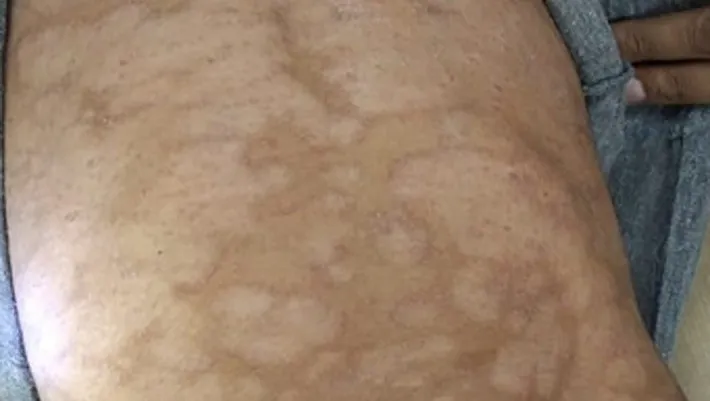
Color is where dark skin gets read wrong. A 2023 review in Dermatitis of allergic contact dermatitis in skin of color patients reports that in higher Fitzpatrick skin types, reactions present with lichenification and hyperpigmentation rather than the erythema and vesicles textbooks describe, and that bright red or pink hues appear violaceous or faint pink. A 2024 review in Current Allergy and Asthma Reports makes the assessment of erythema an explicit diagnostic consideration in skin of color. The inflammation is identical. What reaches the eye is not.
StatPearls describes three phases, and the last two are what Black skin usually shows by the time anyone looks: acute swelling, oozing, crusting, and blisters, then crusts, scales, and hyperpigmentation, then lichenification, skin thickened into leathery plaques with the surface lines exaggerated. On deeply pigmented skin the acute phase can pass for a slightly darker, slightly swollen patch.
Itch is the loudest sign, and AAD says intense itch, burning, or pain often arrives before the rash. Timing is the second clue: StatPearls reports that allergic contact dermatitis appears 24 to 72 hours after exposure and peaks around 72 to 96 hours, while an irritant reaction peaks within minutes to hours and then starts healing. A rash that shows up three days after a salon visit still points at the salon.
The allergens most likely to be behind it
Black patients do not react more overall. The North American Contact Dermatitis Group tested 19,457 patients from 1998 to 2006 and found nearly identical rates of allergic contact dermatitis in Black and white patients, 43.6 percent and 45.9 percent, and its 1992 to 1998 report found no difference in overall response rate either. What differs is which allergens, which the group attributes to culturally determined exposure rather than genetics.
Paraphenylenediamine in permanent hair dye
PPD is the dark dye in permanent hair color, and it is where the difference is most consistent. In the NACDG 1998 to 2006 data, 7.0 percent of Black patients tested positive to PPD versus 4.4 percent of white patients. The 2023 skin of color review lists PPD first among the most common positives in African American patients, and a 2025 study from a comprehensive patch-testing center put it in the top three with methylisothiazolinone and nickel. StatPearls names it a common cause of allergic contact dermatitis on the scalp, face, and ears.
These reactions are not subtle. A Danish study collected 55 cases of severe acute allergic contact dermatitis from hair dye, with swelling of the face, scalp, and ears often mistaken for angioedema. Those cases produced 75 health service visits and 5 hospital admissions, and every one of the 29 percent who got patch tested was positive to PPD.
Federal law dictates the warning here. FDA lets coal-tar hair dyes stay on the market without approval only if the label carries a caution statement and directions for a skin test first. Its checklist adds: test before every application, not only the first, do not scratch or brush the scalp for three days beforehand, do not dye or relax an irritated or damaged scalp, and wait at least 14 days after bleaching, relaxing, or perming before coloring. That 14-day gap is the rule most often crossed.
Once sensitized, you cannot trust the label. A 2025 report in Contact Dermatitis documented three patients who reacted to a dye marketed as p-phenylenediamine free that analysis found contained PPD above the allowed limit. An Australian centre reported that about half of its 11 PPD-allergic patients also reacted to para-toluenediamine, the usual substitute.
Black henna temporary tattoos
The vacation tattoo is the other major PPD exposure, and the one that sensitizes children. FDA is direct: henna is approved only as a hair dye and not for application to skin, the ingredient used to blacken it is often a coal-tar hair dye containing PPD, and by law PPD is not permitted in cosmetics applied to skin. FDA states that temporary tattoos marketed as black henna contain PPD and may increase your risk of allergy to hair dyes. Twelve years of FDA adverse-event reports on these tattoos were analyzed in the Journal of the American Academy of Dermatology in 2015.
The consequence is permanent. A 2003 case series in the Journal of Cosmetic Dermatology is titled for its finding: temporary holiday tattoos may cause lifelong allergic contact dermatitis when henna is mixed with PPD. Published cases also document PPD-sensitized patients later reacting to textile dyes.
Fragrance, preservatives, and the leave-in problem
Personal care products are the biggest single source of positive patch tests: a 10-year review of 297 patch-tested patients traced 72 percent of positives to them. Fragrance mix and balsam of Peru, a natural fragrance and flavoring material from tree resin, rank among the most common positives in African American patients. Methylisothiazolinone, a preservative, was the top allergen in Black patients at one center and second overall in NACDG's 2017 to 2018 series at 15.3 percent.
Common skin conditions are treated in primary care, and community health centers charge on a sliding scale that is often $0. Our directory of free and charitable clinics lists verified centers by state. A same-day telehealth visit is self-pay and cannot be billed to Medicaid or commercial insurance, so the clinic route usually costs less. If you need a prescription sooner than the next appointment:
Affiliate
Dose here is a function of time, and textured-hair routines change the clock. AAD advises washing Black hair once a week or every other week to prevent build-up. That is right for the hair, and it means a leave-in, gel, oil, or edge control sits against the hairline, ears, and nape for seven to fourteen days rather than the two minutes a rinse-out gets. StatPearls lists duration and frequency of exposure among the factors that determine how severe an irritant reaction gets. A 2024 review of hair product allergy ranks dye first, then fragrances and persulfate salts.
Nickel, rubber, and the dyes in clothing
Nickel is the most commonly detected allergen in North America, positive in 16.2 percent of patients in the NACDG 2017 to 2018 series, and AAD notes it is in cell phones, buttons, and zippers as well as jewelry. Black patients in the 1998 to 2006 data also reacted more often than white patients to rubber accelerators in gloves and elastic, thiuram at 6.2 versus 4.3 percent, and to bacitracin at 11.6 versus 8.3 percent. Bacitracin earns its own line: it is the ointment most people put on a cut, so the rash that follows gets read as infection. The metropolitan review also found more reactions to disperse blue and textile dye mix.
Contact dermatitis or eczema: how to tell them apart
This split decides the treatment, and it is the one most often gotten wrong on Black skin, because both conditions lichenify and both leave dark marks.
Atopic dermatitis is driven from inside. It usually starts in childhood, follows the creases behind the knees and inside the elbows, travels with a family history of asthma or hay fever, and flares with no new exposure. The NACDG diagnosed it more often in Black patients referred for patch testing than in white patients, 13.3 percent versus 8.9 percent. If that describes your skin, read our guide to eczema on Black skin instead.
Contact dermatitis is driven from outside. It appears where the substance landed, it has an edge, it clears when exposure stops, and it returns within days of the next contact. The two overlap: AAD names atopic dermatitis as a risk factor for contact dermatitis, because a leaky barrier lets allergens through. Eczema that changes shape, moves, or stops answering its usual cream is a reason to suspect a new allergen.
Irritant contact dermatitis is the third answer and the common one. Frequent handwashing, harsh detergents, and sanitizer strip the barrier directly, and AAD says even water does it when hands are wet all day. It burns more than it itches, peaks fast, and answers to barrier repair.
Two things are not dermatitis at all. Contact urticaria raises wheals within minutes, and StatPearls warns anaphylactic reactions can occur, so hives with lip swelling or trouble breathing are an emergency. Tinea corporis is also in its differential: a ring with a raised scaling edge and a clearer center needs an antifungal, not a steroid.
Treatment, and the dark mark that follows it
Avoidance is the treatment. AAD is unambiguous that removing the cause clears the rash and that everything else is symptom control while that happens.
For an active rash, StatPearls lists high-potency topical corticosteroids such as clobetasol propionate 0.05 percent, with the rule that they do not go on thin skin, meaning face, eyelids, genitals, and folds, because of atrophy risk. Tacrolimus and pimecrolimus are the non-steroid options there, and antihistamines treat the itch rather than the rash. For widespread disease, AAD says prednisone brings relief within 12 to 24 hours, and warns that stopping it suddenly can trigger a rebound rash worse than the first.
Now the part specific to this skin. A review of post-inflammatory hyperpigmentation in skin of color describes it as affecting darker skinned patients with greater frequency and greater severity, with dyschromia among the most common reasons Black patients see a dermatologist at all. Two consequences. Treating the rash quickly is pigment protection, since that review puts management of the initial condition first. And do not attack the dark mark while the skin is inflamed, because the same review cautions that irritation from lightening agents worsens it. Our guide to dark spots and hyperpigmentation on Black skin covers what fades them once the rash is settled.
Patch testing, and the gap in who gets it
Patch testing is the only test that names the allergen, and StatPearls calls it the gold standard. Standardized allergens go on the back under patches. AAD describes leaving them 48 hours, returning to have them removed and read, then a second visit 4 to 7 days later for the delayed reading. That second appointment is the one people skip, and skipping it wastes the test.
Two things to know if your skin is deeply pigmented. A positive reaction can look violaceous, faint pink, thickened, or simply darker rather than red, so an experienced reader matters. And AAD states that darker skin tones may show lighter or darker skin where the patches sat, and that it clears on its own.
Access is the harder barrier. A 2024 article in the Journal of Allergy and Clinical Immunology: In Practice is built around this problem, stating that patch testing may not be available to some patients because of insurance and financial limitations, contributing to health care disparity and leaving them with undiagnosed, incompletely managed dermatitis. No specialist within reach is the other blocker.
The workaround it describes is empiric avoidance, and it starts before any appointment. Stop everything new that went on the affected area in the two weeks before the rash. Reintroduce one product a week and write down the date. Read labels for p-phenylenediamine and para-toluenediamine. Bring the bottles to the visit, and ask when you book whether the practice does patch testing or refers out for it.
What to expect, week by week
The rash builds for three to four days after exposure, peaking around 72 to 96 hours, so day three is usually worse than day one. Once the allergen is gone, StatPearls says isolated cases resolve. Relapse is common and is nearly always re-exposure rather than treatment failure.
The discoloration runs on a separate and much longer clock. Skin can be flat, smooth, and comfortable while the mark is still there, and that is healing rather than active disease. Treating the dark patch as a returning rash, usually with more steroid, is the common mistake. Sun exposure deepens it, which is what makes daily broad-spectrum sunscreen real work.
When to see a dermatologist
Most contact dermatitis clears once the cause is found and removed. Book a board-certified dermatologist when:
- The rash is on your face, eyelids, or genitals, where potent steroids need supervision.
- Your face, scalp, or ears swell after a color service. In the Danish series those reactions were mistaken for angioedema and some required admission.
- You reacted to a black henna tattoo at any point, because that sensitization is lifelong.
- The rash keeps returning and you cannot identify the trigger.
- Long-standing eczema changes character, moves, or stops responding to treatment.
- Dark marks are deepening faster than the rash is clearing.
- Go to emergency care instead for hives with lip or tongue swelling, dizziness, or difficulty breathing.
Ask two things in the room: whether patch testing is available there or by referral, and what to do about the pigment while the rash is treated. You can find a Black dermatologist in our directory, along with clinicians who list a practice focus in skin of color.
Frequently asked questions
Why does my allergic rash look purple or gray instead of red? ▼
Melanin sits above the inflammation and changes what reaches your eye. The 2023 Dermatitis review of skin of color patients reports that in higher Fitzpatrick skin types, reactions present with lichenification and hyperpigmentation rather than erythema and vesicles, and that bright red or pink hues appear violaceous or faint pink.
How do I know if I am allergic to my hair dye? ▼
A reaction to permanent color usually starts 24 to 72 hours after the service rather than during it, and lands on the scalp, hairline, ears, eyelids, and neck. Severe cases swell the face and ears enough to be mistaken for angioedema. The usual culprit is paraphenylenediamine. FDA requires hair dyes to carry a caution statement and directions for a skin test, and says to run it before every application. A patch test confirms it.
Are black henna temporary tattoos safe? ▼
No. FDA says henna is approved only as a hair dye and not for application to skin, that the ingredient used to blacken it is often a coal-tar dye containing PPD, and that PPD is not permitted by law in cosmetics applied to skin. FDA adds that these tattoos may increase your risk of hair dye allergy, and a 2003 case series concluded they can cause lifelong allergic contact dermatitis.
What is the difference between contact dermatitis and eczema on Black skin? ▼
Contact dermatitis is a reaction to something touching the skin: it has an edge, sits where the substance landed, and clears when exposure stops. Atopic dermatitis is chronic and internally driven, starts in childhood, favors the creases behind the knees and inside the elbows, and flares without a new exposure. Both thicken skin and both leave dark marks. Our guide to eczema on Black skin covers the atopic side.
Will the rash leave dark spots, and can I prevent them? ▼
Often, yes. A review of post-inflammatory hyperpigmentation in skin of color reports it affects darker skinned patients with greater frequency and greater severity. Prevention is calming the inflammation early, since that review puts management of the initial condition first, plus daily sunscreen and no scratching. Do not layer lightening agents onto skin that is still inflamed. Our guide to dark spots and hyperpigmentation on Black skin covers the fading step.