Hidradenitis suppurativa (HS) is a chronic inflammatory disease of the hair follicle. It is not a hygiene problem, it is not contagious, and it is not a skin infection you can scrub away. It produces painful, recurring lumps, abscesses, and tunnels in areas where skin rubs against skin: the armpits, groin, buttocks, inner thighs, and under the breasts. In the United States, HS is roughly three times more common in Black adults than in white adults, and Black patients tend to have more severe disease. Most spend years being treated for boils before anyone names the actual condition.
What HS actually is
HS begins when a hair follicle becomes blocked and ruptures, triggering deep inflammation in the surrounding skin. Once thought to be an infection of the sweat glands, it is now understood as a disease of follicular occlusion driven by the immune system. The National Institute of Arthritis and Musculoskeletal and Skin Diseases describes it as a chronic, noncontagious inflammatory condition that starts in the hair follicle and produces painful bumps, boils, and tunnels in and under the skin. The bacteria that sometimes show up in the lumps are a consequence of the inflammation, not the cause of it. That distinction matters, because treating HS as a simple infection with repeated antibiotic courses and drainage rarely stops it from coming back.
The disease favors skin folds. The most common sites are the armpits and the groin, followed by the buttocks, inner thighs, and the skin under the breasts. Early on it can look like a single tender lump. Over time, lesions recur in the same areas, and in more advanced disease they connect underground through narrow tunnels called sinus tracts that drain fluid and scar.
Why Black patients carry more of this disease
A 2017 population analysis in JAMA Dermatology by Garg and colleagues put the overall U.S. prevalence at about 98 cases per 100,000 people, but found it highest among African American patients at 296 per 100,000, roughly three times the rate in white patients, and highest in women and adults in their thirties. A 2022 study reported that being African American is an independent risk factor for severe HS. Black patients are also more likely to land in emergency departments, be hospitalized, and need surgery for their disease than white patients, according to an analysis of two U.S. cohorts. The reasons are not fully understood and are not about behavior; researchers point to a mix of genetic, hormonal, and access-related factors, including longer waits to see a dermatologist.
How HS looks on dark skin
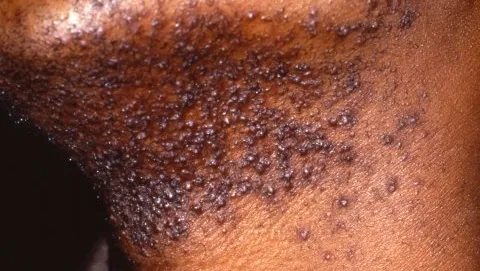
The redness that textbooks describe is the redness of light skin. On Black and brown skin, active HS lesions more often look violaceous, dark brown, or gray, and the surrounding inflammation can be hard to see. When a flare settles, it frequently leaves intense post-inflammatory hyperpigmentation, dark patches that linger long after the pain stops. HS can also produce keloid-like and thick scarring in healed areas. These features are part of the disease, not a separate skin problem, and missing that connection is one reason diagnosis on darker skin gets delayed. If recurring dark lumps in your armpits or groin keep leaving stubborn pigmentation behind, that pattern itself is a clue.
Common skin conditions are treated in primary care, and community health centers charge on a sliding scale that is often $0. Our directory of free and charitable clinics lists centers by state. A same-day telehealth visit is self-pay and cannot be billed to Medicaid or commercial insurance, so the clinic route usually costs less. If you need a prescription sooner than the next appointment:

Prescription skincare from a licensed clinician.
- Online visit and a treatment plan for your skin
- From $59 a month, shown before you book
 with Sesame Care
Affiliate link, we may earn a commission at no extra cost to you.
Because the early lumps look like ordinary bumps or razor irritation, HS is often confused with other follicular conditions. If you have dealt with recurring bumps in shaved areas, it helps to understand how razor bumps present on Black skin and how that differs from a disease that recurs in the folds and scars. The thick scarring HS can leave also overlaps in appearance with keloid scars on Black skin, which a dermatologist can tell apart.
Misdiagnosed as boils for 7 to 10 years
The single most documented failure in HS care is delay. Studies put the average time from first symptom to diagnosis at 7 to 10 years, during which patients see multiple doctors and collect multiple wrong labels: recurrent boils, folliculitis, cysts, abscesses. One real-world analysis found that diagnostic delay was longer for Black patients than for white patients. Each year of delay matters, because untreated HS scars permanently and responds less well to medication once tunnels and fibrosis set in. If a clinician keeps draining the same lumps without ever naming the condition, that is the signal to ask directly whether this could be hidradenitis suppurativa and to request a dermatology referral.
Hurley staging, in plain terms
Dermatologists grade HS with the Hurley system, which sorts disease into three stages and guides treatment. Stage I is one or more abscesses with no sinus tracts and no scarring. Stage II is recurrent abscesses, widely separated, with tract formation and scarring. Stage III is the most severe: multiple interconnected tracts and abscesses across an entire area. Knowing your stage matters because it shapes the plan. Earlier stages are often managed with medication, while later stages may add surgery to remove damaged tissue.
Triggers and conditions that travel with HS
HS is linked to smoking, obesity, and metabolic syndrome, and friction in the skin folds can aggravate flares. A 2024 systematic review and meta-analysis confirmed a strong association between HS and smoking, obesity, and diabetes. These are associations, not blame: HS appears in people of every body size and many who have never smoked. But because the links are real and modifiable, quitting smoking and addressing metabolic health are part of a full treatment plan, alongside, not instead of, medical therapy. Hormones also play a role for many patients, which is why flares can track with the menstrual cycle.
The real treatment ladder
HS is treatable, and the options have expanded sharply in the last decade. North American clinical guidelines from the U.S. and Canadian Hidradenitis Suppurativa Foundations lay out a ladder that escalates with disease severity:
- Topical and oral antibiotics. Topical clindamycin for mild disease; oral tetracyclines such as doxycycline; and for more active disease the combination of oral clindamycin and rifampin. Here antibiotics work partly as anti-inflammatories, not just to kill bacteria.
- Hormonal therapy. Options such as spironolactone or combined oral contraceptives can help patients whose flares are hormonally driven.
- Biologics. Adalimumab, a TNF-alpha inhibitor, was the first FDA-approved systemic drug for moderate-to-severe HS, cleared in 2015. Secukinumab, an IL-17A inhibitor, was approved in 2023, the first new biologic for HS in nearly a decade. Bimekizumab, which blocks both IL-17A and IL-17F, was approved in November 2024.
- Wound care and surgery. Proper dressing of draining lesions, plus procedures ranging from deroofing of tunnels to wide surgical excision for advanced, scarred disease.
Most patients do best with a combination matched to their stage, not a single drug. The goal is to control inflammation, reduce flares, and prevent the scarring that drives the worst long-term outcomes.
How to get care
Start with a primary care visit or go straight to a dermatologist, and use the word: ask whether your recurring lumps could be hidradenitis suppurativa and request a referral if your clinician is unsure. Bring a short history, when the lumps started, where they recur, whether they drain or scar, and any family history, because HS often runs in families. A dermatologist can stage the disease and start treatment, and a clinician who understands how HS and post-inflammatory hyperpigmentation present on Black skin will not mistake it for ordinary boils. You can find a Black dermatologist through our directory.
Frequently asked questions
Is hidradenitis suppurativa caused by poor hygiene? ▼
No. HS is a chronic inflammatory disease that starts in the hair follicle. It is not caused by being unclean, and you cannot wash it away or catch it from someone else. The lumps are driven by the immune system, not by dirt or by an infection you brought on yourself.
Why is HS so often mistaken for boils? ▼
Early HS lumps look like isolated boils or abscesses, and a single lesion can be drained and treated like an infection. What gives HS away is the pattern: painful lumps that keep recurring in the same skin folds, drain, and scar over months and years. The average patient waits 7 to 10 years and sees several doctors before getting the right diagnosis.
Why is HS more common in Black patients? ▼
U.S. data show HS is about three times more common in Black adults, who also tend to have more severe disease. The full explanation is not known, but researchers point to a combination of genetic, hormonal, and access factors, including longer delays in reaching a dermatologist. It is not about behavior or hygiene.
Can hidradenitis suppurativa be cured? ▼
There is no cure yet, but HS is treatable and controllable. Antibiotics, hormonal therapy, and biologics such as adalimumab, secukinumab, and bimekizumab can reduce flares, and surgery can remove badly scarred tissue. Starting treatment early, before extensive scarring, gives the best results.
What does HS look like on dark skin? ▼
On Black and brown skin, active lesions often look violaceous, dark brown, or gray rather than bright red, and the surrounding inflammation can be hard to see. Flares commonly leave intense dark patches of post-inflammatory hyperpigmentation, and healed areas can scar. Those features are part of the disease and a clue to the diagnosis.
When should I see a dermatologist for recurring lumps? ▼
If you have painful lumps that keep coming back in the armpits, groin, buttocks, inner thighs, or under the breasts, especially if they drain or scar, see a clinician and ask specifically about hidradenitis suppurativa. Earlier referral means earlier treatment and less permanent scarring.