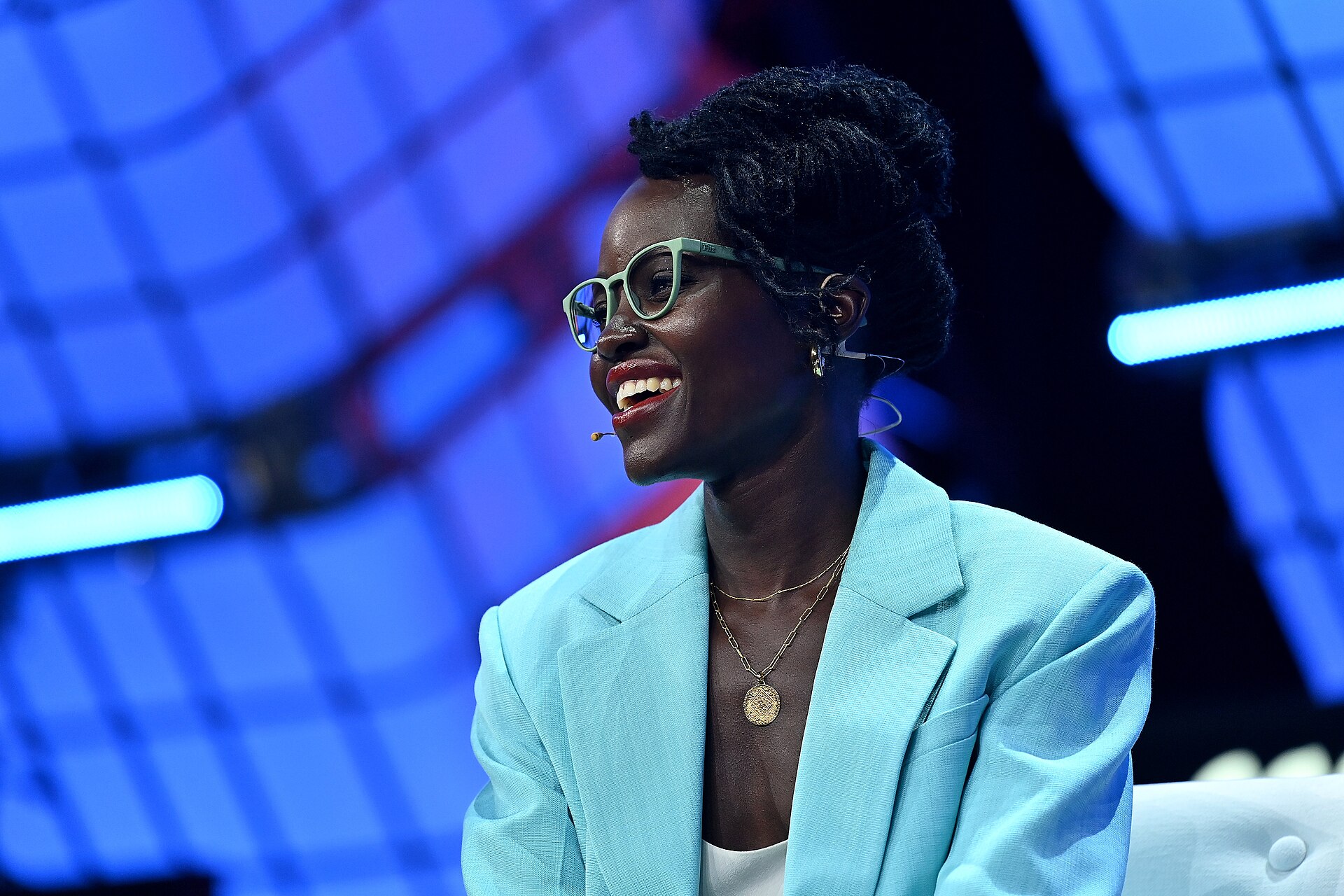
"Over the course of my lifetime, I have carried 77 uterine fibroids: 25 surgically removed, and more than 50 still growing inside me today, the largest the size of an orange." That is how Lupita Nyong'o opens the Make Fibroids Count fundraiser she launched in February 2026 with the Foundation for Women's Health, a campaign with a $200,000 goal to fund research into less invasive fibroid treatments. She describes "seasons of constant pain, losing dangerous amounts of blood each month, and suffering in silence." As of August 12, 2026, the fundraiser has raised $91,649 from 943 donations and remains open.
Her campaign lands on a piece of evidence that complicates the story most people have heard about Black women and fibroids. The familiar version is that Black women end up with hysterectomies at higher rates. But in a multi-site treatment registry of 2,337 women, Black women had hysterectomies less often than White women, 32.2 percent versus 43.6 percent, and chose uterus-sparing options more often (Wegienka et al., Journal of Women's Health 2021, PMID 33524308). The gap in who loses a uterus is not a gap in what Black women want. It is a gap in what they are offered.
Fibroids start earlier and run more severe in Black women
Uterine fibroids are benign tumors of the uterine muscle, and they are common across every group of women. The symptoms are concrete: heavy, prolonged menstrual bleeding, pelvic pressure and pain, frequent urination, and the anemia and fatigue that follow chronic blood loss. Larger fibroids can also complicate fertility and pregnancy. The canonical clinical reference on fibroids states the disparity directly: "black women have a higher risk of developing fibroids earlier in life than their white counterparts and also develop more-severe forms of the disease" (Stewart et al., Nature Reviews Disease Primers 2016, PMID 27335259).
The numbers behind that sentence are large. In an ultrasound-screening study of 1,364 randomly selected women ages 35 to 49, screened whether or not they had symptoms, the estimated cumulative incidence of fibroids by age 50 was more than 80 percent for Black women and nearly 70 percent for White women (Baird et al., American Journal of Obstetrics and Gynecology 2003, PMID 12548202). Most women develop fibroids before menopause. Black women develop them earlier.
How much earlier shows up in the NIEHS Study of Environment, Lifestyle and Fibroids, a Detroit-area cohort built to track fibroids in Black women with standardized ultrasounds rather than waiting for symptoms. Among 1,230 participants who were fibroid-free at enrollment, ages 23 to 35, 24 percent developed fibroids within five years of follow-up (Langton et al., F&S Science 2023, PMID 37028513). That is roughly one in four Black women developing the condition before her mid-thirties, in a window when many have not been screened or counseled about it.
Once fibroids are symptomatic, the burden runs heavier too. In a national survey of 268 African-American and 573 White women with symptomatic fibroids, conducted in late 2011 and early 2012, African-American women were 2.73 times as likely to report severe or very severe anemia and 1.51 times as likely to report severe heavy or prolonged periods (Stewart et al., Journal of Women's Health 2013, PMID 24033092). They also more often reported fibroids interfering with physical activity (1.67 times), with relationships (2.27 times), and with work, missing days 1.77 times as often. The disparity there is in severity among women who already have symptoms, not in who gets diagnosed.
Offered every option, Black women keep the uterus more often
The treatment-pattern evidence is where the standard narrative breaks. The COMPARE-UF registry followed 2,337 women, 1,196 Black and 1,141 White, through their fibroid-treatment decisions at ten clinical sites offering the full menu of options (Wegienka et al. 2021, PMID 33524308). Black women were more than twice as likely as White women to schedule a myomectomy, the operation that removes fibroids and leaves the uterus, with an odds ratio of 2.41, and more than four times as likely to schedule uterine artery embolization, a nonsurgical option, with an odds ratio of 4.24, both measured against hysterectomy. The authors' conclusion is unambiguous: "Black women were more likely to schedule a uterine-sparing UF treatment and a nonsurgical UF treatment than their White counterparts."
The authors add a caveat worth keeping: "this may not be true for all women." A registry is not the whole country, and women who reach a multi-site fibroid program are not a random sample of women with fibroids. But the finding does one specific thing. It removes patient preference as the explanation for the population-level pattern. When Black women sit in front of a provider who offers myomectomy, embolization, and focused ultrasound alongside hysterectomy, they choose to keep the uterus more often than White women in the same rooms. If the broader hysterectomy rate still runs higher, the bottleneck is upstream: reaching a provider who offers the full range at all.
Reaching that full menu is itself a specialist problem. Uterine artery embolization is performed by interventional radiologists, focused ultrasound is offered at a limited number of centers, and a myomectomy on numerous or large fibroids takes surgical experience that not every gynecology practice has. A general OB-GYN who does not perform those procedures, and does not refer out for them, leaves hysterectomy as the option a patient actually hears about. Because fibroids arrive early in Black women, often in the years a woman may still want children, that gap carries a fertility stake. A hysterectomy ends the possibility of pregnancy; the uterus-sparing options can preserve it.
Whatever brought you to this page, community health centers see patients regardless of insurance and charge on a sliding scale that is often $0. Our directory of free and charitable clinics lists centers by state. A same-day telehealth visit is self-pay and is not billed to Medicaid, so if you have Medicaid the clinic route will usually cost less. If you would rather see a clinician online today:

See a doctor online today.
- Same-day video visits from $34
- Price shown before you book
- No insurance needed
 with Sesame Care
Affiliate link, we may earn a commission at no extra cost to you.
Erica E. Marsh, MD, professor of obstetrics and gynecology at the University of Michigan Medical School and chief of the division of reproductive endocrinology and infertility, co-authored that registry study. In June 2024 the Eunice Kennedy Shriver National Institute of Child Health and Human Development named her to lead one of two new federal research centers on fibroid health disparities, a combined $15 million investment, with her center examining why fibroid severity and symptoms differ between Black and White women. The through-line of her work is that what looks like a difference in choice is usually a difference in what was on the table.
Heavy bleeding gets normalized, and waiting narrows the options
The other half of the access problem is how long the road to that provider is, and it often starts inside the home. In a study of 60 women with symptomatic fibroids, 61.7 percent of them African-American, researchers documented a pattern they named an altered perception of normal: "Many women with symptomatic fibroids live with this condition chronically without seeking care. It appears that for some, limited knowledge regarding fibroids and normal menstruation may lead to a distorted view of what is normal with regard to uterine bleeding" (Ghant et al., Journal of Women's Health 2016, PMID 27195902). The five reasons women gave for delay: symptoms felt normal, low knowledge of fibroids, not seeing themselves at risk, avoidance, and distancing themselves from the diagnosis.
When heavy bleeding is what your mother and your aunts lived with, soaking through protection and planning life around a calendar can read as ordinary rather than as a treatable medical problem. That normalization buys time for fibroids to grow and multiply, which narrows the options that remain by the time a woman does seek care. A fibroid small enough for embolization or a targeted myomectomy at 30 can become a uterus-filling burden at 40. The delay is the same pattern of late presentation that drives worse outcomes in other conditions, including the screening gaps covered in our reporting on breast-cancer screening for Black women.
Where the campaign and the bills stand in August 2026
Nyong'o went public with her diagnosis in July 2025 and attached her platform to two levers at once. On July 15, 2025 she joined Senator Angela Alsobrooks and Representatives Shontel Brown and Yvette Clarke as they announced a package of uterine-health bills, saying "I'm grateful to the bill sponsors for leading the way to that future and am committed to supporting this package" (Office of Senator Alsobrooks, July 15, 2025). The same day, the Foundation for Women's Health opened the FWH x Lupita Nyong'o Uterine Fibroid Research Grant to researchers, medical institutions, and health innovators, targeting minimally invasive and noninvasive treatments.
As of August 12, 2026, none of the fibroid bills has moved past committee. The House U-FIGHT Act (H.R. 4392, 54 cosponsors), which would fund grants for early detection, education, and treatment of uterine fibroids, was introduced July 15, 2025. Its bipartisan Senate companion from Alsobrooks and Senator Cynthia Lummis (S. 2531) followed on July 30, 2025 and sits with the Senate health committee. The Stephanie Tubbs Jones Uterine Fibroid Research and Education Act (H.R. 4395, 71 cosponsors, with S. 2275 in the Senate) was introduced the same July day. Neither chamber has voted on any of them.
The research fundraising has moved further than the legislation. In February 2026 Nyong'o launched Make Fibroids Count, the public fundraiser with a $200,000 goal that feeds the grant fund; as of August 12, 2026 it stands at $91,649 from 943 donations and is still collecting. In May 2026 the Atlanta Fibroid Center announced a separate $100,000 donation to the grant from its founder, interventional radiologist John Lipman, MD. The foundation has not announced a grant recipient as of this article's publication.
The gap the campaign is trying to fill is documented at the federal level. A National Academies report released in December 2024 found that 8.8 percent of NIH research-grant spending from fiscal years 2013 through 2023 went to women's health research, and the share fell to 7.9 percent in fiscal year 2023 (National Academies of Sciences, Engineering, and Medicine). For an individual woman, the lever is the appointment and the question she asks in it. For the gap itself, it is the research that has not been funded yet.
What to do if you have fibroid symptoms
Track the symptoms before the visit. Write down how often you change protection on your heaviest days, how many days your period lasts, whether you are passing clots, and what you are skipping because of it. A specific record (six pads on day two, eleven-day periods) gives a clinician something to act on, and gives you a baseline to push back against if the bleeding gets waved off as normal.
Ask about the full menu before you agree to a hysterectomy. The question that puts the registry finding to work is short: what are my uterus-sparing options? Myomectomy, uterine artery embolization, and focused ultrasound are real alternatives for many women, and which one fits depends on the size, number, and location of the fibroids and on whether you want to keep the option of pregnancy. If a provider offers only hysterectomy, that is a reason to get a second opinion at a center that offers the rest, not evidence that hysterectomy is your only path.
Find a provider who will have that conversation. The blackhealth.org provider directory lists Black OB-GYNs and gynecologic specialists with verified license and NPI on file, including clinicians who treat fibroids.
If you want to push on the system layer, both campaign channels are live as of August 2026: the Make Fibroids Count fundraiser is still open, and the four fibroid bills are still sitting in committee, where a call to your representative's office is the action that registers.
Frequently asked questions
Do fibroids always mean a hysterectomy? ▼
No. Myomectomy removes the fibroids and leaves the uterus, uterine artery embolization shrinks them by cutting off their blood supply, and focused ultrasound treats them without surgery. In the COMPARE-UF registry, Black women offered the full range chose these uterus-sparing options more often than White women did. Which option fits depends on the size, number, and location of the fibroids and on whether you want to preserve the option of pregnancy.
What are the uterus-sparing fibroid treatments? ▼
Three main ones. Myomectomy is surgery that removes fibroids while keeping the uterus intact. Uterine artery embolization is a nonsurgical procedure, performed by an interventional radiologist, that blocks the blood vessels feeding the fibroids so they shrink. Focused ultrasound uses targeted sound waves to destroy fibroid tissue without incisions, though it is offered at a limited number of centers. A gynecologist who does not offer a given option can refer you to a center that does.
How common are fibroids in Black women? ▼
By age 50, the estimated cumulative incidence is more than 80 percent for Black women, based on ultrasound screening independent of symptoms. Onset is early: in a Detroit-area cohort of Black women ages 23 to 35 who were fibroid-free at enrollment, 24 percent developed fibroids within five years.
Is the Make Fibroids Count campaign still active? ▼
Yes. As of August 12, 2026, the GoFundMe fundraiser stands at $91,649 of its $200,000 goal and is still accepting donations, which go to the Foundation for Women's Health research grant fund. The foundation has not yet announced a grant recipient, and the four fibroid bills introduced in Congress in July 2025 remain in committee.





.jpg)