Psoriasis is a chronic disease driven by an overactive immune system. The immune system speeds skin-cell turnover from weeks to days, and the cells pile up into raised, scaly plaques. It is not contagious, it has nothing to do with hygiene, and you cannot wash it off. More than 8 million Americans have it. The problem for Black patients is not that psoriasis is rare, it is that it looks different on dark skin than the images doctors are trained on, so it gets named something else and treated too lightly.
What psoriasis actually is
In psoriasis, the immune system misfires and tells skin cells to grow far faster than normal. The cells reach the surface in days instead of the usual three to four weeks, and because the old cells have not shed yet, they stack up into thick, scaly plaques. The American Academy of Dermatology describes it as a condition that makes the body build new skin cells in days rather than weeks. It runs in families, it flares and quiets over a lifetime, and stress, infections, skin injury, and some medications can trigger flares. The one thing it is not: a sign of being dirty or careless. You cannot catch psoriasis from someone and you cannot give it to anyone.
How psoriasis looks on Black and brown skin
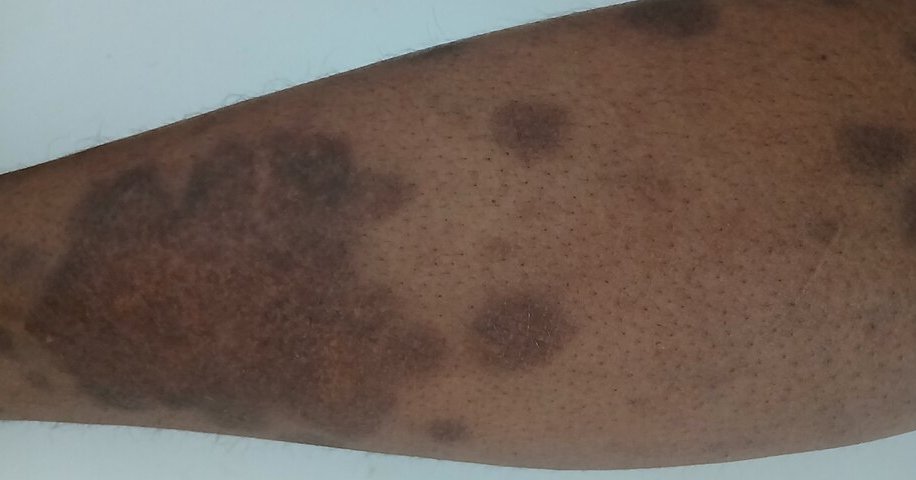
The classic teaching describes psoriasis as bright red or salmon-pink plaques topped with silvery-white scale. That is how it looks on light skin. On darker skin, the inflammation that reads as red on white skin shows up as purple, violet, or more often gray, and the plaques tend to be thicker with a grayer scale, according to a 2025 evidence review in the International Journal of Dermatology. The plaques can also be deep brown and blend into surrounding skin, which makes the borders harder to see. Because it does not match the photo in the textbook, psoriasis on Black skin is regularly mistaken for eczema, seborrheic dermatitis, lichen planus, or a fungal infection, and treated for the wrong thing for months or years.
The second difference is what psoriasis leaves behind. After a plaque clears, Black skin often holds onto dark or light marks at the old site, called post-inflammatory hyperpigmentation or hypopigmentation. These pigment changes can last far longer than the plaque itself and, for many patients, bother them more than the original rash. If you have flaky, scaly patches on your scalp that you have been treating as dandruff, that overlap is real: read our guide to seborrheic dermatitis on Black skin to see how the two differ and why a dermatologist may need to tell them apart.
The types you should know
Psoriasis is not one rash. The American Academy of Dermatology recognizes several types, and a person can have more than one:
- Plaque psoriasis is by far the most common, in 80% to 90% of cases. It causes raised, scaly patches, classically on the elbows, knees, lower back, and scalp.
- Scalp psoriasis is especially common in Black patients and can be mistaken for severe dandruff. It causes thick, scaly buildup and can affect the hairline, behind the ears, and the back of the neck.
- Guttate psoriasis causes small, drop-shaped spots, often after a strep throat infection.
- Inverse psoriasis shows up in skin folds (armpits, groin, under the breasts) as smooth, shiny patches rather than scaly ones.
- Nail psoriasis causes pitting, yellow-brown spots, crumbling, or the nail lifting away from the finger. Patients with skin of color are often diagnosed with nail psoriasis years later and with more severe nail disease.
- Pustular psoriasis causes pus-filled bumps and, in its widespread form, can be a medical emergency.
Psoriasis is more than skin: the joint and heart link
This is the part too many people miss. Psoriasis is a whole-body inflammatory disease, and the most important complication is psoriatic arthritis. The National Psoriasis Foundation reports that roughly 1 in 3 people with psoriasis develop it. It causes joint pain, swelling, and stiffness, often worse in the morning or after sitting still, and it can also cause swelling of a whole finger or toe and heel pain. Untreated, the inflammation can permanently damage joints. Early diagnosis and treatment can prevent that damage, which is why any new joint pain or stiffness is worth reporting to your doctor even if your skin looks calm.
Common skin conditions are treated in primary care, and community health centers charge on a sliding scale that is often $0. Our directory of free and charitable clinics lists centers by state. A same-day telehealth visit is self-pay and cannot be billed to Medicaid or commercial insurance, so the clinic route usually costs less. If you need a prescription sooner than the next appointment:
Prescription skincare from a licensed clinician.
- Online visit and a treatment plan for your skin
- From $59 a month, shown before you book
 with Sesame Care
Affiliate link, we may earn a commission at no extra cost to you.
The same inflammation drives risk elsewhere in the body. People with psoriasis carry higher rates of cardiovascular disease, type 2 diabetes, obesity, and depression. The AAD warns that psoriasis can raise the risk of conditions like psoriatic arthritis and diabetes, which is one more reason it should be managed by a clinician rather than ignored as a cosmetic nuisance.
Why Black patients get diagnosed later and treated less
Three things stack up. First, the textbook-image problem: when a plaque is violet or gray instead of red, a clinician who rarely sees psoriasis on dark skin may not put it at the top of the list. Second, disease tends to be more extensive by the time it is caught. The 2025 review found that the average body surface area affected runs 1% to 2% in White adults but 3% to 10% in Black adults, and Asian, Hispanic, and Black patients are more likely to present with severe disease and a heavier hit to quality of life. Third, access and treatment gaps: Black and other minoritized patients in the US are more likely to have undiagnosed psoriasis and less likely to see a dermatologist at all.
That gap follows patients into treatment. A study of the US Medicare population found the odds of receiving a biologic, the most effective class of psoriasis drug, were 69% lower in Black patients than in White patients. Some of that is patient-side (a 2019 study found Black patients who had never used biologics were more likely to be unfamiliar with them or wary of injections), and some is structural. Either way, the people with the most severe disease are getting the strongest treatment least often.
The treatments that work
Psoriasis cannot be cured, but it can be controlled well at every severity level. Treatment usually climbs a ladder based on how much skin is involved and whether the joints are affected:
- Topicals (prescription corticosteroid creams, vitamin D analogs, and newer non-steroid creams) for limited disease.
- Phototherapy, controlled doses of ultraviolet light, for more widespread plaques. One caveat for darker skin: dosing has to be set for the patient's skin tone, because the standard light schedules were built around lighter skin and can be underdosed or cause burns and extra pigment change if not adjusted.
- Systemic drugs and biologics for moderate-to-severe disease and for psoriatic arthritis. The modern biologics that block specific immune signals (the IL-17, IL-23, and TNF pathways) clear skin dramatically in many patients and protect the joints. These are the drugs Black patients receive least often, and they are worth asking about by name.
Clearing the plaques is only half the job on Black skin. The dark or light marks left behind respond to sun protection, time, and treatments a dermatologist can prescribe, the same toolkit used for other causes of uneven tone.
How to get care
If a patch has been treated as eczema or dandruff for months without clearing, ask specifically whether it could be psoriasis, and ask for a referral to a dermatologist who can take a closer look or do a small biopsy. Bring up any joint symptoms in the same visit. If you would rather see a clinician who understands how psoriasis presents on dark skin, you can find a Black dermatologist or skin-of-color specialist in our directory. For moderate-to-severe disease, ask directly about systemic and biologic options by name, because those are the treatments Black patients are offered least often.
Frequently asked questions
What does psoriasis look like on Black skin? ▼
On Black and brown skin, psoriasis plaques usually look violet, gray, or dark brown rather than the bright red described in most textbooks. The scale tends to be thicker, and after a plaque clears it often leaves dark or light marks that can last for months. Because it does not match the classic red, silvery image, it is frequently mistaken for eczema, seborrheic dermatitis, or a fungal rash.
Is psoriasis contagious or caused by poor hygiene? ▼
No. Psoriasis is a chronic immune-driven disease, not an infection. You cannot catch it from anyone and you cannot spread it. It has nothing to do with how often you wash, and scrubbing harder does not help and can make a flare worse.
Can psoriasis turn into arthritis? ▼
About 1 in 3 people with psoriasis develop psoriatic arthritis, which causes joint pain, swelling, and stiffness. Untreated, it can permanently damage joints. That is why any new or persistent joint pain, stiffness, or swelling should be reported to a doctor promptly, even if your skin is clear at the time.
Why are Black patients less likely to get biologics for psoriasis? ▼
A US Medicare study found Black patients had 69% lower odds of receiving a biologic than White patients. The reasons include later diagnosis, fewer dermatology referrals, access barriers, and less familiarity with the drugs among patients who have never used them. If you have moderate-to-severe psoriasis or psoriatic arthritis, ask your clinician directly whether a biologic is right for you.
Does psoriasis leave dark spots on Black skin? ▼
Often, yes. After a plaque clears, Black skin commonly holds onto dark (hyperpigmented) or light (hypopigmented) marks at the old site. These can outlast the rash by months. Sun protection and treatments a dermatologist can prescribe help them fade over time.
What this gets mistaken for
Black patients with psoriasis are disproportionately misdiagnosed as eczema, tinea, or 'dry skin'. The discriminator: psoriasis plaques are typically well-demarcated, thick, and have heavier scale. A dermatology biopsy settles the question definitively.