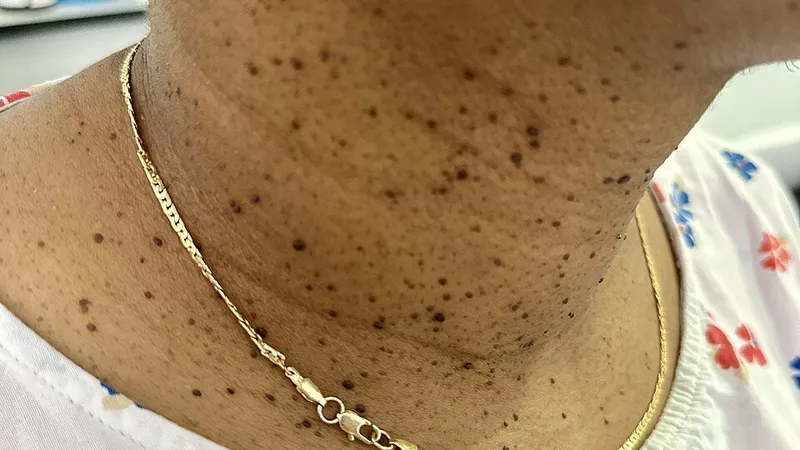
Tretinoin faded dark marks 40% in a 40-week trial
The strongest evidence for retinoids on dark marks in Black skin is also the oldest. In 1993 a University of Michigan team ran a 40-week randomized, double-blind, vehicle-controlled trial that 54 Black participants with post-inflammatory hyperpigmentation completed, 24 of them on 0.1% tretinoin cream and 30 on the vehicle cream. Color measurement showed 40% lightening of the marks toward normal skin color with tretinoin, against 18% with vehicle. Epidermal melanin in the marks fell 23% against 3%, a difference that did not reach statistical significance, so the color measurement is the number to lean on. Improvement showed at four weeks, and unaffected skin lightened to a degree the investigators themselves called clinically minimal. It works on the mark, not on your face.
That trial is small, single-center and over 30 years old, and nothing of comparable design has replaced it. A 2023 Delphi consensus published in the Journal of the American Academy of Dermatology said as much: large randomized trials on acne-associated hyperpigmentation are lacking, so strictly evidence-based recommendations cannot be made. The panel still put a topical retinoid plus benzoyl peroxide first, with hydroquinone, azelaic acid or peels for the pigment.
Retinol, adapalene and tretinoin are three different things
Over-the-counter retinol (also retinaldehyde and retinyl palmitate) is sold as a cosmetic, not a drug. A 2022 review in Advances in Therapy spells out the consequence: efficacy studies are not required to market a cosmetic, so there are real concerns about how well these products perform. Retinol also has to be converted inside the skin into retinoic acid, the active form. Concentration is often absent from the label. Gentlest entry point, least predictable one.
Adapalene 0.1% is a synthetic retinoid and a real drug you can buy without a prescription. FDA's Drugs@FDA record for Differin Gel (NDA 020380) lists its marketing status as over-the-counter and logs the July 2016 supplement as an "Efficacy-Rx To OTC Switch". The 0.3% strength stays prescription-only. What makes it the sensible first purchase is the tolerability data in dark skin, with one caveat you should weigh: the largest piece of that data comes from the company that sells the drug. A meta-analysis of five randomized US and European trials, run by researchers at Galderma Research and Development, which markets adapalene, found significantly less erythema and scaling in Black than white patients, with moderate or severe dryness in 7% against 18%. A separate 12-week study of 65 African patients, open-label and with no comparison group, reported under 5% with moderate or severe irritation alongside improvement in acne hyperpigmentation.
Prescription tretinoin is retinoic acid itself, so there is no conversion step and no ambiguity about dose. Cream, gel and lotion, 0.01% to 0.1%. The lotion vehicle was developed as an option for people who cannot tolerate the older creams and gels, a description that comes from an analysis by authors including an employee of the company that sells it. Tazarotene and trifarotene are also prescription.
The irritation is the real risk, and it is a dial you control
Here is the concern, stated in the dermatology literature itself: retinoids can provoke an irritant contact dermatitis, and irritant dermatitis can cause post-inflammatory hyperpigmentation. That is not theoretical in skin of color. A 2026 review in the American Journal of Clinical Dermatology reports that up to 85% of people with Fitzpatrick phototypes IV to VI develop post-inflammatory hyperpigmentation after inflammatory acne lesions, and that it can last months or years.
What the trial data does not show is retinoids making pigment worse on balance. In the 1993 trial, 12 of the 24 people who finished treatment developed retinoid dermatitis, and it faded as the study went on. That group still ended with 40% lightening against 18%. In a companion melasma trial from the same Michigan group, 28 of the 30 Black patients enrolled completed it, 67% of those on tretinoin had a mild retinoid dermatitis, and the tretinoin group still improved 32% against 10% for vehicle. A 2022 clinical review of retinoids in skin of color, written by a panel that includes an employee of a retinoid manufacturer, gives the practical instruction: start as early as possible unless contraindicated, and use a plain moisturizer, which the review says may reduce the irritation.
How to start: two nights a week, dry skin, moisturizer on top
Build frequency slowly. Two nights a week for two weeks. If your skin is calm, three, then every other night. Daily only if you get there without stinging or flaking. Plenty of people stay at every other night permanently.
Dry skin, pea-sized amount. Cleanse, then wait 20 to 30 minutes, because damp skin takes up more product and stings more. The over-the-counter adapalene Drug Facts label, in this case the Walgreen store-brand gel rather than Differin itself, is direct: do not use it more than once a day, and applying more than directed will not give faster or better results.
Common skin conditions are treated in primary care, and community health centers charge on a sliding scale that is often $0. Our directory of free and charitable clinics lists verified centers by state. A same-day telehealth visit is self-pay and cannot be billed to Medicaid or commercial insurance, so the clinic route usually costs less. If you need a prescription sooner than the next appointment:
Affiliate
Buffer with moisturizer, before or after, either order. Starting a plain moisturizer a couple of weeks ahead of the retinoid is worth doing, and the evidence usually cited for it is thinner than it sounds. In that split-face study, both sides of every face got the two-week moisturizer run-in, so what the trial actually compared was one moisturizer formula against another, in women with photodamaged skin rather than a skin-of-color group. Its authors concluded that improving the skin barrier first eases the early phase of retinization and improves the response. Treat that as reasonable practice, not a tested step.
Stay off the thin spots, park your other actives. The tretinoin label says keep it away from the eyes, mouth, angles of the nose and mucous membranes, which crack first. It also flags abrasive or medicated cleansers, drying soaps, high-alcohol products, astringents and anything with sulfur, resorcinol or salicylic acid.
Retinization versus a reaction you should stop for
The first two to eight weeks are called retinization, and they are supposed to be a little uncomfortable. Expect tightness, mild flaking around the nose and mouth, a brief sting on application, and acne that looks worse before it looks better. The over-the-counter adapalene label says exactly that: acne may appear to worsen before it improves in the early weeks, this is normal, and you should continue unless the irritation becomes severe.
Stop and reassess if your skin becomes, in the tretinoin label's own words, excessively red, edematous (swollen), blistered or crusted. Also stop for raw or weeping skin, burning that does not settle, or an itchy rash spreading past where you applied it, which can mean contact allergy.
On brown and black skin, irritation often does not read as pink. It shows as darker, dusky, grayish or violet, and it is easy to miss in the mirror. Heat, tightness, swelling and tenderness are the more reliable signals.
Sunscreen is part of the treatment, not an extra step
The first reason is the drug. The tretinoin label instructs that sun exposure, including sunlamps, be minimized, and that sunscreen and protective clothing over treated areas are recommended when exposure cannot be avoided. The adapalene label says the same.
The second reason is the pigment. A 2021 Journal of the American Academy of Dermatology review of tinted sunscreens, written by Henry Ford Hospital photodermatology researchers with a co-author employed by a sunscreen company, states that visible light induces redness in light skin and pigmentation in dark skin, that broad-spectrum sunscreens do not adequately protect against visible light, and that mineral filters milled fine enough to avoid a white cast do not block it either. What blocks visible light is tint: iron oxides and pigmentary titanium dioxide, which the review names as useful specifically for melasma and post-inflammatory hyperpigmentation. Our guide to sunscreen for Black skin covers finding a shade that disappears.
How long it actually takes
Acne first. The tretinoin label says results should be noticed after two to three weeks, but more than six weeks may be required before definite benefit. The adapalene label says up to three months.
The marks are slower, and that is the part people quit over. The 2022 skin-of-color review states it directly: acne lesions improve weeks before the hyperpigmentation resolves. The 1993 trial ran 40 weeks to reach its 40% figure. In a 16-week open-label study of adapalene 0.3% with benzoyl peroxide 2.5% in 50 people with skin types IV to VI, 17 of them Black, 30 had pigmentation at baseline, all of it rated very mild to moderate, and by week 16, 75% of those 30 had none or very mild. There was no comparison group, so read that as what happened over 16 weeks, not as what the drug alone did.
Months for the acne, longer for the marks. Left alone, acne-induced pigmentation can sit for months or years, so a slow fade is still a fade. See our guides to fading dark spots on Black skin and treating acne without the dark marks.
When to ask a clinician before you start
Pregnancy or trying to conceive. The tretinoin label states there are no adequate and well-controlled studies in pregnant women, and that it should be used in pregnancy only if the potential benefit justifies the potential risk to the fetus. Most clinicians stop topical retinoids in pregnancy.
Active eczema or a sunburn. The label warns that tretinoin has been reported to cause severe irritation on eczematous skin, and says to wait out a sunburn entirely. If you are already on a pigment prescription, a peel series or laser, coordinate the schedule instead of stacking it.
Frequently asked questions
Is adapalene or retinol better for dark spots? ▼
Adapalene is the more predictable choice: a drug at a fixed 0.1% concentration with published tolerability data in Black and African patients, though the largest piece of that data was produced by the company that markets it. Cosmetic retinol products are not required to run efficacy studies and often do not state their concentration. Retinol is reasonable if your skin is very reactive, but you are trading certainty for gentleness.
Will a retinoid lighten my normal skin as well as the marks? ▼
Not meaningfully. In the 40-week trial, unaffected skin lightened only minimally, a change the investigators called clinically minimal, while the dark marks lightened 40% toward normal color. Retinoids are not skin lighteners and do not work like the creams sold for that purpose.
Can I use vitamin C or exfoliating acids at the same time? ▼
Not in the first month. The tretinoin label flags salicylic acid, sulfur, resorcinol, strong astringents, high-alcohol products and abrasive cleansers as things to use with caution alongside it. Once you are settled, keep them on separate nights. Stacking actives is the most common way people trigger the irritation that leaves marks.
Is purging real, or is my skin just breaking out? ▼
Both FDA labels describe it. The over-the-counter adapalene label says acne may appear to worsen before it improves in the early weeks and that this is normal. The tretinoin label calls it an apparent exacerbation of inflammatory lesions, the drug reaching lesions that were not yet visible. It should be spots where you normally break out, and it should settle. A rash spreading to new areas is not purging.
Can I use a retinoid on razor bumps or dark underarms? ▼
Retinoids are used off the face, but folds over-irritate easily. Underarms and inner thighs are thin and occluded, so start once or twice a week at most and stop at the first soreness. For razor bumps, changing the shaving technique usually does more.