What keratosis pilaris looks like on Black skin
Keratosis pilaris is a plug. Dead skin cells and keratin build up in the opening of a hair follicle, so every bump is one clogged follicle, often with a coiled hair trapped inside. StatPearls calls it the most common follicular keratosis, present in 50 to 80 percent of adolescents and about 40 percent of adults, and states that race and sex do not predispose anyone to develop it. Black people are not more likely to get it. Black people are more likely to be told it is something else.
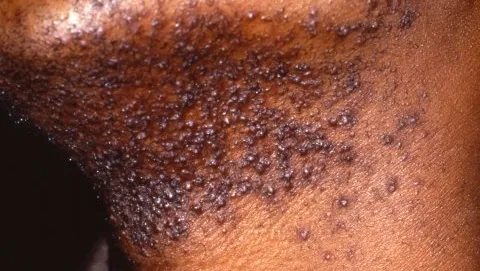
What changes with skin tone is the color of the bump. Clinical descriptions lead with perifollicular erythema, the ring of redness around each plugged follicle, and StatPearls describes patients arriving at the office complaining of red bumpy skin. The American Academy of Dermatology's symptom page lists the full range: skin colored, white, red, pinkish purple on fair skin, and brownish black on dark skin. A 2025 European Journal of Dermatology systematic review describes the papules as erythematous and hyperpigmented with a rough texture. On brown skin you meet the hyperpigmented half.
So the pattern on a Black arm is a field of small dark dots, each centered on a follicle, packed close enough that the whole patch can look dusty from a distance. That is where the internet term strawberry skin comes from: dark dots pitting the surface like seeds on a strawberry. On upper arms and front thighs, those dots are almost always keratosis pilaris. On freshly shaved legs the same look can be ingrown hairs or dark follicular openings, so the site tells you more than the nickname.
Where it sits is the other half of the identification. In the Poskitt and Wilkinson survey of 49 patients published in the British Journal of Dermatology, the arms were involved in 92 percent, the legs 59 percent, the face 41 percent, and the buttocks 30 percent. The AAD maps it by age: upper arms, front thighs, and cheeks in children, and upper arms, front thighs, and buttocks in teens and adults.
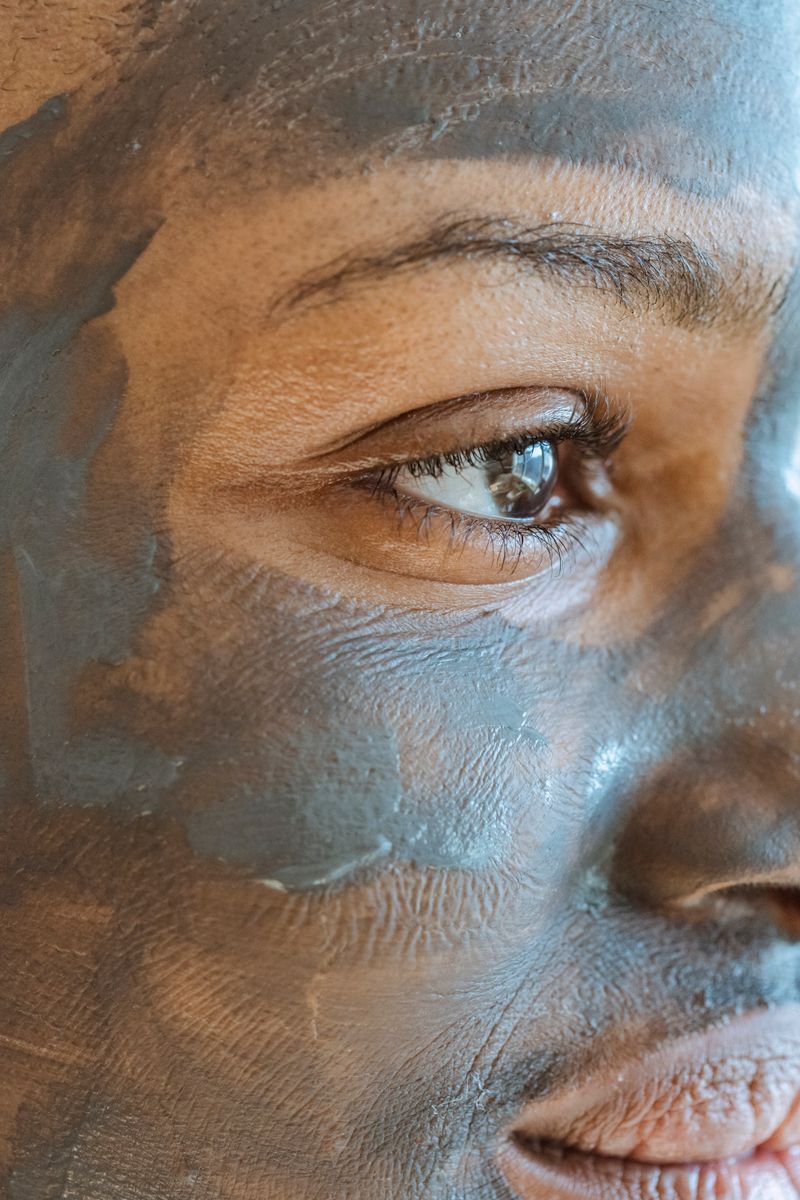
The face deserves its own note, because that is where the misdiagnosis costs the most. A 2022 Pediatric Dermatology case series from the University of Chicago reviewed 20 children with follicular keratosis of the face, and all 20 self-identified as Black or African American. Every one had a hyperpigmented patch studded with hyperkeratotic follicular papules on the cheek, chin, upper lip, or jawline, and five reported rubbing the area. Topical vitamin D analogs and retinoids improved texture and pigment in only four of the 20, and topical corticosteroids did nothing. When a Black child's facial bumps are being treated as acne with no result, follicular keratosis is the question to raise.
Keratosis pilaris travels with dry-skin genetics rather than with any one disease. A Finnish study of 502 patients with atopic dermatitis tied it to palmar hyperlinearity (odds ratio 4.66) and the filaggrin loss-of-function mutation 2282del4 (odds ratio 4.92), with no link to eczema severity or asthma. A Brazilian cross-sectional study of 158 dermatology outpatients aged 14 to 35 found moderate to severe keratosis pilaris on the arms in 26 percent of them, and that group was more likely to report a personal history of atopy (odds ratio 2.80). The barrier leaks, the follicle plugs, and any plan without moisturizer works against the mechanism.
Keratosis pilaris, razor bumps, DPN, or folliculitis
Four things make bumps on Black skin, they get treated identically by mistake, and only one responds to a keratolytic. Sort them by where they are and what they feel like.
Keratosis pilaris sits on the outer upper arms, the front of the thighs, the buttocks, and sometimes the cheeks. It is rough, symmetrical, painless, and has usually been there since childhood. It ignores your shaving schedule.
Razor bumps live only where you remove hair: beard and neck, scalp edges, bikini line, underarms, legs. A cut hair curves back into the skin, so they are tender, they flare within a day or two of shaving, and they leave dark marks and sometimes keloids. Both can share a leg, since the AAD warns that shaving or waxing skin with keratosis pilaris can produce more bumps. Our guide to razor bumps on Black skin covers the shaving side.
Dermatosis papulosa nigra is smooth. StatPearls describes DPN as a benign epidermal growth, a variant of seborrheic keratosis, appearing as hyperpigmented or skin-colored papules on the face and neck from adolescence onward, and reports that up to one third of African American adults have them. They sit on top of the skin, and no acid, retinoid, or scrub removes one. Removal is a procedure. See dermatosis papulosa nigra on Black skin for what that involves.
Folliculitis itches or hurts. StatPearls defines it as an infected or inflamed follicle forming a pustule or red papule, and says the most common form is superficial bacterial folliculitis from Staphylococcus aureus. It arrives over days rather than years, spots come to a head, and it can spread. Keratosis pilaris does none of that. It can be dry and itchy, which the AAD lists among its symptoms, but it does not form pustules and it does not come on in a week.
Common skin conditions are treated in primary care, and community health centers charge on a sliding scale that is often $0. Our directory of free and charitable clinics lists verified centers by state. A same-day telehealth visit is self-pay and cannot be billed to Medicaid or commercial insurance, so the clinic route usually costs less. If you need a prescription sooner than the next appointment:
Affiliate
The fifth thing is not a bump at all. It is what the first four leave behind, and on Black skin those flat marks usually outlast the bumps that caused them. Our guide to dark spots and hyperpigmentation on Black skin covers that half of the problem.
The treatment ladder, and what it costs to rush it
Start with the honest frame. StatPearls says keratosis pilaris is asymptomatic, generally improves over time, needs no treatment, has no cure, and is often refractory to what exists. Treatment buys smoother texture and less visible pigment. Anything sold as a cure is selling something else. A 2023 review in the Italian Journal of Dermatology and Venereology sets the order: general skin measures, then topical keratolytics as first-line therapy, then topical retinoids and corticosteroids, with lasers and microdermabrasion held for skin that does not respond to topicals.
Step one is moisture, applied wet. The AAD's instruction is specific: a thick oil-free cream or ointment rather than a lotion, on damp skin, within five minutes of the shower, and again whenever skin feels dry. Pick one containing urea or lactic acid so it moisturizes and exfoliates in one step. Keep showers under 20 minutes and warm rather than hot, swap bar soap for a mild cleanser, and run a humidifier in dry air.
Step two is a keratolytic, and the cheap ones have trial evidence. In a randomized trial at the Institute of Dermatology in Bangkok, 10 percent lactic acid and 5 percent salicylic acid creams were applied twice daily for three months: lesions fell 66 percent with lactic acid and 52 percent with salicylic acid, with only mild local irritation. StatPearls lists salicylic acid 6 percent lotion and urea 20 percent cream as the texture-improving agents. A 2024 open-label study of 30 adults using 20 percent urea cream once daily found significant smoothing at four weeks, though without a control group it cannot separate the urea from its base. Asked what they reach for first in a 2023 survey, board-certified dermatologists named lactic acid (43.6 percent) then salicylic acid (20.7 percent).
Step three is a retinoid, used carefully. The AAD lists adapalene, retinol, tazarotene, and tretinoin, and StatPearls cites case reports of tazarotene 0.01 percent nightly with fading in two weeks. Retinoids are also the step most likely to backfire on brown skin, because retinoid irritation is inflammation and inflammation is what makes dark marks. Start two or three nights a week, moisturize over it, and stop for a few days at the first sting.
Where lasers fit, and why the evidence does not transfer
Review articles rank laser as the best-supported treatment for keratosis pilaris, and that ranking needs an asterisk on dark skin. A 2022 Journal of Dermatological Treatment systematic review of 47 studies named laser the most supported option, particularly Q-switched Nd:YAG. A 2024 Clinical and Experimental Dermatology review of 52 studies agreed and named the Nd:YAG the preferred device on the strength of its longer wavelength, while criticizing the field for inconsistent outcome measures.
Then read who was in the trials. The strongest single study, a rater-blinded randomized trial of the 810-nm diode laser in JAMA Dermatology in 2015, enrolled only Fitzpatrick skin types I through III, which excludes most Black readers by design. It improved roughness by one point on a four-point scale, did not improve redness, and two of the 23 enrolled patients withdrew because of inflammatory hyperpigmentation after treatment. That happened in a trial with no dark skin in it.
The study that did include skin type V is the more useful one. A single-blind randomized comparison of fractional CO2 laser in 20 patients found moderate to good improvement in 30 percent of treated lesions at 12 weeks, with papules and hyperpigmentation responding better than redness. Four patients with Fitzpatrick skin type V developed transient pigmentary alteration, and the authors closed with a line worth carrying into a consultation: dark-skinned patients should be treated with special caution. A separate randomized, evaluator-blind study of long-pulsed 1064-nm Nd:YAG in 18 Thai patients, one arm treated and the other left as control, did show significant improvement over three sessions.
Laser is reasonable for keratosis pilaris that has not moved on topicals after a few months. It is not a first step, and the 2023 survey found only 8.8 percent of dermatologists use it, with lack of insurance coverage and lack of equipment given as the barriers. On skin type V or VI, ask for a longer-wavelength device such as the 1064-nm Nd:YAG, insist on a test spot with a follow-up before full treatment, and choose a dermatologist who treats dark skin every week. Do not prepay for a package at a medspa.
What to expect: control, not cure
The AAD tells patients to report back if there is no improvement after four to six weeks, and says clearing happens gradually. Judge a keratolytic in months, not days.
Then keep going, because stopping is what brings it back. In the 2023 survey, more than 60 percent of dermatologists reported keratosis pilaris returning within three months of a patient stopping salicylic acid or over-the-counter moisturizer. Maintenance is the point: the AAD describes dropping from daily to twice a week, or switching from the prescription to a non-prescription moisturizing cream, which for keratosis pilaris usually means one containing urea or lactic acid.
The long arc favors you, slowly. In the Poskitt and Wilkinson survey, keratosis pilaris had improved with age in 35 percent of patients, stayed the same in 43 percent, and worsened in 22 percent, with a mean age of improvement of 16 years. Eighty percent noticed a seasonal swing, and among those, 49 percent improved in summer and 47 percent worsened in winter. Move maintenance back up before the air dries out rather than after the bumps return.
Track two clocks. The rough plugs answer to keratolytics in weeks. The dark marks fade on the pigment's own schedule, which runs in months and needs daily sunscreen.
When to see a dermatologist
Keratosis pilaris does not require a doctor. These situations do:
- Two to three months of consistent keratolytic plus moisturizer with no change in texture.
- Bumps on the face, especially on a child, since in the one published series of Black children with facial follicular keratosis, prescription topicals helped only four of 20 and corticosteroids did nothing.
- Bumps that hurt, form pustules, spread, or came on over days, which points to folliculitis.
- Dark marks that bother you more than the bumps do, which is a different plan built around sunscreen and pigment-directed topicals.
- Bumps confined to shaved areas, which is a razor-bump problem with its own solutions.
- Any interest in laser, which needs a device choice and a test spot rather than a package deal.
Bring one question into the room: is this keratosis pilaris, and what is my maintenance plan once it improves. A clinician who treats Black skin routinely answers both without being asked twice. You can find a Black dermatologist in our directory, along with clinicians who list a practice focus in skin of color.
Frequently asked questions
Is strawberry skin the same thing as keratosis pilaris? ▼
On the arms and thighs, usually yes. Strawberry skin is an internet term, not a diagnosis, and it describes dark dots sitting in follicle openings. On freshly shaved legs the same look can be ingrown hairs or dark follicular openings instead. Judge by location and by feel: keratosis pilaris is rough to the touch.
Why are my keratosis pilaris bumps dark instead of red? ▼
Because pigment shows where redness does not. The American Academy of Dermatology lists brownish black among the colors keratosis pilaris takes on dark skin, and a 2025 systematic review describes the papules as both erythematous and hyperpigmented. Dark dots on the back of the arms are the standard presentation on Black skin, not a different disease.
How do I tell keratosis pilaris from razor bumps? ▼
By location and timing. Razor bumps appear only where hair is removed, flare within a day or two of shaving, and are tender. Keratosis pilaris covers the outer upper arms and front thighs whether or not you shave, does not hurt, and has usually been there since childhood. Our guide to razor bumps on Black skin covers the shaving side.
What is the best lotion for keratosis pilaris on Black skin? ▼
A thick cream or ointment containing urea or lactic acid, applied to damp skin within five minutes of the shower. In a randomized trial, 10 percent lactic acid reduced lesions 66 percent over three months and 5 percent salicylic acid 52 percent, and StatPearls lists urea 20 percent cream and salicylic acid 6 percent lotion as texture-improving options. The AAD prefers an oil-free cream or ointment over a lotion.
Will exfoliating scrub the bumps away? ▼
No, and hard scrubbing makes it worse. The AAD says to exfoliate gently with a loofah or rough washcloth and to avoid scrubbing, which irritates the skin and worsens keratosis pilaris. On Black skin the cost of getting this wrong is dark marks, since postinflammatory hyperpigmentation follows skin inflammation with greater frequency and severity in darker-skinned patients.
Does keratosis pilaris go away? ▼
Often, slowly, and not for everyone. In a follow-up survey of patients diagnosed with it, 35 percent improved with age, 43 percent stayed the same, and 22 percent worsened, with a mean age of improvement around 16. Most people also swing with the seasons, better in summer and worse in winter.