What scalp psoriasis looks like on Black skin
The scalp is one of the most common places psoriasis lands. The American Academy of Dermatology reports that about 50 percent of people with plaque psoriasis will have a flare on the scalp. Gelfand and colleagues, surveying 27,220 people including 2,443 African Americans, found psoriasis in 1.3 percent of African American participants and 2.5 percent of Caucasian participants, and concluded it "is not rare in either demographic and carries a substantial burden in both groups."
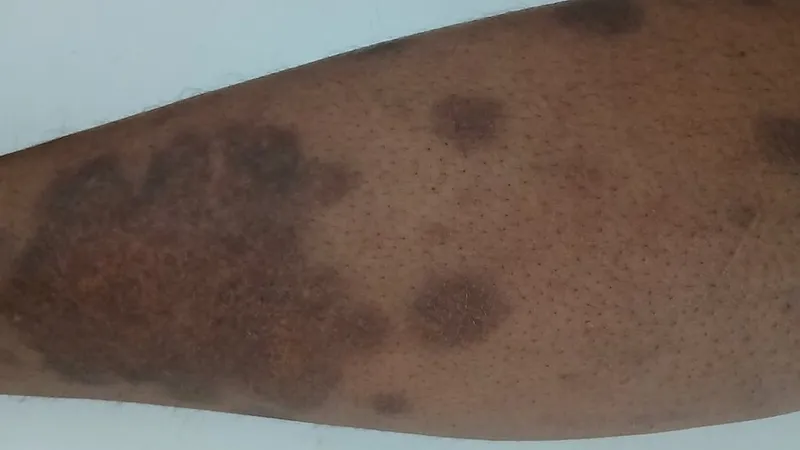
What changes on brown and dark skin is the color of the signal. Alexis and Blackcloud, writing on psoriasis in skin of color, describe the erythema as less conspicuous, noting plaques "may appear violaceous or hyperpigmented." On a dark scalp the plaque reads purple, gray-brown, or simply darker than the skin beside it, and the scale carries the diagnosis.
That scale is thick, dry, and silvery-white, sitting on a plaque with a hard border. StatPearls describes plaque psoriasis as erythematous plaques covered with silvery scales, and notes that forcibly lifting those scales produces pinpoint bleeding, the Auspitz sign. Under a dermatoscope, a systematic review of 45 studies found the most frequent trichoscopic feature of scalp psoriasis to be red dots and globules with twisted red loops.
Severity is the part that gets missed. A 2025 evidence-based update in the International Journal of Dermatology found plaque psoriasis prevalence lower in people with skin of color but "tends to be more severe," with less biologic treatment and worse quality-of-life impact. Alexis and Blackcloud, citing Shah and colleagues' analysis of a community-based etanercept trial, report greater quality-of-life impairment in African American and Hispanic patients even after controlling for percent body surface area affected and physician global assessment.
Scalp psoriasis, seborrheic dermatitis, or dandruff
Both conditions flake, so the flake alone tells you nothing. Three features separate them.
The scale and the border. StatPearls describes seborrheic dermatitis as folliculocentric salmon-colored papules and plaques with a fine white scale and a yellowish crust, "often described as a greasy scale-crust," fading into normal scalp with no wall. Psoriasis scale is dry, thick, and silvery, and it stacks on a plaque you can outline with a fingertip. Rub a flake: greasy and soft points to seborrheic dermatitis, dry and papery points to psoriasis.
Where on the scalp. StatPearls draws the map: psoriasis "tends to affect the occipital and frontal regions, whereas SD tends to affect the vertex and parietal regions." Front hairline and back of the head favors psoriasis, crown and sides favors seborrheic dermatitis.
What else is involved. Seborrheic dermatitis is a face-and-chest disease as much as a scalp one, involving the face in about 88 percent of cases and the chest in 27 percent, per StatPearls. Psoriasis sends you to the elbows, knees, and nails. Plaques there plus scalp scale is one diagnosis, not two.
Two honest complications. The conditions overlap, and StatPearls notes the existence of sebopsoriasis as a separate entity "has come into dispute." And itch does not settle it: StatPearls calls scalp psoriasis mostly nonpruritic in that comparison, yet nearly every participant in the VISIBLE scalp psoriasis trial entered with a scalp itch score of at least 4 on a 0 to 10 scale (97 of the 102 assessed at week 16).
If the flakes are greasy, the edges soft, and your eyebrows and the sides of your nose flake too, read our guide to seborrheic dermatitis and dandruff on Black skin. If plaques are showing up off the scalp, start with psoriasis on Black skin for the whole-body picture. For a child with thick scalp scale, add one more possibility: Silverberg's review names tinea capitis as common in Black and Hispanic children, and tinea needs an oral antifungal, not a steroid.
The wash-frequency collision, and how to get around it
Here is what generic scalp psoriasis advice gets wrong for textured hair. The standard regimen runs on medicated shampoo used daily or several times a week, and the AAD notes clobetasol propionate shampoo can be used safely every day for up to four weeks. If you wash weekly or every other week, that is not a treatment plan. It is a scheduling conflict.
Common skin conditions are treated in primary care, and community health centers charge on a sliding scale that is often $0. Our directory of free and charitable clinics lists verified centers by state. A same-day telehealth visit is self-pay and cannot be billed to Medicaid or commercial insurance, so the clinic route usually costs less. If you need a prescription sooner than the next appointment:
Affiliate
The literature says so plainly. Alexis and Blackcloud write that treatment including daily hair washing with a prescription shampoo "is often not a suitable option for African American female patients, as such frequent hair washing may cause hair dryness, breakage, and interference with usual hair styling, ultimately leading to noncompliance and patient dissatisfaction." They add, from clinical experience rather than trial data, that scalp psoriasis severity appears increased in women of African ancestry, likely because hair is washed less often. The VISIBLE trial opens on the same point: hair textures and hair care practices shape the presentation and management of scalp psoriasis.
Three moves fix the collision. Ask for each by name.
1. Change the vehicle, not the drug. Alexis reports from clinical experience that oils, oil-based suspensions, lotions, and emollient foams are generally the best suited vehicles for the majority of hair textures and styles in African American patients. Fluocinolone acetonide 0.01% scalp oil has randomized evidence behind it: in a double-blind vehicle-controlled multicenter trial over 21 days, signs of psoriasis improved in both arms, significantly more on the steroid oil. The vehicle alone helped too, because the emollient softens the stratum corneum, which is what a thick scalp scale needs.
2. Put medicated shampoo on your existing wash day, then maintain twice weekly. In the CalePso study, patients with moderate to severe scalp psoriasis used clobetasol propionate shampoo 0.05% once daily for up to four weeks, and those who responded were then randomized to the shampoo or its vehicle twice weekly for maintenance. Six months into that maintenance phase, 31.1 percent of the shampoo group were still relapse-free versus 8.1 percent on vehicle, with no greater incidence of skin atrophy, telangiectasia, or HPA-axis suppression. The AAD gives the same shape. A wash schedule can absorb twice weekly. It cannot absorb daily forever.
3. Treat the scalp, not the hair. The AAD's instruction is exact: "Lift your hair out of the way. This helps ensure that you apply the medicine to your scalp and not your hair." Part in rows, apply along the part, keep product off the lengths. That single change keeps a drying medicated product away from the hair shaft. Shampoo gently, since "rubbing, scrubbing, and scratching your scalp tend to make scalp psoriasis worse."
The treatment ladder, and what protects your pigment
Treatment is sequenced by scale thickness and how much scalp is involved.
Soften the scale first. Medicine cannot reach skin under a plate of scale. The AAD recommends a salicylic acid scale softener for thick, stubborn patches, used before the medicated product. Oils do double duty here.
Topical steroid in a vehicle you will use. Corticosteroids are the number one prescribed treatment for scalp psoriasis in children and adults, per the AAD, working quickly on redness, swelling, itch, and scale. The choice to negotiate is form, not molecule: fluocinolone 0.01% oil, an emollient foam, a lotion, or a short-contact shampoo, depending on your wash day.
Add a vitamin D analog. The 2025 psoriatic alopecia review lists topical corticosteroids, vitamin D analogs, and systemic biologics among its treatment strategies. The AAD describes calcipotriene, a lab-made form of vitamin D, applied to the scalp at bedtime, and a combination product pairing it with a strong corticosteroid when clearing needs help.
Escalate if the scalp does not clear. A stubborn scalp is a reason for systemic therapy, not a reason to keep buying shampoo. Cohort B of the VISIBLE trial enrolled 108 adults with skin of color and moderate to severe scalp psoriasis. At week 16, 68.4 percent on guselkumab reached a scalp-specific IGA of 0 or 1 versus 11.5 percent on placebo, and 57.9 percent reached complete clearance versus 3.8 percent. Hold that against the finding that people with skin of color are less likely to receive biologics, and ask directly whether you are a candidate.
The pigment strategy is treating inflammation early. Alexis and Blackcloud report that psoriasis plaques in skin of color "tend to resolve with hyper- or hypopigmented patches that may take 3 to 12 months to resolve depending on the severity and anatomic location." Along a part line, that mark is visible for most of a year after the plaque is gone. What shortens it is clearing the inflammation sooner and stopping the scratch-and-scrape cycle. Skin-lightening products belong nowhere near an inflamed scalp.
Hair shedding, dark marks, and how long each one lasts
Shedding after a flare frightens people more than the plaques do. The AAD's position is specific: hair tends to regrow once the scalp psoriasis clears. Much of the loss is mechanical, from scale removal taking hair with it, which is why the AAD's first instruction on hair loss is to comb and brush the scale away gently.
The limit on that reassurance is worth knowing. A 2025 review in Skin Appendage Disorders describes psoriatic alopecia as an underrecognized manifestation causing both non-scarring and scarring hair loss, driven by the Th17 and IL-23 axis, with sebaceous gland atrophy and, in severe cases, permanent alopecia. Scalp inflammation left running for years is not a cosmetic issue, and that is the argument for escalating rather than waiting it out.
The overlap with tension matters here too. If the loss is centered on the crown, has progressed for months, and does not recover after the plaques clear, ask specifically about central centrifugal cicatricial alopecia, which is scarring and time-sensitive. Our guide to CCCA and hair loss in Black women covers that workup. Chronic inflammation and tight styling stack on each other, and treating one leaves the other running.
Three timelines to hold: scale and itch improve within weeks on a topical steroid, and the AAD notes it is rare to suffer from scalp psoriasis for long once a dermatologist is involved. Shed hair regrows on the hair cycle, so months. Pigment change runs 3 to 12 months. A patch with no scale on it is healed skin waiting on pigment.
When to see a dermatologist
Book a visit when any of these is true:
- Over-the-counter shampoo has not cleared the scale after four weeks.
- The plaques are thick enough that product cannot reach the skin under them.
- You are shedding, or seeing a widening part or a thinning crown.
- You wash weekly or less and no one has offered you an oil, foam, or lotion.
- The scalp relapses within weeks of stopping treatment, which is the argument for a maintenance dose or a systemic drug.
- Plaques are also on your elbows, knees, or nails, or your joints ache, which raises psoriatic arthritis.
- It is a child with thick scalp scale, where tinea capitis has to be ruled out before any steroid.
Bring your wash schedule into the room and say the number out loud. "I wash every 10 days" changes the prescription, and a clinician who does not ask defaults to the daily-shampoo regimen Alexis and Blackcloud call unsuitable. Ask which vehicle fits your wash day, what the maintenance dose is between flares, and when you move to a systemic drug. You can find a Black dermatologist in our directory, along with clinicians who list a practice focus in skin of color and textured hair.
Frequently asked questions
How do I know if it is scalp psoriasis or dandruff? ▼
Feel the flake and feel the edge. Seborrheic dermatitis, the condition behind most dandruff, makes a greasy yellowish scale-crust on patches with soft, fading borders, and usually involves the face and chest too. Psoriasis makes dry silvery scale stacked on a plaque with a border you can trace. StatPearls adds a location clue: psoriasis tends to affect the occipital and frontal scalp, seborrheic dermatitis the vertex and parietal regions. Our guide to seborrheic dermatitis on Black skin covers the dandruff side.
What does scalp psoriasis look like on Black skin? ▼
Not salmon-pink. Alexis and Blackcloud describe erythema in skin of color as less conspicuous, with plaques that may appear violaceous or hyperpigmented, so the plaque reads purple, gray-brown, or simply darker than the skin around it. The reliable sign is thick dry silvery scale on a raised, sharply bordered patch, most often at the front hairline, behind the ears, or at the back of the head.
Can I treat scalp psoriasis if I only wash my hair once a week? ▼
Yes, with the right vehicle. Alexis reports from clinical experience that oils, oil-based suspensions, lotions, and emollient foams suit most textured hair types, and fluocinolone acetonide 0.01% scalp oil has randomized trial evidence. Save medicated shampoo for the days you already wash. In the CalePso study, clobetasol propionate shampoo 0.05% used twice weekly for maintenance kept 31.1 percent of responders relapse-free six months in, versus 8.1 percent on vehicle.
Does scalp psoriasis cause hair loss, and will it grow back? ▼
It can, and it usually grows back. The AAD states that hair tends to regrow once the scalp psoriasis clears, and that much of the loss comes from removing scale forcefully, which pulls hair with it. The exception: a 2025 review in Skin Appendage Disorders describes psoriatic alopecia as causing both non-scarring and scarring hair loss, with permanent alopecia in severe cases. Untreated long-running inflammation is the risk, so escalate rather than wait.
Why is my scalp darker where the plaques used to be? ▼
That is post-inflammatory pigment change, and it outlasts the disease. Alexis and Blackcloud report that psoriasis plaques in skin of color tend to resolve with hyper- or hypopigmented patches that may take 3 to 12 months to fade. A patch with no scale on it is healed skin. Skip lightening products and keep the inflammation controlled so you are not adding new marks on top of old ones.
Can I still get braids, a relaxer, or color with scalp psoriasis? ▼
Not during an active flare, and not tight. The AAD says pulling too tightly on the hair irritates the scalp and can cause a flare, and lists coloring, perming, and relaxing among flare triggers, with the advice to talk to your dermatologist first. The mechanism is the Koebner phenomenon: trauma induces psoriasis at that site. Once the scalp is clear and stays clear, revisit it with your dermatologist rather than assuming a permanent ban.