What stretch marks look like on Black skin
A stretch mark is a scar. The AAD defines it as a scar that forms when skin stretches or shrinks fast enough to rupture the collagen and elastin holding it together. StatPearls describes the same event at tissue level: elastolysis in the mid-dermis, then dermal atrophy leaving streaks perpendicular to the pull. A stretch mark sits in the skin, not on it. Prevalence runs 43 to 88 percent in pregnancy, 6 to 86 percent in puberty, and 43 percent in obesity.
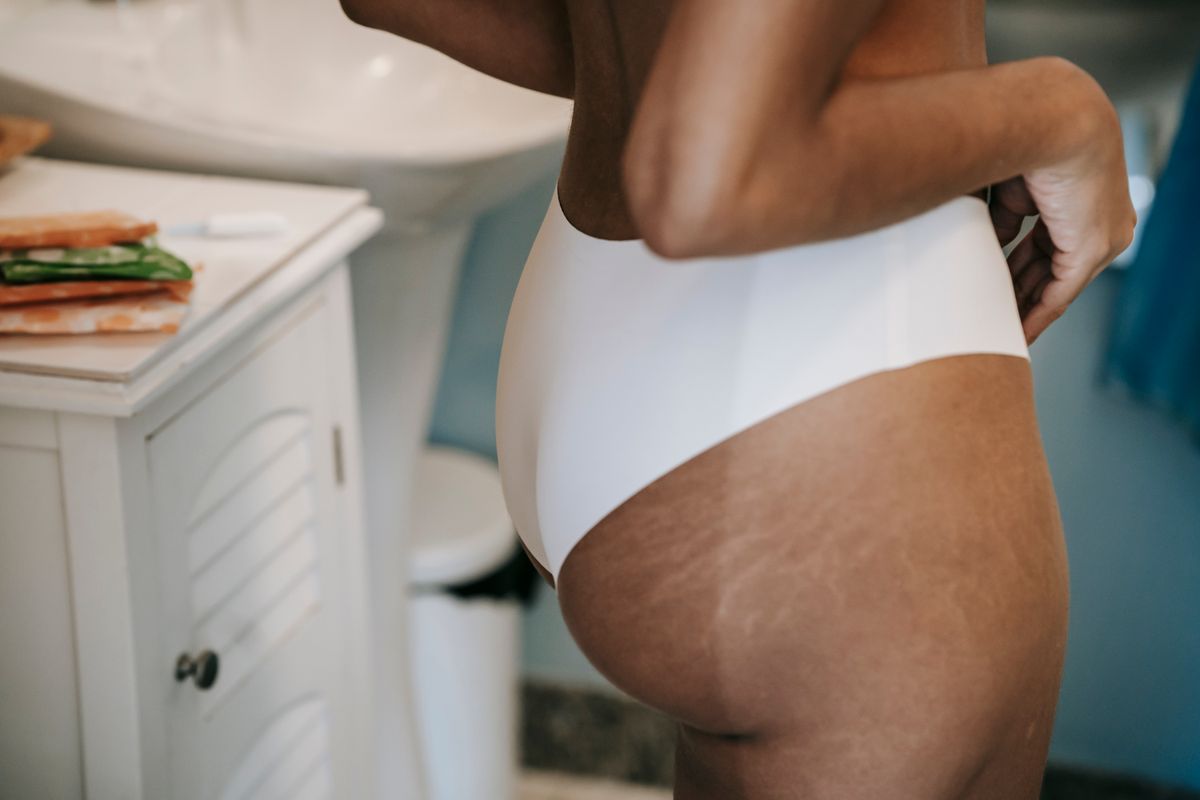
The color sequence is where generic advice stops matching the mirror. The textbook line, and the one StatPearls uses, is that striae start pink to violaceous (striae rubrae) and fade over months to years into hypopigmented, atrophic scars (striae albae). The AAD writes it more carefully: new stretch marks tend to be red, purple, pink, reddish-brown, or dark brown, depending on your skin color. Reddish-brown and dark brown are what most Black readers see, and the pink-to-silver summary leaves them out.
The dark variant has a measurement behind it. Hermanns and Pierard ran high-resolution epiluminescence colorimetry on striae in 2006 and separated four distinct types: striae albae, striae rubrae, striae caeruleae (dark blue), and striae nigrae, the hyperpigmented type, identified in dark-skinned subjects. StatPearls carries striae nigra and striae caerulea in its classification and cites the same work for a useful detail: dermoscopy shows increased melanization inside early striae and decreased melanization inside mature ones.
The best data on how Black women's striae present is recent. Elbuluk and colleagues published a two-part study in Archives of Dermatological Research in 2025: 143 women surveyed (75 Black, 68 White) and 66 assessed in person with standardized photographs. The two groups were similar in age, striae duration, parity, pregnancy-associated weight gain, and family history. Black women averaged more stretch marks, 118 versus 76 (P = 0.01). Their striae were typically white and skin-colored, while White women's were white and violaceous, and Black women more often had marks on the buttocks, lower legs, and axilla.
Put the two together. Early striae on Black skin often read dark; mature ones read pale or skin-colored, not silvery. Mature hypopigmented striae are the hardest to treat: no redness left for a vascular laser to target, no active remodeling left for a topical to influence. If your marks are still dark or red, you are inside the window where the creams have evidence. If they are pale and slightly sunken, that window has closed and what is left are the in-office procedures further down this page.
What else those lines could be
Post-inflammatory hyperpigmentation. Dark marks left by acne, eczema, friction, or a healed rash are flat, trace the shape of whatever came before them, and clear on their own given time. Stretch marks are linear bands that run perpendicular to the stretch, sit slightly above or below the skin surface, and never clear completely. Our guide to dark spots and hyperpigmentation on Black skin covers what fades them, and it matters twice here: every procedure below can cause post-inflammatory hyperpigmentation.
Keloid or hypertrophic scar. Opposite direction. Striae are atrophic, so the skin sits lower; keloids are raised, firm, and extend past the original injury. See our guide to keloid scars on Black skin.
An endocrine cause. StatPearls instructs clinicians that when striae are widespread with no obvious cause, they should take a full history and examine the patient, because striae can signal Cushing syndrome. Prolonged potent corticosteroids do it too, as do Marfan and Ehlers-Danlos syndromes. Wide purple striae with no pregnancy, weight change, or growth spurt is a reason to be examined, not to buy a cream.
Cocoa butter: two randomized trials, no prevention
Osman and colleagues published the earlier of the two in BJOG in 2008: a multicentre, double-blind, randomized, placebo-controlled trial in Beirut and Tripoli, Lebanon. Nulliparous women presenting in the first trimester were randomly assigned to a lotion containing cocoa butter or a placebo lotion, applied daily until delivery. Of 210 women enrolled, 175 completed the study. Stretch marks developed in 45.1 percent on cocoa butter and 48.8 percent on placebo (P = 0.730), with no difference in severity, and the result held when baseline stretch marks and compliance were taken into account.
The second trial matters most here. Buchanan, Fletcher, and Reid, at the University Hospital of the West Indies in Kingston, Jamaica, randomized 300 pregnant women, 150 per arm, to cocoa butter cream or a placebo cream, following them from 16 weeks of pregnancy to delivery. Striae developed in 44 percent on cocoa butter versus 55 percent on placebo, which did not reach significance (chi-squared 2.8, df 1, P = 0.09). Their stated conclusion: cocoa butter cream does not prevent striae gravidarum. That Afro-Caribbean cohort produced something more useful than the cream, that striae tracked with young maternal age and large babies and not with body mass index.
Whatever brought you to this page, community health centers see patients regardless of insurance and charge on a sliding scale that is often $0. Our directory of free and charitable clinics lists verified centers by state. A same-day telehealth visit is self-pay and is not billed to Medicaid, so if you have Medicaid the clinic route will usually cost less. If you would rather see a clinician online today:
Affiliate
Be precise. Neither trial proves cocoa butter does nothing, and the Jamaican trial's 11-point gap could be real with the study underpowered to see it. What 510 randomized women establish is that there is no evidence cocoa butter prevents stretch marks. Ud-Din, McGeorge, and Bayat found cocoa butter and olive oil demonstrated no effect, and the AAD reports that almond oil, cocoa butter, olive oil, and vitamin E neither faded marks nor prevented them. Al-Himdani and colleagues, reviewing the same field for the British Journal of Dermatology, concluded that topical agents appear to lack efficacy in preventing striae. The 2012 Cochrane review is the ceiling: it included six trials and 800 women, and the pooled comparison of active topicals against placebo or no treatment (five trials, 474 women) gave an average risk ratio of 0.74 (95 percent CI 0.53 to 1.03), with the authors finding no high-quality evidence to support any topical for prevention.
What actually has evidence for prevention
Centella asiatica and hyaluronic acid. Ud-Din and colleagues found only two products in the topical literature reached level-2 evidence for prophylactic use: Trofolastin, containing Centella asiatica extract, and Alphastria, containing hyaluronic acid. The AAD names the same two, and Farahnik reached the same shortlist plus daily massage.
Massage, and the study that isolated it. Timur Tashan and Kafkasli followed 141 first-time mothers in Turkey in three groups: bitter almond oil with a 15-minute massage, bitter almond oil alone, and no treatment. Stretch marks developed in 20 percent of the massage group, 38.8 percent of the oil-only group, and 41.2 percent of controls. The oil alone did nothing; the massage moved the number. One limit belongs with that: it was a posttest-only quasi-experimental design, not a randomized trial.
What you cannot change, and what you can. Farahnik names younger age, maternal and family history of striae gravidarum, increased pre-pregnancy and pre-delivery weight, and increased birth weight as the most significant risk factors. Most of that is fixed before you start. StatPearls adds the modifiable end: gradual rather than rapid weight change, and caution with corticosteroids, a documented cause of striae prescribed without anyone mentioning it.
The treatment ladder, and what is safe on Fitzpatrick IV to VI skin
Topicals only have evidence on early marks; the procedures below are what is left once marks turn pale. The 2026 systematic review by Algarra Sahuquillo and Martin-Gorgojo in Actas Dermo-Sifiliograficas evaluated 69 articles and concluded that current evidence does not allow a single best treatment to be defined, that some of the work is low quality with small samples, and that combining treatments helps results.
Step 1: topical tretinoin, early marks only, and never during pregnancy. Tretinoin is contraindicated in pregnancy, so this step does not start until after delivery, and the AAD extends the caution through breastfeeding. Kang and colleagues randomized 22 patients with early, clinically active stretch marks to 0.1 percent tretinoin cream (n = 10) or vehicle (n = 12) daily for six months, double-blind. At six months, 8 of 10 tretinoin patients had definite or marked improvement versus 1 of 12 on vehicle (P = .002). Treated marks shrank 14 percent in length and 8 percent in width; untreated marks grew 10 percent and 24 percent. The 2026 review adds glycolic acid as a second topical with demonstrated improvement in recent marks.
Two hard limits. That pregnancy contraindication rules tretinoin out during exactly the months striae gravidarum are new and most treatable, which is the hard timing of this drug. Second, StatPearls lists irritation, redness, and peeling as its side effects, and on Fitzpatrick IV to VI skin that inflammation is the mechanism of post-inflammatory hyperpigmentation. Ask your prescriber about starting a few nights a week and building up rather than going nightly from day one.
Step 2: microneedling, the procedure with the lowest documented pigment risk. Naspolini and colleagues randomized 20 women with Fitzpatrick skin type III or IV to microneedling versus a 1340 nm non-ablative fractional laser on opposite halves of the same abdomen, five sessions a month apart, with biopsies. Patients reported improvement of striae alba with both, with no significant difference between them, and biopsies showed significant increases in collagen and elastic fibers with both. Their conclusion: both are safe for treating striae, particularly in phototypes III and IV, and microneedling is a low-cost alternative needing no laser platform. It hurt more, a mean 5.2 versus 2.4 on a visual analog pain scale.
The pigment-safety case is stronger still. Mustafa and colleagues meta-analyzed six randomized trials of 166 patients comparing fractional CO2 laser against microneedling in 2025. More than 70 percent improved with either, with no significant difference in improvement or in patient satisfaction. The difference was in harm: the CO2 group carried a relative risk of post-inflammatory hyperpigmentation of 8.37 (95 percent CI 1.42 to 49.44, P = 0.02), and the authors named microneedling the safer option on that basis. Two limits belong with the number. The interval is wide, from 1.42 to 49.44, so read 8.37 as a direction rather than a precise multiple. And a pooled estimate averaged across six trials is not a measurement taken in Fitzpatrick IV to VI skin, so treat it as a general pigment-risk signal rather than a number about Black skin specifically.
Step 3: lasers, and only the pigment-safe ones. StatPearls is explicit that in darker skin types, light and laser therapies carry a higher risk of transient post-inflammatory hyperpigmentation and persistent hypopigmentation, and that non-ablative devices are safer than ablative ones. Persistent hypopigmentation is the outcome to fear: mature striae are already hypopigmented, and a device that lightens the skin around them widens the contrast you paid to reduce.
The devices with published results in dark skin are non-ablative and fractional. Kaewkes and colleagues treated 20 volunteers with Fitzpatrick IV to V skin and striae alba using a fractional 1064 nm picosecond laser, four sessions four weeks apart. At six months, investigators rated 90 percent moderately to markedly improved and 2 of 20 (10 percent) developed transient post-inflammatory hyperpigmentation. Park, Roberts, and Tung reported on a 1550 nm erbium-doped non-ablative fractional laser for striae in Fitzpatrick IV to VI, and Farahnik puts non-ablative fractional lasers at 50 to 75 percent improvement in treated striae. Intense pulsed light is a different proposition: its energy is absorbed by melanin, which is exactly what you do not want targeted in Fitzpatrick IV to VI skin.
What to expect, on a real timeline
Topicals are slow. In the Kang trial the tretinoin group separated from vehicle at two months and the 8-in-10 figure came at six months of daily use. Procedures are a course, not an appointment: Naspolini used five monthly sessions, Kaewkes four sessions four weeks apart with texture still improving at six months. Budget for the full course, since a partial course of a fractional device on dark skin buys the inflammation without the remodeling. The ceiling stays where the AAD put it: stretch marks are permanent, and treatment makes them less noticeable. Tanning is not a shortcut: the AAD says it cannot get rid of stretch marks and makes them more noticeable, because striae do not tan.
When to see a dermatologist
Most stretch marks need no medical care. Book a visit when:
- Striae are widespread and nothing explains them. StatPearls treats that as a reason to rule out Cushing syndrome.
- You are on long-term corticosteroids and new striae are appearing.
- The marks are still red or still dark. This is the treatable window, and it closes.
- You want a procedure. Microneedling and fractional lasers on Fitzpatrick IV to VI skin belong with someone who documents settings and photographs results at six and twelve months.
- A product has cost you months or real money with no result. The AAD says in-office procedures beat creams and gels.
- The marks are changing how you dress. StatPearls names reduced self-esteem and body image dissatisfaction as genuine complications.
One connection worth raising if you have given birth. A 2024 meta-analysis in the International Urogynecology Journal pooled seven studies (605 patients, 660 controls) and found a pooled odds ratio of 2.08 for pelvic organ prolapse in women with striae (95 percent CI 1.04 to 4.19). Heterogeneity was high at 80 percent, so this is an association between two conditions that plausibly share a connective-tissue mechanism, not a screening test. Raise it if you also have leaking, heaviness, or pressure after delivery; our guide to pelvic floor therapy after childbirth covers it.
Bring photographs from when the marks first appeared, because a clinician cannot recover the early-versus-mature distinction from today's skin. Ask two questions: are these still early enough to treat, and what is the pigment risk of what you are proposing on my skin. You can find a Black dermatologist in our directory, along with clinicians who list a practice focus in skin of color.
Frequently asked questions
Do stretch marks ever go away on Black skin? ▼
No. The AAD is direct that stretch marks are a type of scar and, like any scar, are permanent. They fade over months to years, and treatment speeds that fading. Any clinic promising removal is overselling.
Does cocoa butter prevent stretch marks? ▼
There is no evidence that it does. Two randomized double-blind placebo-controlled trials enrolled 510 pregnant women between them. Osman and colleagues found stretch marks in 45.1 percent on cocoa butter versus 48.8 percent on placebo (P = 0.730). Buchanan and colleagues, in 300 women in Jamaica, found 44 percent versus 55 percent, not significant (P = 0.09), and concluded cocoa butter cream does not prevent striae gravidarum. It is a good moisturizer, not prevention.
Why are my stretch marks darker than the rest of my skin? ▼
That is what early striae often look like on skin with more melanin. The AAD says new stretch marks appear red, purple, pink, reddish-brown, or dark brown depending on skin color. Colorimetry by Hermanns and Pierard separated a hyperpigmented type, striae nigrae, in dark-skinned subjects, and dermoscopy shows increased melanization inside early striae. Dark usually means recent, the phase where treatment has the most evidence.
What is the best stretch mark treatment for dark skin? ▼
For marks still red or dark, topical tretinoin has the strongest randomized evidence: 8 of 10 patients improved definitely or markedly over six months versus 1 of 12 on vehicle. It is contraindicated in pregnancy. For marks already pale, microneedling has the best pigment-safety case, since a 2025 meta-analysis of six trials found it matched fractional CO2 laser for improvement while CO2 carried a relative risk of post-inflammatory hyperpigmentation of 8.37 (95 percent CI 1.42 to 49.44).
Is microneedling safe on Black skin? ▼
The published evidence supports it, though the strongest trial stops at Fitzpatrick IV. A randomized split-abdomen study in Fitzpatrick III and IV skin found microneedling and a non-ablative fractional laser equally effective and both safe, with biopsy-confirmed increases in collagen and elastic fibers, and a 2025 meta-analysis found microneedling caused far less post-inflammatory hyperpigmentation than fractional CO2 laser. It still needs a clinician who tests a small area first.
Can I use tretinoin or retinol on stretch marks while pregnant? ▼
No. Tretinoin is contraindicated in pregnancy, and the AAD extends the caution to breastfeeding, advising anyone pregnant or nursing to check with a doctor first because some products contain retinol that can harm a baby. What remains is centella or hyaluronic acid cream applied with a daily massage, then treatment after delivery and weaning.