Bumps that follow a workout come from one of three causes: bacterial folliculitis from Staphylococcus aureus, Malassezia folliculitis from a yeast that already lives on everyone's skin, or acne mechanica from gear pressing on hot, sweaty skin. They look alike and they need different treatment. The bacterial kind clears with an antibacterial wash. The fungal kind gets worse on antibiotics and clears on antifungals. Acne mechanica clears when the friction stops. Guessing wrong costs weeks, and on Black skin every one of those weeks adds pigment to the mark left behind.
Three causes, three different treatments
Bacterial folliculitis is the most common form and usually comes from Staphylococcus aureus, including methicillin-resistant strains. It sits as pustules directly on hair follicles, most often on the thighs, buttocks, chest, and beard line. Frequent shaving, wet workout clothes, obesity, diabetes, immunosuppression, and long antibiotic courses all raise the risk. Clinicians treat mild cases with topical mupirocin or clindamycin and deeper infection with oral cephalexin or dicloxacillin (Winters and Mitchell, StatPearls, 2023).
Malassezia folliculitis, long called Pityrosporum folliculitis, is a yeast overgrowth inside the follicle and the one most often mistaken for acne. In a review of 110 confirmed cases, more than 75% of patients had acne that had recently been treated with antibiotics and 65% reported itching. The lesions were 1 to 2 mm, uniform in size, along the forehead into the hairline and across the upper back (Prindaville et al., Journal of the American Academy of Dermatology, 2018). A 2025 review reports 71% of patients named sweating as an aggravating factor (Chalupczak and Lipner, Journal of Fungi, 2025). Acne is a mix of lesion types. This is one bump repeated, and it itches.
Acne mechanica comes from pressure, friction, heat, and occlusion rather than infection (Basler, Cutis, 1992). Backpack straps, sports bras, weight benches, helmet padding, and compression gear produce it in the shape of whatever pressed there. Skin-on-skin friction at the inner thighs does the same (Mazhar et al., Pediatric Dermatology, 2019). It fades once the pressure and trapped heat stop, which is why most athletes clear at the end of a season.
How to tell them apart
- Bacterial: pustules of differing sizes ringing follicles, sore rather than itchy, sometimes crusted, on thighs, buttocks, chest, or beard line.
- Malassezia: 1 to 2 mm bumps all the same size, itchy, on the upper back, chest, shoulders, and hairline, no comedones, flared after an antibiotic or a heat wave.
- Acne mechanica: maps to where equipment pressed, little itch, better on rest days.
- Hot tub rash: 12 to 48 hours after a hot tub or pool, worst under the swimsuit line (American Academy of Dermatology).
- Heat rash: miliaria is blocked sweat ducts, not follicles. It comes up in heat and settles with cooling and breathable clothing (Guerra et al., StatPearls, 2024).
What these bumps look like on dark skin
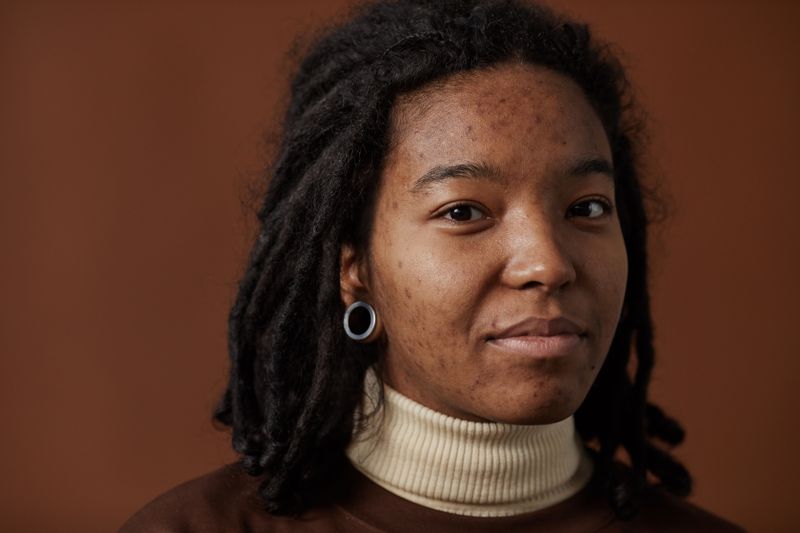
Erythema is often less noticeable in darker skin (Ohanenye, Taliaferro, and Callender, Dermatologic Clinics, 2023). The ring of redness clinical texts use to describe folliculitis can read as almost nothing, so the eruption gets called razor irritation or dry skin and goes untreated for months. Judge by what you can feel: a rough, seeded texture over the follicles, tenderness or itch, and whether the pattern follows sweat, gear, or the hairline.
The mark is the part that lasts. Post-inflammatory hyperpigmentation develops after skin inflammation, occurs more commonly in people with darker skin, and is often more distressing than the eruption that caused it (Kaufman, Aman, and Alexis, American Journal of Clinical Dermatology, 2018). Squeezing a bump drives the inflammation deeper and darkens the spot. Treating the eruption in week one is cheaper than treating pigment in month six.
Common skin conditions are treated in primary care, and community health centers charge on a sliding scale that is often $0. Our directory of free and charitable clinics lists verified centers by state. A same-day telehealth visit is self-pay and cannot be billed to Medicaid or commercial insurance, so the clinic route usually costs less. If you need a prescription sooner than the next appointment:

Sesame Care
An online visit with a licensed clinician for a prescription skincare treatment plan. The Skincare Rx program starts at $59 per month, shown before you sign up (checked August 2026).
Start a skincare consultAffiliate link, we may earn a commission at no extra cost to you.
The treatment ladder
Start with a benzoyl peroxide wash. The 2024 American Academy of Dermatology acne guideline strongly recommends topical benzoyl peroxide and recommends against topical antibiotic monotherapy because of resistance (Reynolds et al., Journal of the American Academy of Dermatology, 2024). Lather it into the chest, back, shoulders, or buttocks, leave it about a minute, rinse. It bleaches fabric, so use white towels.
If it itches and every bump is the same size, switch to an antifungal. Ketoconazole shampoo was the most common treatment in that 110-case series and improved or resolved most patients (Prindaville et al., 2018). Used as a body wash it goes on the area, sits a few minutes, then rinses. Prescription options include ketoconazole 2% cream twice daily for one to one and a half months, oral itraconazole 200 mg daily for 7 to 14 days, or oral fluconazole 200 mg daily for one to two weeks. About 25% of people relapse within four months, so many keep the wash once or twice a week after clearing (Chalupczak and Lipner, 2025).
Escalate when self-care stalls. The Academy's threshold for an acne-type eruption that has not budged is 6 to 8 weeks. Ask for a potassium hydroxide preparation from a pustule: it takes minutes in the office and separates yeast from bacteria instead of leaving you to guess.
Hot tub rash is its own thing
Pseudomonas folliculitis appears 12 to 48 hours after a poorly maintained hot tub or pool and is worst where a swimsuit held contaminated water against the skin (American Academy of Dermatology; Centers for Disease Control and Prevention). It is self-limited: this form typically resolves within 7 to 10 days with good hygiene, and antibiotics are held for cases that do not settle (Winters and Mitchell, 2023; Yu et al., Journal of the American Academy of Dermatology, 2007). CDC prevention is specific: take the suit off and shower with soap right after getting out, wash the suit, and use test strips to check disinfectant and pH before getting in.
Prevention that changes the outcome
- Change and shower immediately after exercising, not after the drive home (American Academy of Dermatology).
- Moisture-wicking fabric next to skin, looser fit, and clean soft padding between equipment and skin where gear has to press.
- Wash the swimsuit or wetsuit after every use and dry it fully.
- Do not share towels, washcloths, or razors. MRSA survives on towels, razors, and surfaces for hours to weeks, which is why the CDC tells athletes to cover cuts and keep personal items personal.
- Own your clipper guards. In a survey of 1,003 men in Ibadan, Nigeria, 41.9% believed shaving bumps came from barbers' instruments, and the authors flagged men bleeding during haircuts without owning personal shaving kits (Ogunbiyi and Adedokun, British Journal of Dermatology, 2015). Bring your own blades or use a shop that sterilizes in front of you.
- Move heavy product off the skin edge. Malassezia folliculitis concentrates on the forehead into the hairline, exactly where thick pomades and oils sit. Keep product on hair only for two weeks and watch what happens.
When it is not folliculitis
Recurring painful lumps in the armpits, groin, buttocks, or under the breasts are hidradenitis suppurativa. HS makes deep nodules and abscesses that drain, tunnel, and scar in the same places, and no antibacterial wash touches it. Prevalence among Black individuals in the United States is about 296 per 100,000, Black patients wait an average of 4.8 years for the diagnosis, and roughly 5 years pass between first presentation and seeing a dermatologist (Negbenebor and Riley, Dermatology and Therapy, 2025). Those years are the disease progressing while it is called boils. Read our guide to hidradenitis suppurativa on Black skin.
Bumps confined to the beard line are pseudofolliculitis barbae. The cut hair re-enters the skin and the body treats it as a foreign body, leaving painful, itchy, often hyperpigmented papules in people with tightly curled hair who shave or tweeze (Perry et al., Journal of the American Academy of Dermatology, 2002). In a randomized study of 90 Black men, those shaving 2 to 3 times a week ended up with significantly fewer ingrown hairs than those shaving daily (Daniel et al., Journal of Drugs in Dermatology, 2013). See razor bumps on Black skin.
Firm bumps and keloid-like plaques at the nape are acne keloidalis nuchae. It is the most common scarring alopecia in men of African descent, with reported prevalence from 1.6% to 16.1%, fed by trauma, ingrown hairs, and secondary infection (Ogunbiyi and Adedokun, 2015). Scarred follicles do not grow back, so this one goes to a dermatologist early rather than to a closer clipper.
How to get care for this
Photograph the area in daylight before the visit, because these eruptions calm down in a waiting room and the photo is the evidence. Bring three facts: when it started, what you have tried and for how long, and whether you took an antibiotic in the months before it appeared. Ask for a potassium hydroxide preparation if the bumps itch and are uniform, ask which of the three causes you are being treated for, and ask what the plan is for the dark marks. You can find a Black dermatologist in our directory by city and specialty.
Frequently asked questions
Why do I break out on my back and butt after the gym? ▼
Sweat trapped under tight clothing plus friction from benches, straps, and waistbands inflames the follicles. If the bumps map to where gear pressed, it is acne mechanica: moisture-wicking fabric, a looser fit, and changing immediately after exercise handle it. If they are itchy and identical in size across the upper back, try an antifungal wash before another acne product.
How do I know if my bumps are fungal instead of acne? ▼
Every bump is the same size, they itch, and no blackheads or whiteheads are mixed in. Recent antibiotics make it more likely: in a series of 110 confirmed cases, more than 75% of patients had been treated with antibiotics for acne shortly before. A potassium hydroxide preparation confirms it in minutes.
Does benzoyl peroxide wash work on folliculitis? ▼
It is the first step for the bacterial kind, and the 2024 American Academy of Dermatology acne guideline strongly recommends topical benzoyl peroxide while advising against a topical antibiotic on its own. It does nothing for Malassezia folliculitis, so if two to three weeks changes nothing on itchy uniform bumps, that is your answer.
Can I use ketoconazole shampoo as a body wash? ▼
Yes. It was the most common treatment in the published case series for Malassezia folliculitis and improved or resolved most cases. Apply to the affected skin, leave a few minutes, rinse. Relapse runs about 25% within four months, so many people keep using it once or twice a week after clearing.
Are heat bumps and folliculitis the same thing? ▼
No. Heat rash, or miliaria, comes from blocked sweat ducts rather than inflamed hair follicles, and miliaria rubra involves the follicles minimally. It settles with cooling, breathable clothing, and removing anything occlusive. Folliculitis is centered on the follicle, often carries pustules, and does not clear just by cooling off.