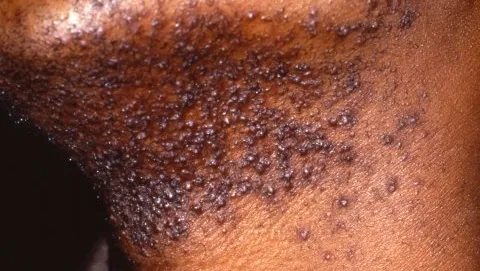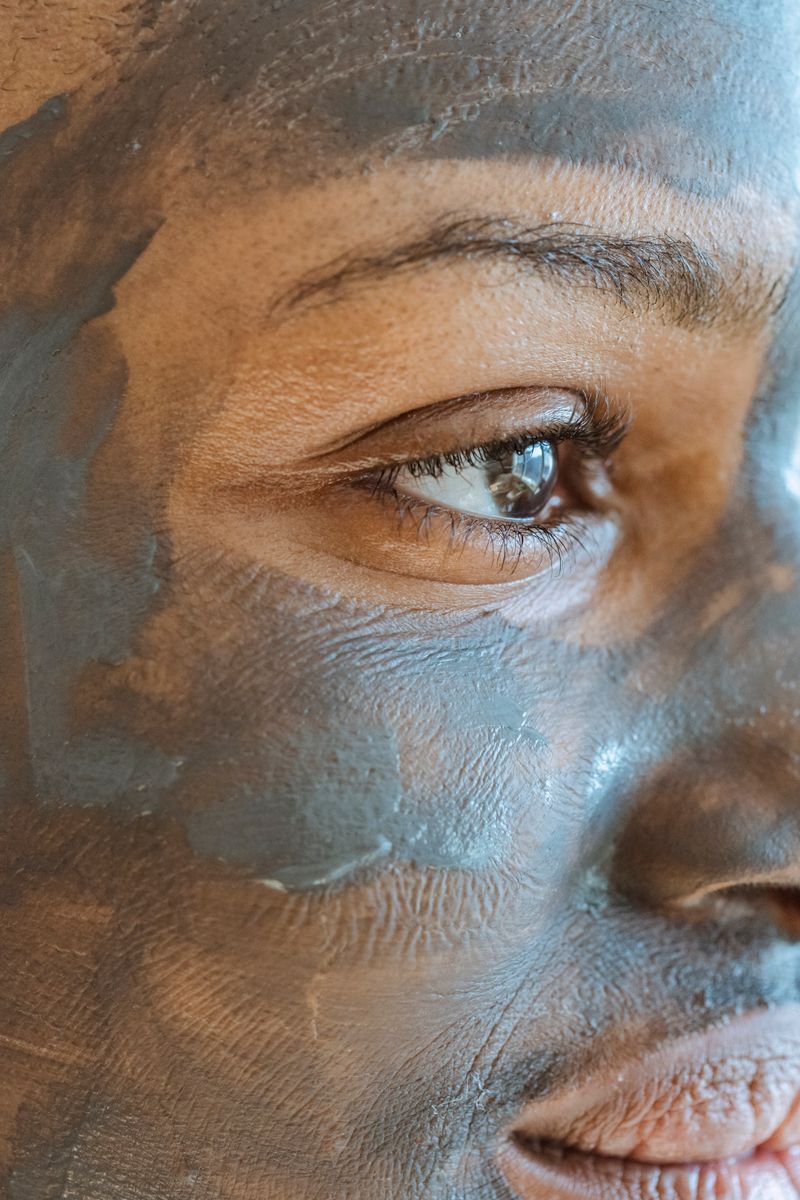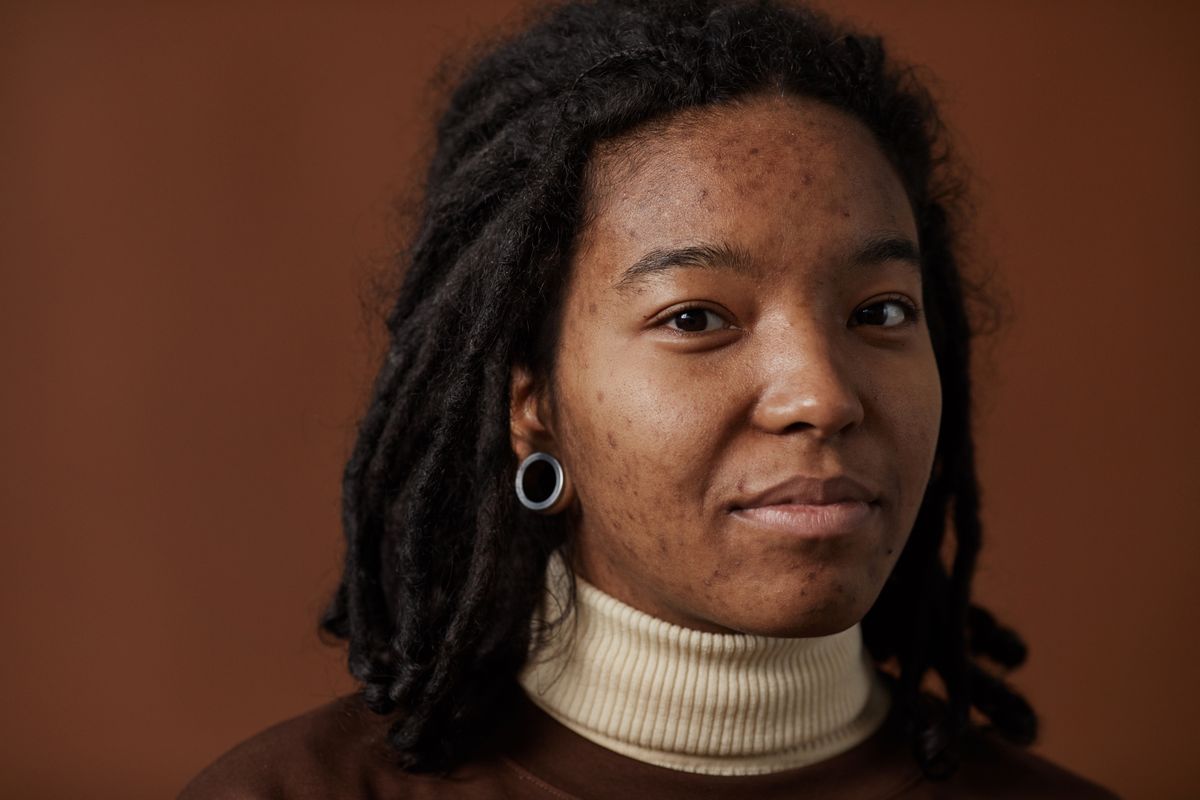
Acne is a disease of the hair follicle and its oil gland: the pore plugs, oil and Cutibacterium acnes build up behind the plug, and the follicle wall inflames. That process is the same on every skin tone. What changes on brown and black skin is what the inflammation leaves behind. Each inflamed lesion tells the pigment cells at the base of the follicle to overproduce, and the flat brown or slate-gray mark that results outlives the pimple by months. Ask most Black patients what bothers them about their acne and they will point at the marks, not the bumps.
The mark outlives the pimple
A 2011 study photographed and graded the faces of 2,895 women across five ethnic groups. Clinical acne was found in 37% of the African American women, compared with 32% of Hispanic, 30% of Asian, 24% of Caucasian, and 23% of Continental Indian participants. The gap in the aftermath was much wider: hyperpigmentation was present in 65% of the African American women, 48% of Hispanic, 25% of Caucasian, 18% of Asian, and 10% of Continental Indian. Dyspigmentation and atrophic scarring were both more common in the African American and Hispanic groups than in any other. The authors' conclusion was that acne is a more heterogeneous condition than previously described and that treatment has to be tailored to skin color.
Dermatologists have measured the same thing from the clinic side. A 2002 review from the Skin of Color Center in New York, drawing on a survey of its own acne patients, documented that acne in skin of color differs clinically and histologically from acne in white patients and that response to the same therapies varies. A review of post-inflammatory hyperpigmentation in skin of color found that dyschromias are among the most common reasons darker-skinned patients seek dermatologic care at all, and that treatment of the pigment has to begin with control of the condition that caused it. A 2022 expert panel on racial and ethnic variation in acne put it plainly: post-inflammatory hyperpigmentation can frequently be the most bothersome aspect of acne for patients with richly pigmented skin. That is the practical test for any plan you are handed. If it counts pimples and says nothing about pigment, it is answering half the question.
What acne looks like on Black skin
Melanin absorbs the red wavelengths that make inflammation obvious on light skin. An inflamed papule that would look bright red on a white face reads dark brown, dusky, or violet on a dark one. Two things follow. Severity gets underestimated, both by a clinician scanning for redness and by you in the mirror. And the lesion that looks like it is already healing to a brown spot is often still active underneath.
Three things sit on the skin at once and get treated as one problem. Learn to sort them by touch and light rather than color:
- An active lesion is raised and usually tender. Your fingertip catches on it. This is what acne medication treats.
- A post-inflammatory mark is flat. Your fingertip runs straight over it. It cannot be popped, it will not respond to benzoyl peroxide, and it is what most people are actually looking at when they say their acne is not clearing.
- A scar is a change in texture, not color: a depression, a pit, or in some cases a raised firm nodule. Scars do not fade on their own and need procedural treatment.
Photograph your face in daylight near a window rather than under a phone flash, which flattens tone and hides both the marks and the depressions. Bring those photos to an appointment.
Location matters too. Breakouts clustered along the jawline and lower cheeks in an adult woman raise a hormonal question. Bumps that follow the hairline, temples, and forehead edge point at hair products. Firm bumps at the nape and the back of the scalp are a separate condition with a separate clock, described below.
What acne gets mistaken for
Razor bumps. Pseudofolliculitis barbae lives on the beard area, jawline, and neck, and each bump centers on a hair that curled back into the skin. It responds to shaving technique, hair-removal choices, and prescription topicals, and it does not respond to an acne regimen. Read razor bumps on Black skin for that workup.
Acne keloidalis nuchae. Firm papules and pustules on the nape and occipital scalp that fuse into keloid-like plaques and destroy the follicles under them. The name says acne; the outcome is scarring alopecia, and time spent treating it as ordinary acne is time the follicles do not get back. See acne keloidalis nuchae for the distinction.
Hidradenitis suppurativa. Recurrent painful nodules, abscesses, and tunnels in the armpits, groin, buttocks, or under the breasts. It is sometimes called acne inversa, which misleads patients and clinicians alike. Our guide to hidradenitis suppurativa on Black skin covers it.
Old marks, not new acne. Flat brown patches where breakouts used to be are post-inflammatory hyperpigmentation. Escalating acne medication because of them does nothing but irritate the skin. The ingredient-by-ingredient plan for fading them is in how to fade dark spots and hyperpigmentation on Black skin.
Pomade acne: the breakouts that follow your hairline
Pomade acne was named and described in 1970 by Plewig, Fulton, and Kligman in the Archives of Dermatology, and reported again in Black skin in a 1974 letter to the same journal. It has been in the literature for half a century and is still missing from most general acne advice, which is why people cycle through face washes for a problem their hair products are creating.
Common skin conditions are treated in primary care, and community health centers charge on a sliding scale that is often $0. Our directory of free and charitable clinics lists verified centers by state. A same-day telehealth visit is self-pay and cannot be billed to Medicaid or commercial insurance, so the clinic route usually costs less. If you need a prescription sooner than the next appointment:
Affiliate
The mechanism is simple. Oil in a shampoo, conditioner, gel, wax, grease, or edge control migrates onto the skin it touches and plugs those pores. The American Academy of Dermatology calls the general category acne cosmetica and describes the result as whiteheads and small flesh-colored papules along the hairline, upper forehead, and back of the neck, sometimes subtle enough that you feel them before you see them. The distribution is the tell: a band that traces exactly where product sits, with the center of the face relatively clear.
What actually works, in order:
- Apply oils and pomades to the hair shaft, not to the scalp edge, the hairline, or the nape.
- Wipe the hairline and the back of the neck with a gentle cleanser after styling.
- Wash what your head touches: pillowcases, bonnets, durags, scarves, headbands, hats, and helmet padding. Product residue transfers back.
- Read labels for non-comedogenic, oil-free, or will-not-clog-pores. Shaving creams, aftershaves, and sprays count as products too.
- Give it 4 to 6 weeks after the product stops touching skin. That is how long the AAD says clearing takes. If it has not cleared by 6 weeks, see a dermatologist rather than adding more actives.
None of this is an argument against protective styles, oils, or the way you wear your hair. The target is the product sitting on skin, not the style.
The treatment ladder, weighted for pigment risk
Start over the counter if your acne is comedones plus a handful of inflamed lesions. Three ingredients carry the load. Adapalene 0.1% gel is a retinoid available without a prescription; retinoids clear plugged follicles and, as a class, also lighten existing pigment. Benzoyl peroxide at 2.5% to 5% kills the bacteria; the AAD's 2024 acne guideline gives it a strong recommendation, and higher percentages mostly buy irritation. It bleaches towels and pillowcases, so keep white linens on the bed. Azelaic acid is the pick when pigment is the main complaint.
Azelaic acid is the one ingredient that treats both halves of the problem. It is comedolytic and antibacterial, and it inhibits tyrosinase, the enzyme that drives melanin production. In a randomized, double-blind, placebo-controlled trial of 72 patients with mild to moderate acne, 15% azelaic acid gel applied twice daily for 12 weeks significantly reduced measured melanin content in post-inflammatory hyperpigmented lesions by week 12, improved quality-of-life scores, and did so without damaging skin-barrier function. Read that result with one caveat the trial itself reports: placebo-treated dark marks faded over the same 12 weeks too, and the clean separation from placebo was on post-inflammatory redness rather than on brown pigment. It sells over the counter at 10% and by prescription at 15% to 20%. The AAD guideline lists it as a conditional recommendation for acne, which is a fair reading of the acne evidence alone. The pigment effect is what earns it a place at the top of the list here.
The expert panel on acne in skin of color reached the same conclusion from the clinical side: better outcomes come from starting treatment early and maintaining it, from paying attention to the tolerability of the active ingredient, the vehicle, and the dosing schedule, and from using pH-balanced non-irritating cleansers and non-comedogenic moisturizers alongside the prescription. Skincare is not a garnish on the plan; it is what keeps the plan on the face long enough to work. A 24-week phase IV trial of trifarotene in patients with acne-induced hyperpigmentation paired every arm with a cleanser, moisturizer, and sunscreen. Adverse events were lower in the trifarotene group than in the vehicle group (16.7% versus 30.2%), patients said the supporting routine made the treatment easier to stick with, and the trial's post-acne hyperpigmentation index fell 18.9% with trifarotene versus 11.3% with vehicle at week 24.
Move to prescription treatment when three months of consistent over-the-counter use has not worked, when lesions are deep and painful, or when anything is scarring. The 2024 AAD guideline makes strong recommendations for benzoyl peroxide, topical retinoids, topical antibiotics, and oral doxycycline, and conditional recommendations for topical clascoterone, salicylic acid, and azelaic acid, plus oral minocycline, sarecycline, combined oral contraceptive pills, and spironolactone. It advises combining topicals with different mechanisms of action, limiting how long systemic antibiotics run, always pairing an oral antibiotic with a topical, and injecting large lesions with corticosteroid rather than waiting them out. Oral isotretinoin carries a strong recommendation for acne that is severe, that is scarring, that is causing psychosocial burden, or that has failed standard therapy. On skin that scars and keloids, waiting it out is the expensive option.
One of the few trials to report results specifically for Black participants pooled four studies of a fixed-dose clindamycin 1.2% / adapalene 0.15% / benzoyl peroxide 3.1% gel and analyzed the 156 participants who identified as Black or African American. At 12 weeks, inflammatory lesions fell 68.8% with the triple combination versus 51.4% with vehicle, and non-inflammatory lesions fell 57.8% versus 45.5%. Average hyperpigmentation scores stayed at or below where they started, meaning the regimen did not add pigment while clearing lesions. The analysis was done after the fact and was not powered to prove a difference in this subgroup, so read it as reassurance about tolerability rather than as a head-to-head result.
What happens after the acne clears
Expect the pigment to lag the acne by a long way. The AAD's own timeline: a spot a few shades darker than your natural skin color usually fades within 6 to 12 months once the cause is controlled, and discoloration that sits deeper in the skin, the kind that reads slate blue to gray rather than brown, can take years. Knowing that number in advance is what keeps people from abandoning a working acne regimen at week 8 because the face still looks spotted.
Sunscreen is the part most people skip and the part that decides how fast the marks go. Visible light, not only ultraviolet, drives pigmentation in darker phototypes, and standard sunscreens do little about it. In a study of Fitzpatrick type IV participants, formulations containing iron oxide protected against visible-light-induced pigmentation significantly better than an untinted mineral SPF 50+ sunscreen. That is why the AAD tells patients with darker skin tones to use a tinted sunscreen containing iron oxide at SPF 30 or higher, broad-spectrum, water-resistant, and non-comedogenic if the skin is oily. Iron oxide appears in the inactive ingredient list, since it is not blocking UV.
For the marks themselves, the AAD names azelaic acid, glycolic acid, kojic acid, retinoids, and vitamin C as ingredients that fade existing pigment, with prescription-strength hydroquinone reserved for a dermatologist's supervision. Skip the imported skin-lightening creams: researchers have found steroids and mercury that were not listed on the label in skin-care products imported from other countries, and long-term use of a hidden topical steroid thins skin and can leave permanent discoloration. Do not pick, do not scrub, and do not layer three fading products at once, since the irritation feeds the pigment. Our guide to fading dark spots on Black skin works through each ingredient, the order to add them, and what to expect month by month.
How to get care
Acne on dark skin is best handled by a dermatologist who treats skin of color often, because the whole plan turns on judgments a generic protocol does not make: how much irritation your skin will convert into pigment, whether that hairline eruption is a product problem, and whether the marks you are counting are pigment or texture. You can find a Black dermatologist in our directory. Bring photos taken in daylight at their worst, a list of every product that touches your face, scalp, and hairline including oils and edge control, and an honest account of how many nights a week you actually use each active. Ask three questions: what is the plan for the dark marks, not only the pimples; how do we ramp this up without irritating my skin; and at what point do we move to an oral treatment.
Frequently asked questions
What is the best acne treatment for Black skin? ▼
The regimen that clears lesions with the least irritation, because irritation creates the dark marks. A common starting build is adapalene 0.1% gel two or three nights a week, benzoyl peroxide 2.5% to 5% in the morning, and a non-comedogenic moisturizer twice a day. Azelaic acid is worth adding or substituting when dark spots are the main complaint, since it treats acne and lowers melanin at the same time. If three months of that does not work, or if anything is scarring, move to prescription treatment.
How do I get rid of acne dark spots on Black skin? ▼
Control the acne first. Post-inflammatory hyperpigmentation keeps forming as long as new lesions form, so a fading serum applied over active acne loses ground. Then add daily tinted sunscreen containing iron oxide, since visible light darkens existing spots, plus a fading ingredient such as azelaic acid, a retinoid, glycolic acid, kojic acid, or vitamin C. A spot a few shades darker than your skin usually fades within 6 to 12 months.
Can benzoyl peroxide cause dark spots on Black skin? ▼
Indirectly, yes. Benzoyl peroxide does not stain the skin, but the irritation it causes is inflammation, and inflammation on dark skin deposits pigment. That is why 2.5% to 5% is the sensible range rather than 10%, why it goes on with a moisturizer, and why you stop and reassess if your skin is stinging or peeling. It also bleaches fabric, so use white towels and pillowcases.
What is pomade acne and how do I get rid of it? ▼
Pomade acne is a breakout caused by oil in hair products migrating onto the skin they touch, producing whiteheads and small bumps along the hairline, upper forehead, and back of the neck. It was first described in 1970 and is still missing from most general acne advice. Apply product to the hair shaft rather than the scalp edge, wipe the hairline after styling, wash pillowcases, bonnets, durags, and hats, and switch to non-comedogenic formulas. The AAD says clearing takes 4 to 6 weeks after the product stops touching skin. If it has not cleared by 6 weeks, see a dermatologist.
Is azelaic acid good for acne on Black skin? ▼
It is the strongest dual-purpose option. Azelaic acid unclogs pores and kills acne bacteria while inhibiting tyrosinase, the enzyme behind melanin production. In a randomized placebo-controlled trial, 15% azelaic acid gel used twice daily for 12 weeks significantly reduced measured melanin content in post-inflammatory hyperpigmented lesions and improved quality of life without harming the skin barrier, though placebo-treated marks faded over the same period as well. It is sold at 10% over the counter and at 15% to 20% by prescription.
How long do dark marks from acne take to fade on Black skin? ▼
According to the American Academy of Dermatology, a mark a few shades darker than your natural skin color usually fades within 6 to 12 months once the cause is under control. Pigment that sits deeper in the skin, which looks slate blue to gray rather than brown, can take years. Daily sunscreen shortens the wait and prevents the spots from getting darker. Marks that are getting darker while you treat your acne are a sign the routine is irritating your skin.