A cold sore is treatable, and the treatment works best in a narrow window. The FDA label for valacyclovir says to start it at the earliest symptom of a cold sore, the tingling, itching or burning that comes before anything shows. Cold sores come from herpes simplex virus type 1 (HSV-1), and in CDC's most recent national survey 58.8% of Black Americans aged 14 to 49 carried it. If you get them, you have plenty of company and a real plan available.
How common HSV-1 is
In the CDC's 2015 to 2016 National Health and Nutrition Examination Survey, 47.8% of all Americans aged 14 to 49 carried HSV-1, and the share rose with age, from 27.0% of teens aged 14 to 19 to 59.7% of adults aged 40 to 49. Among Black Americans the figure was 58.8%, down from 68.4% in 1999 to 2000 (NCHS Data Brief 304). Those numbers come from blood tests in a representative national sample, so they count infection, not diagnoses.
CDC's STI treatment guidelines note that most people with HSV-1 antibodies picked the virus up orally in childhood, often with no symptoms at all. After the first infection heals, the virus settles into sensory nerve cells and stays dormant until something wakes it up. Some carriers never get a cold sore. Others get them again and again.
What a cold sore looks like on brown and dark skin
The sequence is the same on every skin tone. It starts with a prodrome: pain, tingling or burning at the spot. Small fluid-filled blisters follow, usually on the vermilion border, the edge where the lip meets the skin. The blisters break, a soft scab forms and then hardens, and the scab falls off. A 2023 review in Viruses puts full healing at seven to ten days, and the lesion heals without scarring.
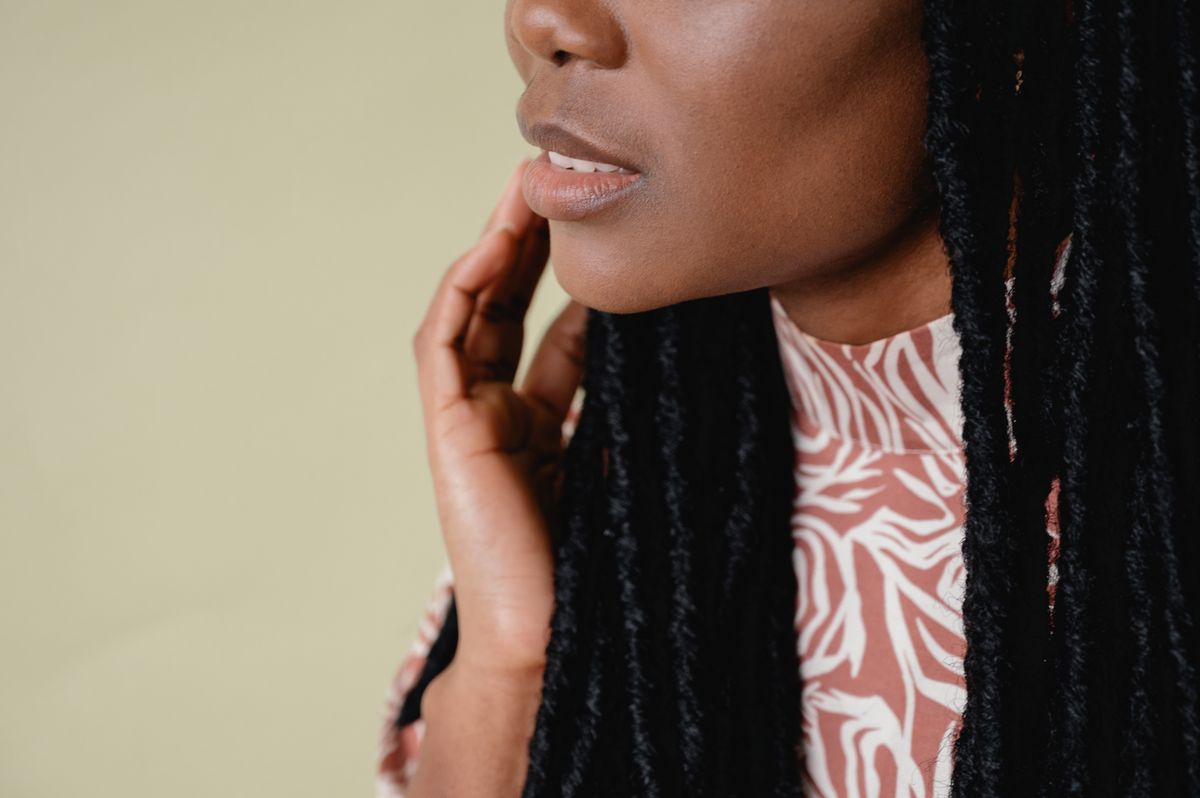
Color is where the standard description fails. Clinical training and diagnostic criteria have centered lighter skin, and on darker skin, redness from inflammation may not be visible at all or can look different, which leads to underdiagnosis and misclassification, according to a 2025 review in Cureus. So do not wait for the bright red ring you see in textbook photos. On brown and dark skin, look for the pattern: a tight cluster of small blisters at the lip border, a spot that tingled first, and crusting a few days later.
Then there is what the sore leaves behind. Post-inflammatory hyperpigmentation, a flat dark patch where skin was inflamed, tends to affect darker skin with greater frequency and severity, according to a review by dermatologists Valerie Callender and Erin Davis. A dark mark on your lip after a cold sore has healed is pigment, not an active outbreak and not a scar. Their review says treatment starts with managing the original inflammation and includes sun protection, which also happens to address a top cold sore trigger. If a mark lingers, a dermatologist can treat it.
Cold sore, canker sore or angular cheilitis
Three common mouth problems get called the same thing. They have different causes and different fixes.
A cold sore is HSV-1. It sits on the outside of the lip, often at the border, starts with tingling, and forms grouped blisters that crust.
Community health centers test on a sliding scale and many charge nothing; our directory of free and charitable clinics lists centers by state. At-home kits are self-pay and are not billed to Medicaid, so if you have Medicaid the clinic route will almost always cost less. If you would rather test at home:

Everlywell
At-home STI test panels covering chlamydia, gonorrhea, HIV, herpes, and syphilis, with a mail-in sample and physician-reviewed results online.
Browse at-home STI testsAffiliate link, we may earn a commission at no extra cost to you.
A canker sore (recurrent aphthous stomatitis) sits inside the mouth, on the inner lip, inner cheek or floor of the mouth. It is a small round or oval ulcer, usually with a gray-white coating, and it typically heals in 10 to 14 days. No single cause has been identified, and it is not a herpes infection to treat with antivirals.
Angular cheilitis sits at the corners of the mouth: cracking, moist skin, crusting and sometimes ulcers. Its causes mix irritation, allergy and infection, mostly bacterial and fungal, and it can signal an underlying condition. Antivirals will not touch it.
If you cannot tell which one you have, a clinician can swab a fresh blister. A lab test of the fluid names the virus, and it works best before the sore crusts over.
What sets off a cold sore
Reported triggers include stress, fever or illness, menstruation and hormonal shifts, surgery or other trauma to the area, corticosteroid drugs, and sunlight. Sun is the best studied. In a National Institutes of Health trial, 27 of 38 people exposed to UV light on the lip developed a cold sore after a placebo, and none did after sunscreen. A later review found that protection was harder to show outside the lab, but an SPF lip balm costs little and also guards against the dark marks described above.
Treatment: what is FDA-labeled, and when it works
Every option works better earlier. A review of randomized trials in Canadian Family Physician found that antiviral creams and pills have a small benefit on symptom length, and only when started promptly.
Prescription pills are the strongest single-episode treatment:
- Valacyclovir: 2 grams twice in one day, 12 hours apart, started at the earliest symptom. In two randomized trials, this one-day course cut the median episode by about one day compared with placebo.
- Famciclovir: 1,500 mg as a single dose for recurrent cold sores in adults with a healthy immune system.
Creams have FDA labeling too: prescription acyclovir 5% cream (five times a day for four days, started during the tingle or when the sore appears), prescription penciclovir cream, and over-the-counter docosanol 10%, whose label says to apply it at the first tingle, five times a day until healed, and to see a doctor if a cold sore is not healed within 10 days.
If cold sores come often, ask about daily suppressive medicine. The same Canadian review found that long-term oral antivirals reduce how many outbreaks you get. A practical move: ask for a standing prescription so you have pills at home when the tingle starts, instead of waiting two days for an appointment.
Kissing, oral sex and genital herpes
HSV-1 spreads through saliva and contact with sores, including kissing and shared towels or utensils, and it can also spread when no sore is visible. Skip kissing and oral sex from the first tingle until the scab is gone, and do not share towels or utensils during an outbreak.
HSV-1 is not only an oral virus. CDC's 2021 STI guidelines state that an increasing proportion of genital herpes infections are caused by HSV-1, especially among young women and men who have sex with men. Oral sex from a partner with a cold sore is how it gets there. The guidelines also note that genital HSV-1 recurs and sheds far less often than HSV-2, so knowing the type changes the outlook. Our guides to genital herpes in Black women and Black men cover testing, treatment and telling a partner.
What to ask for
With a fresh blister, ask for a swab of the sore for an HSV PCR test, typed for HSV-1 or HSV-2. CDC calls these lab tests the most sensitive option, and they lose accuracy as the sore heals. With frequent outbreaks, ask about a one-day valacyclovir or single-dose famciclovir prescription to keep on hand, or daily suppressive therapy. With a sore anywhere in the genital area, use our STD testing guide to find a site. You can also find a Black clinician in our directory.
Frequently asked questions
What does a cold sore look like on Black skin? ▼
A tight cluster of small fluid-filled blisters, usually at the lip border, that breaks and crusts over several days. The red base shown in most textbook photos may not be visible on darker skin or may look different, so go by the pattern and the tingling that came first.
Why do I get a dark spot after a cold sore? ▼
That is post-inflammatory hyperpigmentation, which affects darker skin more often and more severely. Cold sores heal without scarring, so the flat dark patch is pigment. Sun protection helps it fade, and a dermatologist can treat a mark that lingers.
Is a cold sore the same as herpes? ▼
Yes. Cold sores are caused by herpes simplex virus type 1. In CDC's 2015 to 2016 national survey, 47.8% of Americans aged 14 to 49 carried HSV-1, many since childhood.
How can I tell a cold sore from a canker sore? ▼
Location. Cold sores form on the outside of the lip and start as blisters. Canker sores are round ulcers inside the mouth, often with a gray-white coating. Cracking at the corners of the mouth is usually angular cheilitis.
Can a cold sore give someone genital herpes? ▼
Yes. HSV-1 can spread to the genitals through oral sex, and CDC reports it causes a growing share of genital herpes. Avoid oral sex from the first tingle until the sore has fully healed.
What is the fastest treatment for a cold sore? ▼
A prescription antiviral started at the first tingle. The FDA-labeled valacyclovir regimen is 2 grams twice in one day, and famciclovir is labeled as one 1,500 mg dose. Ask for a prescription to keep at home.