Most of the marks people call scars on Black skin are not scars at all. A flat dark spot left after a pimple, bite or cut is post-inflammatory hyperpigmentation, and the American Academy of Dermatology says a spot a few shades darker than your skin usually fades within 6 to 12 months once the cause stops (AAD). A true scar changes the skin's texture: it is sunken, raised, or a different color that does not fade. Sunken acne scars can be improved on dark skin, and the academy says microneedling and radiofrequency microneedling are safe for all skin tones (AAD). The first step is knowing which kind you have.
Scar or dark mark? Tell them apart first
Run a fingertip over the spot and look at it in side light. A flat mark that is only darker than your skin is pigment. A review of post-inflammatory hyperpigmentation in skin of color describes it as more frequent and more severe in darker skin, and says treatment starts with controlling the inflammation that causes it, plus sunscreen (Davis and Callender, 2010). These marks fade with time, faster with the right ingredients. Our guide to dark spots and hyperpigmentation on Black skin covers that.
The academy notes that deep pigment, which often looks slate blue to gray or a brown much darker than your skin, can take years to fade (AAD). That is still pigment, not a texture change, and a dermatologist can help with it.
A scar is a change in the skin itself:
- Sunken (atrophic) scars: narrow, deep ice pick scars, wide rolling scars that make the surface look wavy, and boxcar scars with sharp edges. The academy notes ice pick scars need different treatment than rolling scars (AAD).
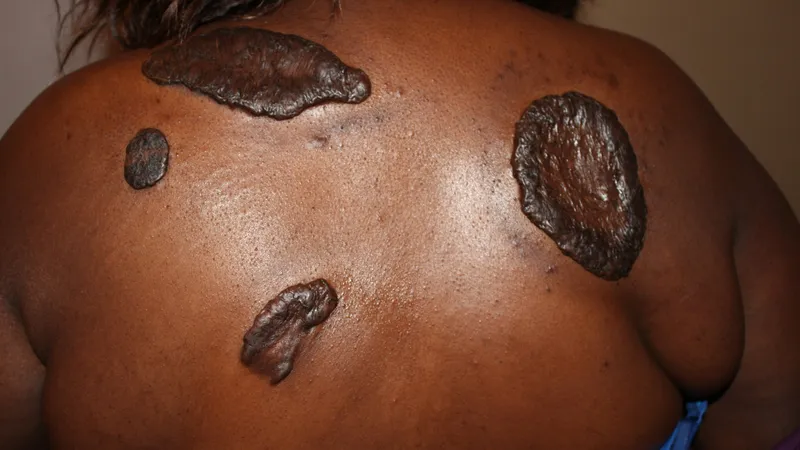
- Raised scars: hypertrophic scars stay within the original wound; keloids grow past it. A review of raised scars in skin of color notes that people with skin types IV to VI are particularly prone to both (Bronte et al., 2024). Keloids have their own guide: keloid scars on Black skin.
- Light (hypopigmented) scars: flat patches lighter than the skin around them. We found far less treatment research on these than on dark marks or sunken scars, so a dermatologist's exam matters most here.
Treating sunken scars on dark skin
The academy's sequence starts with acne. If you still break out, your plan begins with acne treatment, and scar treatment usually starts once breakouts are under control. Tell your dermatologist about every acne medicine you have used in the last two years, because starting some scar treatments during or soon after certain acne medicines can cause side effects (AAD).
Common skin conditions are treated in primary care, and community health centers charge on a sliding scale that is often $0. Our directory of free and charitable clinics lists centers by state. A same-day telehealth visit is self-pay and cannot be billed to Medicaid or commercial insurance, so the clinic route usually costs less. If you need a prescription sooner than the next appointment:
 Sesame Care
Prescription skincare from a licensed clinician.
From $59 a month, priced up front
Start a skincare consultThen the options, from the academy's list of treatments for depressed scars (AAD):
- Microneedling. Tiny needles puncture the skin to make new collagen. The academy says it is safe for all skin tones and is often combined with radiofrequency, peels or platelet-rich plasma. A review in Clinical, Cosmetic and Investigational Dermatology calls it a viable resurfacing option for skin of color (Iriarte et al., 2017).
- Radiofrequency and radiofrequency microneedling. Heat from radiofrequency energy builds collagen. The academy says both are safe for all skin tones, and that combining radiofrequency with microneedling can work better than either alone.
- Chemical peels. Mild and medium peels often take several sessions, for example 3 to 5 mild peels 2 to 4 weeks apart. The academy describes pre-peel priming for 2 to 4 weeks, such as a retinoid, and sun protection beforehand to help prevent discolored skin after treatment.
- Fillers. Add volume under a sunken scar. Most last 3 months to 2 years; some are permanent.
- Lasers. Resurface the skin so it rebuilds collagen. On dark skin, which laser and which settings matter.
- Scar surgery. A dermatologist can cut out a scar or lift it free from the tissue underneath so the skin rises, often followed by another treatment.
- A retinoid or salicylic acid can make mild scarring less noticeable.
What the evidence on skin of color shows: a 2020 review of acne scar treatment in skin of color found no guidelines specific to darker skin, rated the evidence highest for microneedling, fractional radiofrequency, fractional CO2 and erbium lasers in mild to moderate scars, found that a technique called TCA CROSS worked for ice pick scars, and found combinations worked better than single treatments, while noting a lack of high-quality data overall (Gupta et al., 2020). In a study of 30 patients with skin types IV and V, TCA CROSS (a tiny amount of strong acid placed inside each ice pick scar) gave more than 70% improvement in 73.3% after four sessions, with brief pigment changes in three patients (Khunger et al., 2011).
The real risk on dark skin: new dark marks
Any treatment that inflames the skin can leave post-inflammatory hyperpigmentation, and darker skin is more prone to it (Davis and Callender). In a study of 82 patients, mostly skin type IV, treated with fractional lasers for acne scars, temporary dark marks appeared in 17% after a non-ablative laser and 14% after an ablative CO2 laser, and about a third of patients improved by more than 50% (Alajlan and Alsuwaidan, 2011). Those marks were temporary, and the clinic used bleaching creams to prevent them.
Ask before you book:
- How many patients with skin like mine have you treated for this kind of scar?
- Which device and settings will you use, and why are they right for my skin type?
- What will I use before and after to prevent dark marks, and how long should I protect the area from sun?
- How many sessions, how far apart, and what will it cost? The academy notes medical insurance does not cover acne scar treatment (AAD).
Daily sunscreen protects treated skin. Our guide to sunscreen for Black skin covers formulas without a white cast.
Raised scars
For raised acne scars, the academy lists lasers, injections of a corticosteroid or another medicine, and prescription medicine applied to the scar (AAD). A 2024 review of nonsurgical treatment for hypertrophic and keloid scars in skin of color found a lack of clearly effective treatments for this population and called for more individualized, combined approaches (Bronte et al.). If a scar keeps growing past the edge of the original wound, it is likely a keloid; the academy lists cuts, scrapes, burns, acne and even bug bites among the injuries that can start one (AAD). See keloid scars on Black skin and what the evidence supports for keloid treatment.
When to see a dermatologist
Book a board-certified dermatologist if scars bother you, if a dark mark has not faded after 6 to 12 months of sun protection, if a scar is growing, or if you are not sure whether you have a scar or a mark. The academy suggests asking yourself whether the scars limit your social life, work or school before deciding on treatment, since some people see no need to treat them (AAD). You can find a dermatologist in our directory, and our guide to dermatologist costs without insurance helps with planning.
Frequently asked questions
Do scars on Black skin fade? ▼
Flat dark marks, which are usually pigment rather than scars, often fade in 6 to 12 months if you protect them from sun. Sunken and raised scars change the skin's texture and do not go away on their own, though treatment can improve them.
Is microneedling safe for dark skin? ▼
The American Academy of Dermatology says microneedling and radiofrequency microneedling are safe for all skin tones. Any procedure can cause temporary dark marks, so ask how your dermatologist prevents them.
Can lasers treat acne scars on Black skin? ▼
Yes, with the right device and settings. Studies in darker skin show improvement with fractional lasers, with temporary dark marks in some patients. Choose a dermatologist experienced with your skin type.
Does insurance cover acne scar treatment? ▼
The American Academy of Dermatology notes that medical insurance does not cover the cost of acne scar treatment.
Why does my scar keep getting bigger? ▼
A scar that grows past the edge of the original wound is likely a keloid. Keloids are more common on darker skin and need a dermatologist's care, often with more than one treatment.