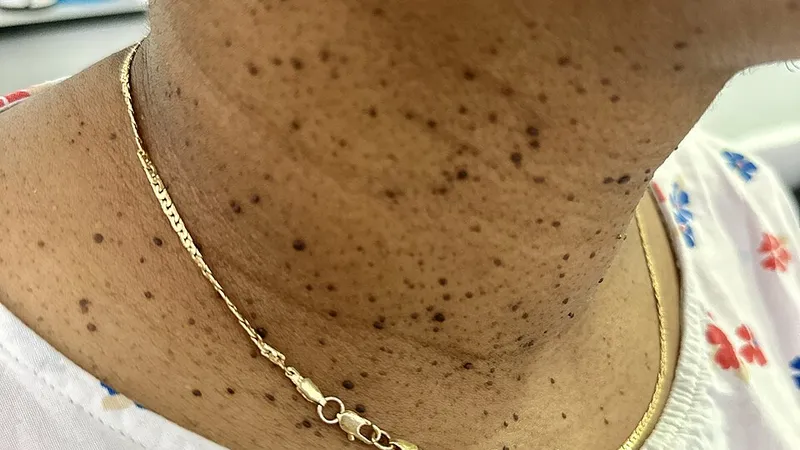
Flea bites on Black skin are small, very itchy bumps, usually in clusters or short rows on the ankles, lower legs and feet. Mosquito bites are single puffy bumps on any skin that was uncovered outdoors, and they show up within minutes. On brown and Black skin, both often look pink, purple, darker brown or skin-colored instead of red, and both can leave dark marks that last far longer than the itch. If you are getting flea bites at home, the fix is treating every pet and the house, not just the skin.
What flea bites look like on Black skin
Fleas prefer animals and bite people when they share space with an infested pet (CDC). The Centers for Disease Control and Prevention says flea bites often land on the lower legs and feet, which is why long socks and pants are part of its prevention advice (CDC). They tend to come in small groups or short lines. Dermatologists call it the "breakfast, lunch and dinner" sign, a hallmark of both flea and bed bug bites (Peres et al., 2018).
Color is the unreliable part. On darker skin tones, inflammation often looks pink, slightly purple, or lighter than the surrounding skin rather than red, as the American Academy of Dermatology describes for other rashes (AAD). A fresh bite may be a raised bump with a tiny dot in the center; a review of papular urticaria notes that these bumps often have a central puncture mark (Stibich and Schwartz, 2001). As a bite heals, the academy notes, it can leave a dark spot (AAD).
What mosquito bites look like, and how they differ
The CDC's list of mosquito bite signs is worth reading closely, because two of them describe what bites often look like on darker skin (CDC):
- A puffy, reddish bump that appears a few minutes after the bite.
- A hard, itchy, reddish-brown bump, or several, a day or so later.
- Small blisters instead of hard bumps.
- Dark spots that look like bruises.
The differences from fleas: mosquito bites can be anywhere skin was bare, including arms, neck and face, and they usually follow time outdoors. Some people react more strongly, with a large area of swelling and soreness. The CDC says severe reactions are more likely in children, in adults bitten by a mosquito species they have not met before, and in people with immune system disorders (CDC).
If the bites are on your arms, shoulders or neck and appear after a night in bed rather than after time outside, think about bed bugs. Our guide to bed bug bites on Black skin compares bed bugs, fleas, mosquitoes and scabies side by side.
When a child keeps breaking out in itchy bumps
Some children react to insect bites far more than adults do, with crops of very itchy bumps that keep coming back. Doctors call it papular urticaria: a hypersensitivity reaction to the bites of fleas, mosquitoes, bed bugs and other insects (Howard and Frieden, 1996; Stibich and Schwartz). Pediatric dermatologists who reviewed it in Pediatrics wrote that affected children are frequently misdiagnosed and often put through expensive, sometimes invasive tests (Hernandez and Cohen, 2006). Fleas are a common cause. One review describes children with flea-bite papular urticaria from day care centers, park playgrounds and homes with pets (Howard and Frieden).
If your child has repeated crops of itchy bumps on the legs, arms or waist and no one else in the house seems bothered, tell the pediatrician about pets, playgrounds and where the child sleeps. The reaction settles when the bites stop, so the treatment is finding the insect.
Common skin conditions are treated in primary care, and community health centers charge on a sliding scale that is often $0. Our directory of free and charitable clinics lists centers by state. A same-day telehealth visit is self-pay and cannot be billed to Medicaid or commercial insurance, so the clinic route usually costs less. If you need a prescription sooner than the next appointment:
 Sesame Care
Prescription skincare from a licensed clinician.
From $59 a month, priced up front
Start a skincare consultHow to treat flea and mosquito bites
For mosquito bites, the CDC recommends washing the bite and surrounding skin with soap and water, holding an ice pack on it for 10 minutes and repeating as needed, and using an over-the-counter anti-itch or antihistamine cream as the label directs. A paste of 1 tablespoon of baking soda with just enough water, left on for 10 minutes and then washed off, can also ease the itch (CDC). The American Academy of Dermatology's advice covers other bites too: an ice pack or over-the-counter hydrocortisone for itch, or an oral antihistamine (AAD).
Do not scratch. Scratched bites can become infected. The CDC says an infected bite may appear red, feel warm, or have a red streak spreading outward from it, and to see a healthcare provider if symptoms get worse (CDC). Warmth and a spreading streak are easier to judge than color on darker skin.
Keeping bites from leaving dark marks
The marks that linger are post-inflammatory hyperpigmentation, and a review of the condition in skin of color found it more frequent and more severe in darker skin. The same review says treatment works best started early, by controlling the inflammation, and that sunscreen is part of first-line care (Davis and Callender, 2010). Calm the itch fast so you scratch less, and put sunscreen on healing bites on your legs and arms if they will see sun. Our guide to sunscreen for Black skin covers formulas without a white cast.
Once the bites stop, the academy says a spot a few shades darker than your skin usually fades within 6 to 12 months, while deep, gray or slate-blue marks can take years (AAD). Bug bites are also on the academy's list of skin injuries that can start a keloid in people prone to them (AAD). If a bite scar starts growing, see our guide to keloid scars on Black skin. For fading marks that are already there, see dark spots and hyperpigmentation on Black skin.
Getting rid of fleas at home
The CDC says getting rid of fleas is hard because of their long life cycle, and that a moderate to severe infestation can take months to control. Its four steps (CDC):
- Clean. Wash bedding, rugs and pet bedding, and vacuum floors, carpets and along the edges of walls.
- Treat every pet. Bathe pets with soap and water, comb with a flea comb, and ask your veterinarian which flea control product fits each animal.
- Treat the home at the same time. A licensed pest control applicator can choose products for inside and the yard, focusing on shady spots where pets spend time.
- Follow up. Some flea life stages resist treatment, so two or more follow-up treatments 5 to 10 days after the first are needed, with vacuuming in between.
To keep fleas away, the CDC recommends treating pets year-round with a product your veterinarian recommends, limiting contact with stray and wild animals, keeping the yard mowed and dry, and emptying the vacuum bag outside (CDC).
Preventing bites in the first place
The CDC recommends insect repellents registered with the Environmental Protection Agency that contain DEET, picaridin, IR3535, oil of lemon eucalyptus, para-menthane-diol or 2-undecanone. Used as directed, they are safe and effective, including during pregnancy and breastfeeding. Do not use oil of lemon eucalyptus or para-menthane-diol on children under 3 (CDC). Clothing and gear treated with 0.5% permethrin stays protective through several washes (CDC).
For children, the CDC advises dressing them in clothes that cover arms and legs, covering strollers with mosquito netting, keeping repellent off their hands, eyes, mouth and any cuts, and applying it to your own hands first before putting it on a child's face (CDC). If you wear sunscreen too, the dermatology academy says to put sunscreen on first, let it dry, then add repellent, and to skip combination sunscreen-repellent products (AAD).
When a bite is more than a bite
Most bites are only a nuisance, but both insects can carry germs. In the United States, fleas can spread flea-borne (murine) typhus, most often reported in California, Texas and Hawaii, plague, mostly in rural parts of the West, and the germ behind cat scratch disease (CDC). Mosquitoes spread viruses such as West Nile, dengue and Zika, and parasites such as malaria (CDC).
The American Academy of Dermatology says to see a doctor right away if you feel tired all the time, or develop a headache, fever, body aches or a rash after a bug bite, and to mention the bite so you can be checked for an infection it may have carried (AAD). Go to the emergency room for trouble breathing, a feeling that your throat is closing, swelling of the lips, tongue or face, chest pain, a racing heartbeat that lasts more than a few minutes, dizziness or vomiting (AAD).
For bites that keep coming back or marks that will not fade, you can find a board-certified dermatologist in our directory.
Frequently asked questions
What do flea bites look like on Black skin? ▼
Small, very itchy bumps in clusters or short rows, mostly on the ankles, lower legs and feet. On darker skin they can look pink, purple, brown or the same color as your skin, sometimes with a tiny dot in the middle, and they often leave flat dark spots as they heal.
How can I tell flea bites from mosquito bites? ▼
Location and timing. Flea bites cluster low on the legs and keep appearing at home, especially with pets. Mosquito bites can be anywhere skin was bare, show up within minutes of being outside, and are usually single bumps.
Why do bites leave dark spots on my skin? ▼
Inflammation from the bite and from scratching tells pigment cells to make more melanin. That post-inflammatory hyperpigmentation is more common and more intense in darker skin. Treat the itch early, avoid scratching, and protect healing spots from sun.
Can fleas live on people? ▼
Fleas prefer animals and bite people mainly when they share space with an infested pet or when no animal is available. The infestation lives on pets and in carpets and bedding, which is why the CDC's plan treats pets and the home together.
Why does my child react so badly to bug bites? ▼
Some children develop papular urticaria, a hypersensitivity to insect bites that causes repeated crops of itchy bumps for weeks. It is not contagious and fades once the bites stop, so the goal is finding and removing the insect.