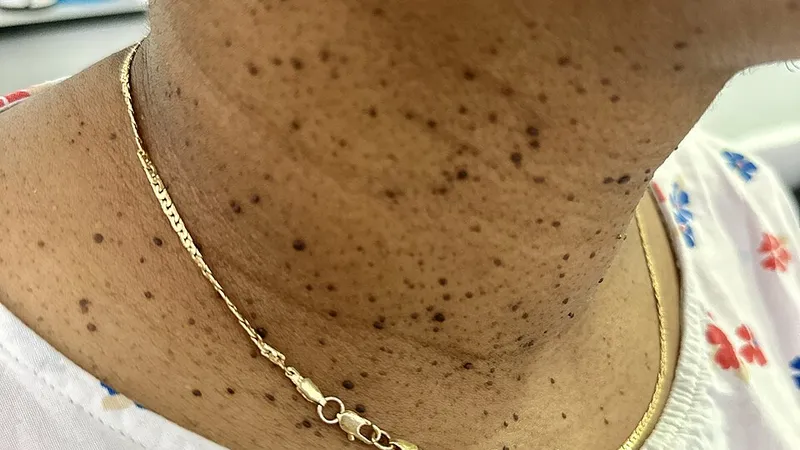
Bed bug bites on Black skin usually show up as small itchy bumps in a line or a tight cluster on skin that was uncovered while you slept, like your arms, neck, hands or face. On brown and Black skin they often look pink, purple, darker brown or the same color as your skin rather than bright red, so the pattern tells you more than the color does. Most bites heal on their own within a week or two (American Academy of Dermatology). The bites are not the real problem. The bugs are, and the only way to stop new bites is to find and remove them.
What bed bug bites look like on brown and Black skin
The Centers for Disease Control and Prevention describes bed bug bites as slightly swollen, itchy spots that look a lot like mosquito or flea bites, and says the marks may be random or appear in a straight line (CDC). The American Academy of Dermatology adds the detail that helps most: the bites often come in clusters of 3 to 5 laid out in a zigzag (AAD). They land where skin was exposed while you slept. The CDC lists the face, neck, arms and hands.
Most bite photos online are taken on light skin, where the bumps look red. On darker skin, inflammation often does not read as red at all. The academy describes the same thing for other rashes: on darker skin tones they often look pink, slightly purple, or lighter than the surrounding skin (AAD). The CDC's own list of mosquito bite signs includes a firm reddish-brown bump and dark spots that look like bruises (CDC). We could not find a study that photographs bed bug bites across skin tones, so judge yours by the shape and the timing: a row or a tight group of bumps on arms, shoulders or neck after a night in bed.
Timing confuses people. Bed bugs inject a numbing fluid as they feed, so you do not feel the bite, and most people notice the marks one to several days later. In some people they take as long as 14 days to appear, and some people have no marks at all (CDC). That is why one person in a shared bed can be covered while the other has nothing.
Reactions range widely. A review in Clinical Microbiology Reviews describes bites that start as small flat spots and can grow into raised welts about 5 centimeters (2 inches) across with intense itch, occasional blisters, and, when the bugs are numerous, widespread hives (Doggett et al., 2012). Serious allergic reactions are rare (CDC).
Bed bugs, fleas, mosquitoes or scabies?
These four get mixed up all the time, and the dermatology academy notes that bed bug bites are also mistaken for hives, an itchy rash or chickenpox (AAD). Where the bites are and when they show up usually separates them. Fleas and bed bugs both tend to bite in small runs, a pattern dermatologists nickname "breakfast, lunch and dinner" (Peres et al., 2018).
| Bed bugs | Fleas | Mosquitoes | Scabies | |
|---|---|---|---|---|
| Where on the body | Skin that was uncovered while you slept: face, neck, arms, hands | Mostly lower legs, ankles and feet | Any uncovered skin, usually after time outdoors | Between fingers, wrist and elbow folds, armpits, waist, buttocks, nipples, penis |
| Pattern | A straight line, or clusters of 3 to 5 bites in a zigzag | Small clusters or short rows of bumps | One bump or a few scattered bumps | A pimple-like rash, sometimes with tiny burrows |
| Timing | Marks appear 1 day to 2 weeks after the bite; some people get none | Bites after time around an infested pet, carpet or yard | A puffy bump within minutes, a firm itchy bump a day later | First infestation takes 4 to 8 weeks to itch; itch is worst at night |
| Clues at home | Rusty or black specks on sheets and mattress seams, shed shells, a sweet musty smell | Fleas or "flea dirt" (flea droppings) on a pet or in pet bedding | Bites after time outdoors | Close contacts or family members with the same itch |
| What stops it | Professional pest control | Treating every pet and the home at the same time | Repellent and covering up | Prescription treatment for everyone in the household |
Sources for the table: bed bugs (CDC, AAD), fleas (CDC, Peres et al.), mosquitoes (CDC), scabies (CDC). If the bites are mostly around your ankles, read our guide to flea and mosquito bites on Black skin. If the itch is worst at night and sits between your fingers or at your waist, see scabies on Black skin, because scabies needs prescription treatment for the whole household.
How to confirm it is bed bugs
Bites alone cannot prove it. The academy's advice is to look for the bugs' traces where people sleep (AAD):
- Small rusty or red specks of blood on sheets, mattress pads and mattress seams.
- Tiny blackish specks, which are bed bug droppings, on bedding, the headboard or under couch cushions.
- Shed shells, the outer skins bed bugs leave behind as they grow.
- White, oval eggs in cracks and crevices.
- A sweet, musty smell in a heavily infested room.
Common skin conditions are treated in primary care, and community health centers charge on a sliding scale that is often $0. Our directory of free and charitable clinics lists centers by state. A same-day telehealth visit is self-pay and cannot be billed to Medicaid or commercial insurance, so the clinic route usually costs less. If you need a prescription sooner than the next appointment:
 Sesame Care
Prescription skincare from a licensed clinician.
From $59 a month, priced up front
Start a skincare consultCheck the seams of the mattress and box spring, the bed frame and headboard, nightstands and nearby cracks. The CDC says bed bugs can travel more than 100 feet in a night but tend to live within 8 feet of where people sleep (CDC). Adults, young bed bugs and eggs can all be seen with the naked eye (EPA). An adult that has just fed is about the size of an apple seed, and a hungry or young one about the size of a poppy seed (AAD). If you are still unsure, a board-certified dermatologist can often tell from the bites whether bed bugs are the cause (AAD).
Treating the bites
Most bites need only home care. The academy recommends washing the bites with soap and water, which helps prevent infection and calms the itch, then applying a corticosteroid cream such as over-the-counter hydrocortisone if they itch (AAD). The CDC adds that an antihistamine may help with itchy reactions (CDC). Bites usually heal within a week or two (AAD).
Try hard not to scratch. Intense scratching can lead to a skin infection (CDC), and on darker skin every scratched bump is a chance for a dark mark that outlasts the bite by months. Keeping nails short and treating the itch early both help.
Be realistic about the evidence. A review in JAMA found that treatments for bed bug bite reactions, from antihistamines to steroids, had never been tested in clinical trials (Goddard and deShazo, 2009). Home care is for comfort while the bites heal. Removing the bugs is the treatment that matters.
Keeping bites from leaving dark marks
The dark spots that linger after bites are post-inflammatory hyperpigmentation: the skin's pigment cells overreact to the inflammation. A review of the condition in skin of color describes it as more frequent and more severe in darker skin, and says treatment works best started early, beginning with controlling the inflammation that causes it, plus sunscreen (Davis and Callender, 2010).
In practice that means calming the itch fast so you scratch less, and wearing sunscreen on any healing bite that will see sun. Once the cause is gone, the academy says a spot a few shades darker than your natural skin usually fades within 6 to 12 months, while deeper, gray or slate-blue marks can take years (AAD). Our guide to dark spots and hyperpigmentation on Black skin covers the ingredients that speed fading.
Getting rid of bed bugs at home or in an apartment
Both the CDC and the dermatology academy recommend a professional pest control company with experience treating bed bugs (CDC; AAD). The academy advises against bug sprays and foggers, which have little effect on bed bugs (AAD), and the Environmental Protection Agency notes that bed bugs in many parts of the country have become resistant to common pesticides (EPA). Never use an outdoor pesticide inside (EPA).
While you wait for treatment, the EPA's steps help (EPA):
- Run bedding and clothes through a dryer on high heat, which can kill bed bugs, and carry laundry in sealed plastic bags.
- Put a tear-resistant encasement on the mattress and box spring to remove hiding places.
- Cut clutter around the bed and vacuum often.
- Check secondhand furniture before it comes inside.
- In an apartment, add door sweeps and seal cracks around baseboards to slow spread between units.
A home freezer is not a reliable fix: the EPA says home freezers do not always get cold enough, and bed bugs can look dead for days and then revive (EPA).
If you rent, tell your landlord or property manager in writing as soon as you suspect bed bugs. The EPA's guidance to landlords says to inspect promptly, check the units on either side and above and below, and not to blame the tenant, since often no one is at fault (EPA). Who has to pay depends on where you live. The EPA counts 21 states with some bed bug law or regulation, mostly aimed at hotels and landlords, and says to check your state and city rules (EPA). Public housing residents can point their housing authority to the Department of Housing and Urban Development's bed bug guidance, which the EPA links from the same page. The EPA itself has no money to help individuals pay for treatment (EPA).
The toll on sleep and stress is real
Bed bugs cost people sleep and peace of mind, and the CDC lists insomnia and anxiety among their effects (CDC). In a study of Montreal tenants, people living with an infestation had about five times the odds of sleep disturbance and 4.8 times the odds of anxiety symptoms compared with unexposed tenants (Susser et al., 2012). If you are lying awake checking the sheets weeks after treatment, tell your doctor. That is a common response, not an overreaction.
When to see a doctor
The academy recommends seeing a dermatologist if you have many bites, blisters, bites that feel tender or ooze pus, or a red, swollen or hive-like allergic reaction (AAD). Go to the emergency room right away for trouble breathing, a feeling that your throat is closing, swelling of the lips, tongue or face, chest pain, a racing heartbeat that lasts more than a few minutes, dizziness or vomiting after any bite (AAD).
You can search our directory for a board-certified dermatologist near you.
Frequently asked questions
What do bed bug bites look like on Black skin? ▼
Small itchy bumps in a line or a zigzag cluster of 3 to 5 on skin that was uncovered in bed. On brown and Black skin they often look pink, purple, darker brown or skin-colored instead of red, so the pattern and timing are better clues than the color.
Why am I the only one in the bed getting bitten? ▼
Bed bug bites affect each person differently, and the CDC says some people show no marks at all. Your partner may be bitten too without any reaction.
Do bed bugs spread disease? ▼
They are not known to. The CDC says bed bugs are not known to spread diseases to people, and the EPA notes that no study has shown bed bugs passing disease between humans. The harm is itching, lost sleep, skin infection from scratching and stress.
How long do bed bug bites last? ▼
The bites usually heal within a week or two. A dark mark left behind on darker skin can take 6 to 12 months to fade, longer if it sits deep in the skin, which is one more reason to treat the itch and avoid scratching.
Will a bug bomb or spray get rid of bed bugs? ▼
Usually not. The American Academy of Dermatology says sprays and foggers have little effect on bed bugs, and many bed bugs are resistant to common pesticides. A pest control company with bed bug experience is the reliable route.