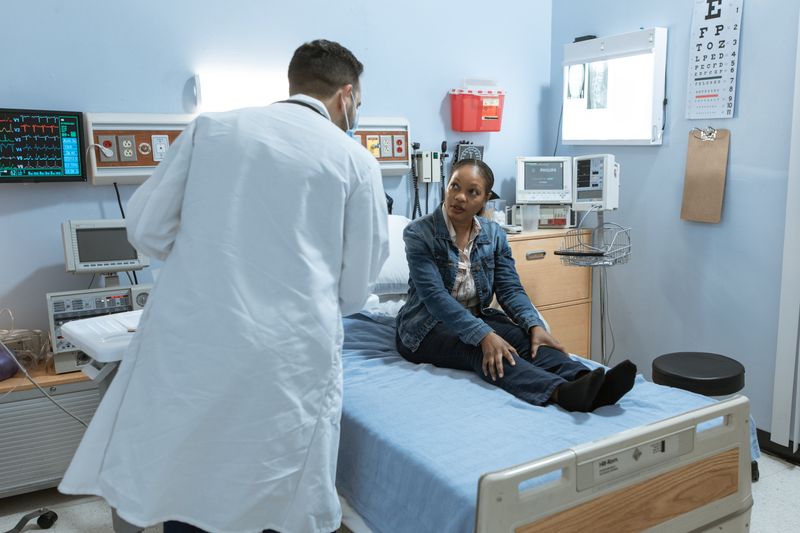
The disparity is real, and it is about outcomes
Colorectal cancer is one of the most preventable cancers, yet the burden falls unevenly. From 2017 to 2021, colorectal cancer incidence was 20% higher in Black men than White men and 14% higher in Black women than White women.
The gap in deaths is wider than the gap in new cases. Black men die from colorectal cancer at rates 40% higher than White men, and Black women at rates 25% higher than White women. Five-year survival is 59% among Black patients compared with 65% among White patients. Those numbers reflect differences in risk factors and in access to timely care, not biology alone.
Black Americans are also more likely to develop colorectal cancer at younger ages and to die from it, which is part of why earlier screening is the right call. The age-45 starting point exists because catching this cancer, or the polyps that precede it, earlier is what changes survival.
When to start: 45 for most, earlier for some
In May 2021, the U.S. Preventive Services Task Force lowered the recommended starting age for colorectal cancer screening from 50 to 45 for average-risk adults. The recommendation carries:
- A grade B for adults aged 45 to 49 (screen).
- A grade A for adults aged 50 to 75 (screen).
- A grade C for adults aged 76 to 85 (screen selectively, based on health and prior screening history).
The American Cancer Society and the CDC both align with starting at 45 for average risk. The American College of Physicians does not. Its 2023 guidance for asymptomatic average-risk adults suggests starting at 50 (ACP, August 1, 2023), so a clinician following ACP may give you a later age than this page does. The three schedules are laid side by side with the date each was published if you want the comparison in hand at your appointment.
Some people should start earlier than 45. A personal or family history of colorectal cancer or polyps, inflammatory bowel disease such as Crohn's or ulcerative colitis, a confirmed genetic syndrome like Lynch syndrome or familial adenomatous polyposis, or prior abdominal radiation can all mean earlier and more frequent screening. If a parent or sibling has had colorectal cancer or polyps, tell your clinician. The right starting age for you may be younger, and the test choice may be colonoscopy specifically.
Find a provider in our directory to start the conversation, and see our screening overview for how the tests fit together.
Screening options compared
There is no single "best" test for everyone. There are good tests, and the one you complete on schedule beats the one you put off. Below are the average-risk options the Task Force, CDC, and ACS endorse.
Community health centers can order a FIT test or refer you for a colonoscopy on a sliding scale. Most insurance plans cover colon cancer screening without a copay, and Medicaid covers it in most states. Our directory of free and charitable clinics lists centers by state. A self-pay telehealth consult is not billed to Medicaid, so confirm what your plan already covers before paying out of pocket. If you want a mail-in test now:

Everlywell
An at-home FIT test that checks a stool sample for hidden blood, a first-line colon cancer screening tool you take at home. A positive result still needs a colonoscopy.
Order an at-home FIT testAffiliate link, we may earn a commission at no extra cost to you.
Colonoscopy, every 10 years. A gastroenterologist examines the entire colon and can remove polyps in the same session, so it both screens and prevents. It requires bowel prep the day before and usually sedation, which means a ride home and a day off. It is the test used to follow up any abnormal result from the tests below.
FIT (fecal immunochemical test), every year. A stool sample you collect at home and mail to a lab. No prep, no sedation, no time off. It detects hidden blood. It does not remove polyps, and a positive result must be followed by a colonoscopy to count as complete screening.
Stool DNA-FIT (sold as Cologuard), every 1 to 3 years. A mail-in stool test that combines a DNA marker panel with FIT. More involved than FIT alone, still done at home, and like FIT a positive result requires a follow-up colonoscopy.
Flexible sigmoidoscopy, every 5 years (or every 10 years paired with annual FIT). Examines the lower colon only.
CT colonography (virtual colonoscopy), every 5 years. An imaging scan that still requires bowel prep, and any finding routes you to a colonoscopy.
The Task Force is explicit on the principle that matters most: a positive stool-based or imaging test only delivers its benefit if you complete the follow-up colonoscopy. A stool test you finish at home is far better than a colonoscopy you keep rescheduling.
Symptoms that need prompt care, at any age
Screening is for people without symptoms. If you have symptoms, you are not in screening territory, you are in evaluation territory, and that is true even if you are under 45. The CDC lists these signs:
- A change in bowel habits.
- Blood in or on your stool.
- Diarrhea, constipation, or a feeling that the bowel does not empty all the way.
- Abdominal pain, aches, or cramps that do not go away.
- Weight loss when you are not trying.
Unexplained anemia, often found on routine bloodwork, can also point to slow bleeding in the colon. Do not assume rectal bleeding is hemorrhoids and wait it out. Get it checked. Because Black Americans are more likely to develop this cancer young, "you are too young for colon cancer" is not a safe assumption, and it is reasonable to ask directly for an evaluation.
Barriers, and how to get screened anyway
The disparity in deaths is driven in part by access and timing, not by anything inherent. Three barriers come up most.
Cost and coverage. Under the Affordable Care Act, screening rated grade A or B by the Task Force is covered without cost-sharing by most plans, which now includes screening at 45. If a positive stool test leads to a follow-up colonoscopy, that colonoscopy is part of the screening process. Ask your plan to confirm before you schedule.
Fear of the prep or the procedure. This is the most common reason people delay, and it is also the easiest to route around. If colonoscopy prep is the wall you keep hitting, start with an annual FIT at home. It keeps you screened while you decide.
Distrust and not feeling heard. A clinician who takes your history seriously, including family history and symptoms, changes outcomes. If you have felt dismissed before, it is fair to come in with your family history written down and to ask plainly whether you should start screening now.
How to get screened, simply: confirm your age and risk with a clinician, pick a test you will actually finish, and if it is a stool test, commit in advance to the follow-up colonoscopy if it comes back positive. Find a provider to get started, or read our screening guide first.
Frequently asked questions
At what age should Black adults start colon cancer screening? ▼
For average risk, screening starts at 45, the same age the Task Force, CDC, and American Cancer Society now recommend for all average-risk adults. People with a family history, inflammatory bowel disease, or a genetic syndrome may need to start earlier and should ask their clinician.
Is a colonoscopy required, or can I use an at-home stool test? ▼
Both are valid first-line options for average risk. An annual FIT or a stool DNA-FIT every 1 to 3 years can be done at home with no prep. The key rule: if a stool test is positive, you must complete a follow-up colonoscopy for screening to count.
Why is colorectal cancer worse for Black Americans? ▼
Incidence is higher (20% higher in Black men, 14% higher in Black women than their White counterparts), and the death gap is larger still (40% higher in Black men, 25% higher in Black women), with lower five-year survival. The reasons largely reflect risk factors and access to timely care, not biology alone.
I am under 45 with rectal bleeding. Should I wait until 45? ▼
No. Symptoms mean evaluation, not screening, at any age. Rectal bleeding, a lasting change in bowel habits, unexplained weight loss, or unexplained anemia are reasons to be seen now.
How often do I need to be screened? ▼
It depends on the test: colonoscopy every 10 years, FIT every year, stool DNA-FIT every 1 to 3 years, CT colonography or flexible sigmoidoscopy every 5 years. Your clinician may screen more often based on your risk.