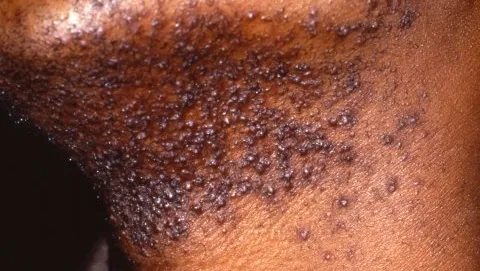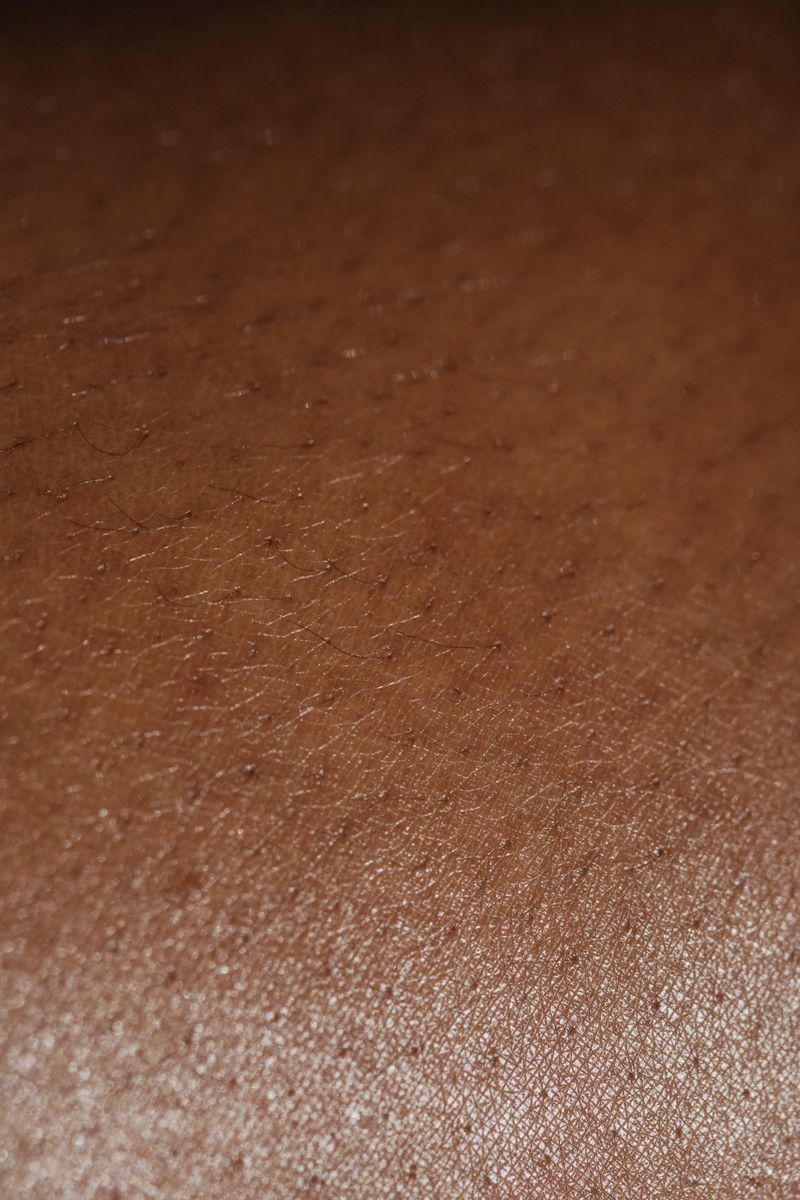
What the darkening actually is, and why it reads differently on Black skin
The dark patch in an armpit, along the bikini line, where the thighs meet, or under the breast band is almost always post-inflammatory hyperpigmentation. Skin gets irritated, pigment cells respond by overproducing melanin, and the melanin stays behind long after the irritation is gone. Dyschromias like this are among the most common reasons darker-skinned patients see a dermatologist at all, and they run more frequent and more severe in richly melanated skin.
Body folds are the worst possible place for that mechanism. The skin there is thin, it rubs against itself with every step, it stays warm and damp, it gets shaved or waxed, and it carries deodorant, detergent residue, and seam pressure all day. Every one of those is a low-grade injury, repeated daily for years.
Here is the part that changes how you read your own skin: on Black skin, irritation usually does not announce itself as redness. In a review of contact dermatitis in patients with skin of color, positive patch-test reactions in higher Fitzpatrick skin types presented with lichenification and hyperpigmentation rather than the erythema and vesicles described in textbooks, and the bright red hues used to grade a reaction showed up violaceous or faintly pink instead. So "my underarms were never irritated, they just got dark" is not evidence that nothing was irritating them. The darkening was the irritation.
What you are looking at, physically: a flat patch, brown to gray-brown to nearly black, with edges that follow the geography of the friction. One armpit darker than the other. A band exactly where the waistband sits. A stripe along the inner thigh where skin touches skin. The surface feels like the skin next to it, just a different color.
Flat or velvety: the ten-second check that changes what you do next
Run a finger over the dark area with your eyes closed. If it feels identical to the skin beside it, you are dealing with pigment. If it feels raised, thickened, and velvety, closer to suede than to skin, that is acanthosis nigricans, and it is not a cosmetic problem.
Acanthosis nigricans is a velvety darkening and thickening with poorly defined borders that settles into intertriginous areas: the back of the neck, the armpits, the groin, and under the breasts. It is driven from the inside. High circulating insulin activates insulin-like growth factor receptors on skin cells, and those cells proliferate. That is why it is most commonly associated with insulin resistance and type 2 diabetes.
The numbers say why this matters specifically to Black readers. In a study of 618 urban youth aged 7 to 17, acanthosis nigricans was found in 19 percent of African American children compared with 4 percent of white children, and in 62 percent of youth at or above the 98th BMI percentile. In a study of African American adults, fasting insulin rose in direct proportion to how severe the neck involvement was, and among adults who had it, type 2 diabetes reached 50 percent by their forties.
The distribution is the second tell. Friction pigment shows up where friction happens, usually asymmetric, usually one or two spots. Acanthosis nigricans tends to appear in several folds at once, and it very often includes the back of the neck, which nothing rubs. If your neck, both armpits, and your groin darkened over the same year, that is a metabolic pattern, not a laundry problem. The full workup, the diabetes connection, and what treatment actually reverses it are covered in our guide to acanthosis nigricans and dark neck on Black skin.
What else darkens a body fold, and how to tell them apart
Four other things get mistaken for friction pigment, and three of them have specific treatments that a lightening product will never deliver.
Erythrasma. A bacterial overgrowth (Corynebacterium minutissimum) that produces well-demarcated red-brown patches with fine scale in the groin, armpits, and under the breasts. It glows coral red under a Wood's lamp in the office, which makes it one of the fastest diagnoses in dermatology. It is treated with a topical or oral antibiotic. People spend years fading it with the wrong products.
Fungal intertrigo and tinea cruris. Itchy, scaly, often with a raised advancing edge and clearer skin in the middle. It responds to an antifungal, not to azelaic acid. Itch plus scale plus a defined border means see someone before you start treating pigment.
Terra firma-forme dermatosis. Brown, dirt-looking patches that will not come off with soap and water no matter how hard anyone scrubs, but wipe away completely with 70 percent isopropyl alcohol. The diagnosis and the cure are the same alcohol swab. It is worth knowing about precisely because it is the condition people are wrongly accused of having when their skin is actually pigmented.
Hidradenitis suppurativa. Painful deep nodules, recurring boils, draining tunnels, and scarring in the armpits, groin, and under the breasts, with darkening around the scarred areas. It is an inflammatory disease, it is more common in Black patients, and it needs medical treatment early because the scarring is permanent. Pain and lumps are the dividing line. Pigment does not hurt.
There is also frictional melanosis, documented over bony areas rubbed repeatedly with a towel, brush, or clothing. It is the same mechanism as fold darkening, and it confirms the principle: mechanical rubbing alone, with no rash and no infection, is enough to lay down pigment in melanated skin. For the general approach to fading marks anywhere on the body, see our guide to dark spots and hyperpigmentation on Black skin.
Common skin conditions are treated in primary care, and community health centers charge on a sliding scale that is often $0. Our directory of free and charitable clinics lists centers by state. A same-day telehealth visit is self-pay and cannot be billed to Medicaid or commercial insurance, so the clinic route usually costs less. If you need a prescription sooner than the next appointment:
Prescription skincare from a licensed clinician.
- Online visit and a treatment plan for your skin
- From $59 a month, shown before you book
 with Sesame Care
Affiliate link, we may earn a commission at no extra cost to you.
The triggers doing the damage, ranked by how often they are the answer
Shaving. The most common single cause in the underarm and bikini area. A blade abrades the skin surface, and coarse curved hair that re-enters the skin produces razor bumps, each one an inflamed papule that heals into a dark spot. Treatment reviews for pseudofolliculitis barbae start with the same first move regardless of what comes after: reduce the trauma of the shave itself. Trim rather than shave close, use a sharp single-blade razor with lubricating gel, shave with the grain, and never dry-shave an already-dark area. Our guide to razor bumps on Black skin covers the full technique and the prescription options.
Deodorant, antiperspirant, and detergent. Axillary contact dermatitis is common, and the frequently implicated sources are deodorants, antiperspirants, detergents, soaps, and clothing, with fragrance the ubiquitous ingredient across all of them. Metals and dyes contribute. Because the reaction reads as darkening rather than redness on Black skin, people keep using the product that is causing it for years. Switch to a fragrance-free formula, and apply it to dry, unshaved skin.
Waxing, epilation, and depilatory creams. Waxing strips the surface layer of skin along with the hair. Depilatory creams dissolve hair chemically and can burn thin fold skin. Both routinely leave PIH in the exact shape of the treated area.
Friction from clothing and skin on skin. Tight waistbands, seams, bra bands, synthetic fabric that traps sweat, and thighs that rub while walking or running. This is the main driver of inner-thigh darkening, and it does not require any product at all. Cotton or moisture-wicking fabric, a looser cut, and anti-chafe balm on long walks or runs do more than any cream.
Scrubbing, loofahs, and bleaching. The trigger that people add themselves. The skin-of-color reviews attach the same warning to every treatment they recommend: irritation itself can cause or worsen post-inflammatory hyperpigmentation. Mechanical scrubbing is irritation delivered on purpose, daily, to the exact spot you are trying to fade. Stopping alone is worth more than it sounds. In the 2024 systematic review, among the patients who received no treatment at all, 62 percent still had partial pigment fading.
What is actually safe to put on underarm and groin skin
Fold skin is not face skin, and the difference is not cosmetic caution. Percutaneous absorption varies markedly by body region, and occlusion significantly enhances how much of a topical gets through. A fold occludes itself: skin against skin, warm and damp, all day. The same cream that is mild on a cheek is a stronger effective dose in an armpit. Build the routine accordingly.
Step one, and do it alone for four weeks: remove the trigger. Fragrance-free deodorant. Change the hair-removal method. Looser fabric. No scrubbing, no loofah, no exfoliating mitt. Treating the pigment while the trigger is still running means fading marks slower than you are making them.
Step two, over the counter: azelaic acid or niacinamide. In a randomized, double-masked trial in patients with Fitzpatrick types IV to VI, azelaic acid 20 percent cream reduced pigment intensity significantly more than its vehicle over 24 weeks and was well tolerated, with slightly more burning and stinging in the early weeks. Niacinamide works by a different route, blocking the transfer of pigment packets from pigment cells to surface skin cells: in laboratory models it produced 35 to 68 percent inhibition of that transfer, and a 5 percent niacinamide moisturizer significantly reduced hyperpigmentation against its vehicle after four weeks. Start one at a time, and stop if the skin stings or itches.
Step three, cautiously: a low-strength retinoid. Topical tretinoin is the best-evidenced option for post-inflammatory hyperpigmentation specifically in Black patients: in a 40-week double-blind, vehicle-controlled trial of tretinoin applied to the face and arms, 0.1 percent tretinoin lightened lesions about 40 percent versus 18 percent for the vehicle. The catch matters more here than on the face, because half the tretinoin group in that trial developed retinoid dermatitis, and retinoid dermatitis in an occluded fold is a new source of PIH. Use adapalene 0.1 percent or the lowest tretinoin strength, two or three nights a week, applied to dry skin and buffered with moisturizer. Never on the day you shave.
What not to use. Hydroquinone in the underarm or groin without a dermatologist supervising it. A systematic review of 126 reported cases of exogenous ochronosis, the blue-black staining that hydroquinone can cause, concluded that concentrations above 4 percent and courses longer than 3 months are the pattern associated with new onset. The median duration of use before onset was 5 years, and just over half the reported patients were Black, with Fitzpatrick types V to VI. That is the risk profile on normal skin. In a self-occluding fold, exposure runs higher. Also off the list: imported lightening creams that may contain undisclosed steroids or mercury, potent topical steroids in a fold (skin atrophy and striae are the classic local effects, and thin fold skin is where they land first), bleach, lemon juice, and baking-soda pastes.
One honest difference from facial hyperpigmentation: the daily-sunscreen rule that dominates every dark-spot guide matters much less for skin that lives under clothing. If the darkening extends onto the neck or you wear sleeveless clothing regularly, sunscreen on the exposed edges still helps. For the underarm and groin, the trigger and the topical are where the effort belongs.
In-office options, and why to go slow with them here
When trigger removal plus a topical stalls, a dermatologist has tools you cannot use at home. The evidence for them in this specific area is thinner than the marketing suggests, so know what you are buying.
Low-fluence Q-switched 1064 nm Nd:YAG laser has been studied for axillary post-inflammatory hyperpigmentation directly. In a single-center observational study of 17 women treated every two weeks, a minimum of three sessions produced good to excellent improvement and results held for at least six months after the last session. That is a small, uncontrolled study, and it is the strongest underarm-specific laser evidence available. Intense pulsed light was compared head to head with the same laser in a randomized split-side study of 22 people. Both significantly improved axillary hyperpigmentation after three sessions, with no significant difference between them and less pain from the light.
The general caution for melanated skin holds. A 2024 systematic review of post-inflammatory hyperpigmentation treatment in skin of color pooled 1,356 patients. Topical retinoids produced partial improvement in 85 percent of the patients who received them and laser therapy in 66 percent. Laser was the only intervention that offered complete resolution in a subgroup of patients (26 percent), and it is also the one the review flags for inducing new hyperpigmentation with repeated procedures, at 11 to 17 percent in darker skin types. Chemical peels and hydroquinone came out less effective than either. A device and settings chosen for darker skin, in the hands of someone who treats darker skin routinely, is the whole ballgame.
If the diagnosis is acanthosis nigricans, the office menu is different: topical retinoids, vitamin D analogs, keratolytics, oral retinoids, insulin sensitizers, trichloroacetic acid peels, and lasers all appear in the literature, but reviews are blunt that complete clearance is difficult and that addressing the underlying cause, usually weight and insulin resistance, is the most practical strategy.
How long fading actually takes
The single most common reason people conclude that nothing works is quitting at week three. Here is a realistic clock.
- Weeks 0 to 8: trigger removal only. Fragrance-free deodorant, changed hair removal, no scrubbing. Judge nothing before eight weeks.
- Week 4 onward: niacinamide showed a measurable drop in hyperpigmentation by four weeks in its trial, and the azelaic acid trial measured its result at 24 weeks.
- Weeks 4 to 40: the retinoid window. The controlled trial in Black patients showed first improvement near week four and ran a full 40 weeks to reach about 40 percent lightening.
- Months to years: that is the published range for epidermal pigment to resolve. The trials that produced real change ran 24 to 40 weeks, pigment sitting deeper in the skin can be permanent, and complete clearance from topicals alone is uncommon.
Acanthosis nigricans runs on a different clock entirely. It tracks the metabolic picture, so it improves when insulin resistance improves and does not respond to lightening products used on their own.
When to see a dermatologist
Book an appointment rather than buying another product if any of these apply:
- The patch feels velvety or thickened, or the darkening covers several folds including the back of the neck.
- It appeared suddenly or spread quickly. Rapid onset is uncommon and, when it happens alongside multiple new skin tags, sudden crops of seborrheic keratoses, or thickened ridged palms, it can point to an internal cause that needs investigating.
- There are painful lumps, boils, or draining tunnels. That is hidradenitis suppurativa, and early treatment prevents permanent scarring.
- It itches, scales, or has a raised advancing border, which suggests a fungal or bacterial cause with a specific cure.
- Three months of correct home care produced no change at all.
- It is on a child. Acanthosis nigricans in a child is a reason to check glucose, not a cosmetic issue.
Bring photographs taken in consistent lighting, a list of every product that touches the area including laundry detergent, and your hair-removal routine. Ask directly whether the pattern looks like acanthosis nigricans, and if the answer is yes, ask for an A1c before you leave. If you want a clinician with hands-on experience treating pigment in melanated skin, you can find a Black dermatologist in our directory.
Frequently asked questions
Why are my armpits dark even though I wash them every day? ▼
Because the pigment is in the skin, not on it. Repeated friction, shaving, and product irritation switch on pigment cells, and the melanin they leave behind sits below the surface where soap cannot reach. Scrubbing harder adds a fresh round of inflammation and makes the patch darker. If the area also feels velvety and thickened rather than flat, that is acanthosis nigricans, a different condition with a metabolic cause.
How do I tell acanthosis nigricans from ordinary friction darkening? ▼
Texture and pattern. Acanthosis nigricans is velvety and thickened, with soft borders, and it usually shows up in several folds at once: back of the neck, both armpits, groin, under the breasts. Friction pigment is flat and smooth, and it maps to where the rubbing happens, such as the razor path or the line where the thighs touch. If the patch is velvety or spread across multiple folds, ask your clinician for an A1c or fasting glucose and read our guide to acanthosis nigricans and dark neck on Black skin.
Can I use hydroquinone or a skin-lightening cream on my underarms or bikini line? ▼
Not without a dermatologist. Fold skin is thin and sits against itself, which acts like a bandage and raises how much of any topical gets absorbed. Long or high-strength hydroquinone use can cause exogenous ochronosis, a blue-black staining reported most often in Black patients with the deepest skin tones. Imported lightening creams are worse: many contain undisclosed steroids or mercury, and potent steroids in a fold cause thinning and stretch marks.
Does shaving make your underarms and inner thighs darker? ▼
Yes, in two ways. The blade irritates the skin surface, and curved hair that re-enters the skin creates razor bumps, each one an inflamed spot that heals into a dark mark. Shaving in the direction of growth with a sharp single-blade razor and a lubricating gel reduces both. Trimming instead of shaving close removes the ingrown-hair problem entirely. Our guide to razor bumps on Black skin covers the technique in detail.
How long does it take for dark inner thighs to fade? ▼
Months, not weeks. Give trigger removal alone four to eight weeks before judging anything. Epidermal pigment takes months to years to resolve, and pigment sitting deeper in the skin can be permanent. The topical trials that produced real change in darker skin ran 24 to 40 weeks, and the tretinoin trial in Black patients showed first improvement around week four.
Should I stop using deodorant? ▼
Switch it, do not skip it. Fragrance is the ingredient most often behind axillary contact dermatitis, and dyes and metals in clothing contribute. Move to a fragrance-free deodorant, apply it to dry skin rather than freshly shaved skin, and give it a month. If the itching or darkening keeps returning, ask a dermatologist about patch testing.