Almost every piece of melanoma advice you have ever read was written for someone else's skin. Stay out of the midday sun. Watch the mole on your shoulder. Wear sunscreen at the beach. That advice is not wrong, and for Black readers it is close to beside the point, because the melanoma that turns up on Black skin usually has nothing to do with sun exposure and does not appear anywhere a swimsuit would leave uncovered.
The risk is low. The stakes are not.
Both halves of that sentence are true at once, and most coverage only manages one of them. The National Cancer Institute's SEER program puts melanoma incidence for 2019 to 2023 at 1.1 new cases per 100,000 non-Hispanic Black men and 0.9 per 100,000 non-Hispanic Black women, against 40.7 and 27.6 for non-Hispanic white men and women. The American Cancer Society puts lifetime risk at about 1 in 1,000 for Black people and 1 in 33 for white people. Nobody should read this page and start worrying about a freckle.
The survival figures run the other way. A CDC analysis of national cancer registry data by MaryBeth Culp and Natasha Buchanan Lunsford found five-year relative survival of 66.2% among non-Hispanic Black patients and 90.1% among non-Hispanic white patients. In the same data, 55% of Black patients were diagnosed while the cancer was still localized, compared with 78% of white patients. A cancer that is highly curable when it is caught early is being caught late.
You will see a different pair of numbers quoted widely, usually around 70% against 95%. We could not trace those to a primary document. They appear on advocacy and foundation websites without a citation that leads anywhere you can check. The 66.2% and 90.1% figures above come from a peer-reviewed CDC journal analysis of registry data, which is why we use them. The direction of the gap is not in dispute. The exact size of it depends on which years and which registry you read, and anyone quoting it to the decimal without naming a source is guessing.
It starts where the sun does not reach
This is the part worth memorising. In the same CDC analysis, 48.2% of melanomas among Black patients were on the lower limbs, overwhelmingly the foot. The subtype involved is called acral lentiginous melanoma, which simply means melanoma of the palms, soles, and nail beds. It made up 16.7% of cases in Black patients with a specified histology, against 2% in white patients.
Acral melanoma is not caused by ultraviolet light. It occurs at roughly the same rate across every population studied, which is exactly why it makes up such a large share of melanoma in people who almost never get the sun-driven kind. Melanin is genuinely protective against the melanomas that sunlight causes. It offers no protection at all against this one.
The nail stripe, and when it matters
A brown or black band running lengthwise up a nail is called longitudinal melanonychia, and in Black adults it is usually harmless. Many people have several, on several nails, for their whole adult lives. That is normal pigmentation, not cancer, and it is why the sign gets ignored when it does matter.
Whatever brought you to this page, community health centers see patients regardless of insurance and charge on a sliding scale that is often $0. Our directory of free and charitable clinics lists centers by state. A same-day telehealth visit is self-pay and is not billed to Medicaid, so if you have Medicaid the clinic route will usually cost less. If you would rather see a clinician online today:

See a doctor online today.
- Same-day video visits from $34
- Price shown before you book
- No insurance needed
 with Sesame Care
Affiliate link, we may earn a commission at no extra cost to you.
What changes the picture is a band that behaves differently from the rest of your nails. A single new band on one nail in an adult, a band that is widening, one that is getting darker or has more than one shade in it, one on the thumb, index finger, or big toe, or pigment that spreads from the nail onto the surrounding skin. Any of those is worth a dermatologist rather than a wait. So is a nail that splits, lifts, or will not heal after an injury you cannot clearly remember.
Late diagnosis is not the whole explanation
The standard account of the survival gap is that Black patients are diagnosed later, and that later diagnosis explains the worse outcome. The evidence for that account has become more complicated, and it is worth saying so rather than repeating the tidy version.
A 2025 analysis of SEER data published in the Journal of the American Academy of Dermatology found no significant difference in disease severity at diagnosis between Black and white patients with acral lentiginous melanoma, and yet Black patients still faced roughly double the risk of dying of it (hazard ratio 2.04, 95% confidence interval 1.31 to 3.11). Acral melanoma was the only major subtype where that held. The authors write that their findings counter the assumption that the disparity is primarily about delay.
An earlier study of the same registry, covering 2000 to 2016, pointed the other way: it found that adjusting for socioeconomic status and stage at diagnosis shrank the gap, and that the difference for Black patients specifically was not statistically significant once those were accounted for. Two careful analyses of the same database reached different conclusions about the cause. That is an open research question, not settled science, and we are not going to flatten it into a slogan.
What is not an open question is where to look. Both studies agree that acral melanoma is the subtype that matters most for Black patients, and both agree that it is found on the extremities. You do not need the causal question resolved to check your own feet.
What a clinician will and will not offer you
Be prepared for a mismatch here. In 2023 the US Preventive Services Task Force reviewed the evidence on whole-body visual skin examination by a clinician in adolescents and adults without symptoms and issued an I statement, meaning the evidence is insufficient to weigh the benefits against the harms. That is not a finding that screening is useless. It is a finding that the studies needed to judge it have not been done. Practically, it means routine skin checks are not a guaranteed covered benefit and your primary care doctor may not offer one.
The lever you do have is the specific complaint. A general request for a skin check may go nowhere. A named lesion, a named location, and a named duration is a different conversation: a dark patch on the ball of my left foot, roughly this size, that I first noticed in June and that is bigger now. Photograph it next to a ruler or a coin so change is measurable rather than remembered. If a lesion is dismissed and it keeps changing, that is a reason to ask for a dermatology referral, not a reason to drop it.
Why the pictures are so hard to find
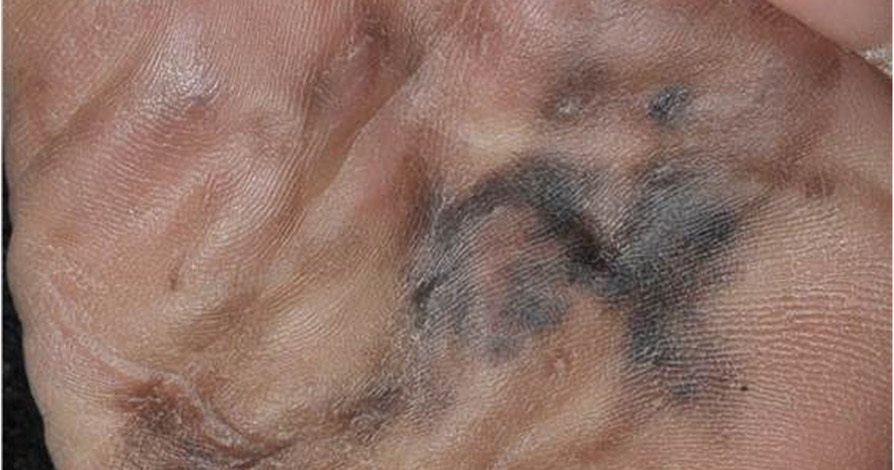
There is a reason this is difficult to learn by eye. Openly licensed clinical photographs of acral melanoma on dark skin are scarce. Most freely available melanoma images, including the one at the top of this page, show lighter skin. The image above is a genuine acral lentiginous melanoma on the sole of a foot, which is the anatomy and the pattern this article is about, but it is not an example of the lesion on deeply pigmented skin, and we would rather say that plainly than caption it as something it is not.
That shortage is part of the problem itself. Clinicians learn to recognise skin disease from image libraries, and those libraries under-represent dark skin. If you want to see more examples, DermNet maintains a good image library of acral melanoma; we link to it rather than reproducing it because its licence does not allow republication.
Frequently asked questions
Do Black people need sunscreen if melanoma is this rare? ▼
Yes, though for reasons beyond melanoma. Sun exposure drives hyperpigmentation, melasma, and post-inflammatory dark marks, which are among the most common reasons Black patients see a dermatologist at all, and it still causes squamous cell carcinoma. What sunscreen will not do is prevent acral melanoma, because that subtype is not caused by ultraviolet light. Use sunscreen, and check your feet anyway.
I have dark stripes on several nails. Should I worry? ▼
Usually not. Multiple bands across several nails, present for years and unchanged, are normal pigmentation in adults with darker skin. The pattern that warrants a dermatologist is a single new band on one nail, a band that is widening or darkening, one with several shades in it, or pigment spreading onto the skin around the nail.
Is a dark spot on my foot probably cancer? ▼
Almost certainly not. Melanoma is genuinely rare in Black adults, and moles, calluses, blood blisters, and old bruises are all common on feet. The question is not whether a spot exists but whether it is changing. Something that has looked the same for a decade is very different from something that appeared six weeks ago and has grown.
Did Bob Marley die of this? ▼
Yes. Bob Marley was diagnosed in 1977 with acral lentiginous melanoma under the nail of his right big toe, which he first noticed after a football match. He died of metastatic disease in May 1981, at 36. It is the most widely known case of exactly the pattern this article describes, and the reason many people first hear of melanoma under a nail.
How often should I check? ▼
There is no trial that establishes an ideal interval, which is part of why the US Preventive Services Task Force issued an insufficient-evidence statement on routine clinician screening. Twice a year is a reasonable habit for a check that takes two minutes, and any new or changing lesion is a reason to look sooner rather than waiting for the next scheduled check.