Minoxidil restarts shrinking follicles and needs a living follicle to work on
Minoxidil is a prodrug. It does nothing until sulfotransferase, an enzyme inside the follicle, converts it to minoxidil sulfate, the active form. Once activated it retimes the hair cycle: it shortens telogen, the resting stretch when a follicle holds an old hair and grows nothing, pushes the follicle into the growing phase early, then holds it there longer. That turns a short fine hair into a longer thicker one.
Sulfotransferase activity differs between people, and a 2022 review in the Journal of Dermatological Treatment states that those with higher activity may respond better than those with lower activity. That is the mechanical reason "it did not work for me" is a real outcome rather than a compliance failure. The narrower claim that an enzyme assay can predict who responds rests on a 2020 letter in the Journal of the European Academy of Dermatology and Venereology. Weigh it accordingly: it is a letter rather than a trial, it studied oral minoxidil, one of its four authors works for Applied Biology, a private biotech, and the record carries no conflict of interest statement. Expect response to vary. Do not expect it to be predicted for you.
All of it needs one thing: a follicle. Minoxidil enlarges follicles that have shrunk. It cannot build one where none is left.
The diagnosis decides whether minoxidil is the right drug or an expensive delay
Minoxidil is approved for androgenetic alopecia, or female pattern hair loss: gradual thinning through the top and crown as follicles miniaturize. Central centrifugal cicatricial alopecia is a different disease, and the most common scarring alopecia in Black women. It starts at the crown and spreads outward. In a cross-sectional survey of 326 Black women recruited at two churches and a health fair in Cleveland, 28% scored as having clinically evident central hair loss, and 59% of those showed scarring signs the investigators read as consistent with CCCA. That is a convenience sample in one city, not a national rate. It is still reason enough not to assume crown thinning is pattern loss.
Cicatricial means scarring. A 2016 review in Clinical, Cosmetic and Investigational Dermatology puts it flatly: CCCA is a scarring alopecia, and the amount of hair lost cannot be regained. Minoxidil still has a place there. Those authors report, from their own clinical experience rather than from a trial, that topical minoxidil paired with topical or intralesional steroids or calcineurin inhibitors helps halt progression. What minoxidil cannot do alone is stop the inflammation doing the scarring. A 2024 Delphi panel of 27 hair specialists, published in the Journal of the American Academy of Dermatology, states there is no established standard of care for CCCA, and reached strong consensus on only 20 of its 70 statements. Buying a bottle and waiting six months, there, is six months of scarring.
CCCA is also not a verdict on your styling history. The grooming study behind that link compared 51 women with a clinical and histologic diagnosis of CCCA against 50 women without hair loss at one Detroit clinic, using recalled styling history. It found associations with sewn-in weaves and with cornrows or braids that use artificial extensions, and it found no correlation with either hot combing or relaxers. A 2019 report in the New England Journal of Medicine identified variants in PADI3, a hair shaft gene, in some women with CCCA.
Traction alopecia is mechanical instead. South African population studies reported it in 17.1% of schoolgirls aged 6 to 21 and in 31.7% of women aged 18 to 86, with the highest risk, compared with natural hair, when traction was added to relaxed hair. Caught early it can be halted before it becomes permanent. Minoxidil does not loosen a braid. If pulling is the cause, the style is the treatment.
The label rules out other causes by name: do not use it if your loss is sudden or patchy, associated with childbirth, or of a reason you do not know. Smooth round patches point toward alopecia areata. Diffuse shedding two to four months after a birth, surgery, or illness points toward telogen effluvium. Thinning with fatigue and cold intolerance points toward thyroid disease.
What the trials show, and who was in them
The Cochrane review of female pattern hair loss pooled 47 trials and 5,290 participants, and rated only five of the 47 at low risk of bias. Six of those trials pooled participant-reported regrowth, all testing 2% minoxidil except one at 1%. In them, 157 of 593 women on minoxidil reported a moderate to marked increase against 77 of 555 on placebo: about 26% against about 14%, a risk ratio of 1.93 on moderate quality evidence.
An over-the-counter minoxidil from any pharmacy is the same active ingredient a paid prescription service sells at a markup, and a community health center can check for an underlying cause on a sliding scale. Our directory of free and charitable clinics lists verified centers by state. A same-day telehealth visit is self-pay and is not billed to Medicaid, so try the pharmacy shelf and a clinic workup first. If you want a telehealth visit instead:
Affiliate
The 2% label discloses who was studied. In clinical studies of mostly white women aged 18 to 45 with mild to moderate hair loss, 19% reported moderate regrowth after eight months against 7% on placebo. So expect modest thickening in a minority of users, on evidence whose one disclosed population was mostly white, and none of which tested CCCA, because these were trials in pattern hair loss. That is not a reason to skip the drug. It is a reason to know what you have first.
Oral minoxidil trades a daily scalp routine for a systemic drug
Minoxidil tablets are a prescription antihypertensive, and the prescribing information warns the drug can cause pericardial effusion occasionally progressing to tamponade, and can worsen angina. Those warnings come from blood pressure dosing, which runs higher than the doses used for hair loss.
Low dose oral minoxidil for hair loss is off label. A 2025 international Delphi consensus in JAMA Dermatology, 43 specialists across 12 countries, agreed on 76 items covering dosing, contraindications, and monitoring. A consensus statement is structured expert opinion, not trial evidence, and those authors listed topical versus oral efficacy as unresolved.
The largest safety series covers 1,404 patients, two thirds of them women. The commonest effect was hypertrichosis, unwanted hair on the face and body, at 15.1%. Systemic effects were uncommon: lightheadedness 1.7%, fluid retention 1.3%, tachycardia 0.9%. In total 1.7% stopped for an adverse effect, none life threatening. It was retrospective with no control group, so read it as one cohort, not a rate. The appeal is obvious if you wash weekly and wear protective styles: a pill does not care about your schedule.
The shed around week four is the drug working, and it is when people quit
Shedding after starting comes straight from the mechanism. Shortening telogen releases the resting hairs in those follicles sooner than they otherwise would, several at once. StatPearls names it: minoxidil induced telogen effluvium. Hair leaving then is old hair clearing for new.
It is less universal than the internet suggests, at least where anyone has counted it. In a retrospective chart review of 115 patients started on low dose oral minoxidil, six, or 5.2%, reported it, and keeping topical minoxidil going through the start did not reduce it. That review was retrospective and patient reported, and it measured oral initiation, so do not read 5.2% as the rate for topical.
The label sets the judging window. Once daily 5% foam: results may occur at three months, and some women need at least six. Twice daily 2% solution: at least four months. Quitting in week four is quitting before the trial period starts. Photograph your part on day one in the same light and repeat monthly.
Applying it on textured hair you do not wash every day
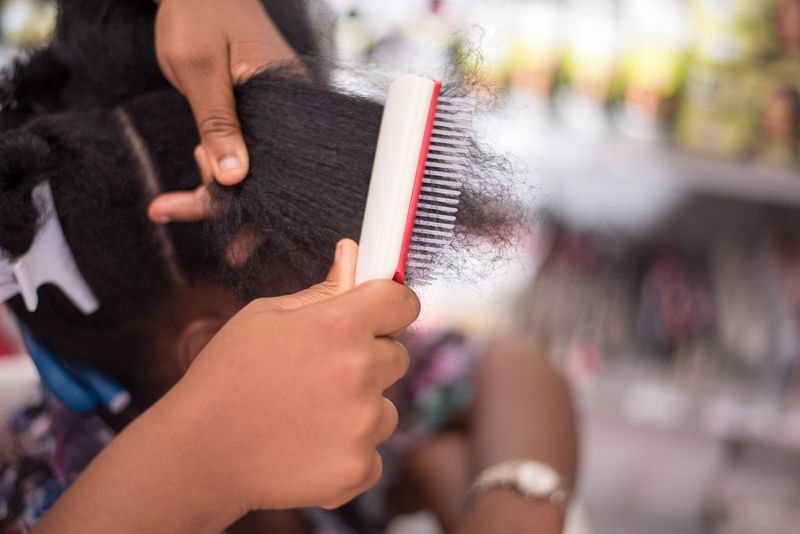
The drug has to reach skin. Hair is dead protein and absorbs nothing. Part in sections across the thinning area, apply along each part, and work it in with your fingertips.
Format matters more than strength. A 24 week randomized trial in 113 women compared once daily 5% foam against twice daily 2% solution. Foam was noninferior on hair count and hair width, beat the solution on agreement that the treatment does not interfere with styling, and caused significantly less itching and flaking. Participants could see which product they had, so those comfort and styling verdicts are unblinded self-report. The 2% solution's inactive ingredients include propylene glycol; the foam has none. If an earlier attempt left your scalp itchy and flaking, change the vehicle before giving up.
The dose is fixed: half a capful of foam once a day, or 1 mL of solution twice a day, and the label says using more or more often will not improve results. Wash your hands well afterward, because unwanted facial hair is the effect most likely to end treatment. The foam is labeled extremely flammable, so let it dry before a hooded dryer or a flat iron.
What to ask before you start
Bring photos of your part in consistent light, and find a dermatologist who treats textured hair.
- What is the name of my diagnosis? Hair loss is a symptom, not an answer.
- Is a scalp biopsy indicated, and are you using dermoscopy to pick the site?
- If there is inflammation or scarring, what treats that alongside minoxidil?
- What date do we review this, and what counts as it working?
Frequently asked questions
Will minoxidil regrow my edges? ▼
Only if the follicles are still there. Traction alopecia can be halted before it becomes permanent, so what decides the outcome is taking the tension off. If the skin at your edges is smooth and shiny with no visible follicle openings, get it examined rather than treated blind.
Does minoxidil work for CCCA? ▼
Not on its own. CCCA is a scarring alopecia and hair already lost to it cannot be regained. Dermatologists who treat it report, from clinical experience rather than from trials, pairing topical minoxidil with steroids or calcineurin inhibitors to halt progression rather than restore what is gone. A 2024 expert panel found no established standard of care for it.
What happens if I stop using it? ▼
You lose the gains. The label is unambiguous: continued use is necessary to increase and keep your regrowth, or hair loss will begin again. Minoxidil retimes the hair cycle only while it is present.
Is 5% better than 2% for women? ▼
Not meaningfully. Cochrane found no difference between 2% and 5% across four trials in 1,006 participants. The largest single trial, 381 women over 48 weeks, found 5% beat 2% on one endpoint only, the patient's own assessment of benefit. What separates them in practice is the routine, and once daily foam is easier to keep up.
Is oral minoxidil safer than topical? ▼
It is differently risky, not safer. Topical delivers about 1.4% of the dose into the body, and the main complaints are scalp irritation and unwanted facial hair. Oral minoxidil is a systemic vasodilator taken off label, so it needs a prescriber who knows your heart history.