Syphilis is curable. One penicillin injection cures the early stages, and a routine blood draw finds it. But syphilis is built to be missed. The first sign is a sore that does not hurt. The next is a rash that fades on its own. Both go away whether or not you are treated, and the infection continues underneath.
The sore you do not feel
Primary syphilis starts as a chancre, a firm, round, painless ulcer where the bacteria entered. It appears 10 to 90 days after exposure, usually around three weeks, and is typically a single sore. It turns up wherever contact happened: genitals, anus, rectum, or mouth. One on the cervix or in the rectum is invisible, and the visible ones get shrugged off anyway, because a painless sore is not what sends people to a clinic.
It lasts three to six weeks, then heals on its own, treated or not. Healing is not recovery. It is the infection moving on, and this is the easiest stage to cure.
The secondary rash, and what it looks like on brown and black skin
Weeks to months later the bacteria spread through the bloodstream, producing the rash that defines secondary syphilis. The most useful cue is where it lands: the palms of the hands and the soles of the feet. Clinical references call palm and sole involvement a singular distinguishing feature, because few other rashes do it.
Now the part textbooks get wrong for us. Standard descriptions call it reddish brown, copper colored, or ham colored, all from photographs of light skin. Dermatology written for darker skin says something else: in black skin, inflammation that would look bright red instead appears reddish brown, violet, grey, or intensely hyperchromic, because background melanin changes what you see. The same review notes secondary syphilis in Black patients can scale heavily enough to look psoriasiform.
Two things make it easy to dismiss. It is usually not itchy, and often faint. Up to one in five people never notice their lesions. One published case describes hyperpigmented macules on the palms and soles that went unnoticed for six months before a dermatologist saw them. Darker marks can linger after the rash clears, since post-inflammatory hyperpigmentation is the most common pigmentation change in black skin.
Secondary syphilis brings more than a rash, and the rest is just as easy to misread:
- Condylomata lata: flat, moist, wart like plaques in skin folds and the anogenital area, highly contagious and often mistaken for genital warts.
- Mucous patches: shallow greyish white patches inside the mouth or on the genitals. Painless, and contagious.
- Patchy hair loss: the classic “moth eaten” scalp pattern, plus thinning eyebrows and beard.
- Whole body symptoms: fever, sore throat, swollen glands, and fatigue.
Why “it went away” means nothing
Syphilis moves through four stages: primary, secondary, latent, and tertiary. The sore and the rash resolve untreated, but the infection has not cleared. It has gone quiet. The latent stage has no symptoms at all, and only a blood test finds it. Early latent means infection within the past year; late latent means longer or unknown, which changes how much penicillin you need. Tertiary syphilis arrives 10 to 30 years later. Most untreated people never reach it, but it damages the heart, blood vessels, and nervous system.
Vision or hearing changes are an emergency at any stage
Syphilis reaching the brain, eye, or ear is not a late complication, though it is often treated as one. The bacteria can invade the central nervous system at any stage, and spinal fluid abnormalities are common in early syphilis even without neurologic symptoms. Ocular syphilis and otosyphilis can too. Any new vision or hearing symptom is urgent, and eye complaints need an ophthalmologist the same day. These forms require IV penicillin for 10 to 14 days, not the single shot.
Community health centers test on a sliding scale and many charge nothing; our directory of free and charitable clinics lists centers by state. At-home kits are self-pay and are not billed to Medicaid, so if you have Medicaid the clinic route will almost always cost less. If you would rather test at home:

Everlywell
At-home STI test panels covering chlamydia, gonorrhea, HIV, herpes, and syphilis, with a mail-in sample and physician-reviewed results online.
Browse at-home STI testsAffiliate link, we may earn a commission at no extra cost to you.
Testing takes two tests, and here is why
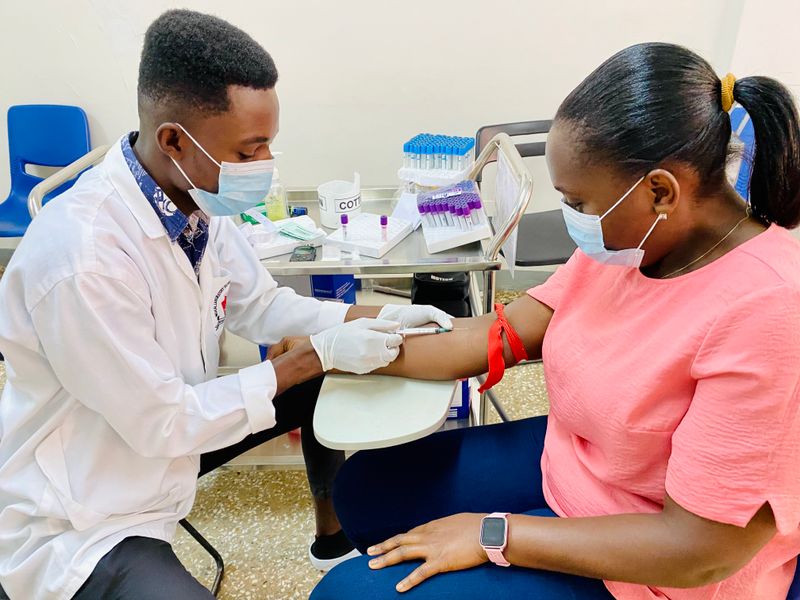
Nontreponemal tests (RPR, VDRL) return a titer, a number like 1:8 or 1:32. Treponemal tests (TP-PA, EIA, CIA) detect antibodies specific to Treponema pallidum. The traditional algorithm screens nontreponemal first, then confirms with a treponemal test. The reverse sequence algorithm, used by most labs now, screens treponemal first. You need both, because each alone misleads.
Roughly 85% of people stay positive on the treponemal test for life, even after a cure. It records that you were infected once, not that you are now. The RPR titer tracks treatment: a fourfold drop, 1:32 to 1:8, means it worked. Expect repeat draws at 6 and 12 months.
The US Preventive Services Task Force gives an A grade to screening nonpregnant adults at increased risk, reaffirmed in 2022. For pregnancy it is also an A grade, reaffirmed in 2025, and broader: screen everyone who is pregnant regardless of risk, as early as possible, and if missed, even at delivery.
Treatment: one shot, and a shortage worth knowing about
Benzathine penicillin G, injected into muscle, is first line. Primary, secondary, and early latent syphilis take a single 2.4 million unit dose. Late latent and tertiary take that dose weekly for three weeks. If you are allergic to penicillin and not pregnant, doxycycline 100 mg twice daily is standard: 14 days for early syphilis, 28 days for late latent. Azithromycin is never acceptable, because of resistance.
Pregnancy is the exception with no workaround. Penicillin is the only therapy with documented efficacy in pregnancy and the only one that treats the fetus. A pregnant patient reporting a penicillin allergy should be desensitized and then treated with penicillin, an established hospital procedure. A dose before 28 weeks, at least 30 days before delivery, is about 98% effective at preventing congenital syphilis.
The Jarisch-Herxheimer reaction is fever, chills, headache, and muscle aches in the first 24 hours after treatment, caused by large numbers of bacteria dying at once. It is not a penicillin allergy, and it passes. If pregnant, tell your obstetric team, since it can trigger early contractions.
The shot is also hard to get. The FDA listed a benzathine penicillin G shortage in April 2023, and a Pfizer recall of Bicillin L-A lots in July 2025 deepened it. As of April 2026 Pfizer estimated recovery in late 2027. Health departments are reserving it for pregnant patients and infants and treating other adults with doxycycline. If you are pregnant and a clinic has none, ask for referral to a health department clinic, which holds reserved supply.
Congenital syphilis is almost entirely preventable with timely testing. We covered it in our report on the congenital syphilis surge and its toll on Black infants.
What the case numbers actually measure
CDC surveillance shows Black Americans accounting for about a third of reported chlamydia, gonorrhea, and primary and secondary syphilis cases, while making up roughly 13% of the population. Reported rates count diagnosed and reported infections, so they measure testing as much as infection. Publicly funded STI clinics report far more completely than private practices, so screening intensity manufactures part of the gap.
CDC states plainly that these disparities are unlikely to be fully explained by differences in sexual behavior, and instead reflect access to quality sexual health care and sexual network characteristics. The mechanism is arithmetic: where background prevalence is higher, each encounter carries a greater chance of involving an infected partner, at identical behavior. Laumann and Youm established this in 1999.
Tuskegee, honestly, and then what you do now
From 1932 to 1972 the US Public Health Service ran the Untreated Syphilis Study at Tuskegee. Researchers enrolled 399 Black men who already had late latent syphilis, plus 201 controls, to watch the disease run its course. The men were not deliberately infected. They were deceived: there is no evidence of informed consent, and treatment was withheld even after penicillin became widely available. It ended only after a reporter exposed it.
That distrust is not irrational. What it should not cost you is care you are entitled to now. Syphilis today is a blood test and, for early infection, one injection. You can ask which test is being run, see your titer, and be treated the day you test positive.
How to get care
Request syphilis testing by name rather than assuming an STI panel covers it. If you test positive, ask to be treated that day and tell partners from the past 90 days to get tested. Health department clinics do this at low or no cost, findable through our state-by-state guide to free STD testing, and you can find a Black clinician in our directory. Syphilis raises HIV risk, so our PrEP guide covers prevention.
Frequently asked questions
What does a syphilis rash look like on black skin? ▼
Often brown, violet, grey, or deeply hyperpigmented patches rather than the bright red or coppery color textbooks describe. It commonly covers the palms and soles and is usually not itchy.
Can syphilis go away on its own? ▼
The symptoms do. The infection does not. The sore heals in three to six weeks and the rash fades whether or not you are treated. Only antibiotics cure it.
How many shots does it take to cure syphilis? ▼
Primary, secondary, and early latent syphilis take one injection of 2.4 million units of benzathine penicillin G. Late latent takes that dose weekly for three weeks.
Why do I still test positive for syphilis after treatment? ▼
About 85% of people stay positive on the treponemal test for life, even after a cure. The RPR titer tracks active disease, and a fourfold drop means treatment worked.
What if I am pregnant and allergic to penicillin? ▼
You still need penicillin. It is the only treatment that reaches the fetus. The standard of care is desensitization, then the normal penicillin course.