"Test me for everything" does not get you tested for everything. A standard panel checks four infections: chlamydia, gonorrhea, HIV, and syphilis. Herpes is not on it. Trichomonas usually is not. And if the only sample you gave was urine, the lab never looked at your throat or rectum, where chlamydia and gonorrhea are common and almost always silent. CDC tells clinicians to name the infections they are not testing for. Most people never hear that sentence.
What a standard panel covers
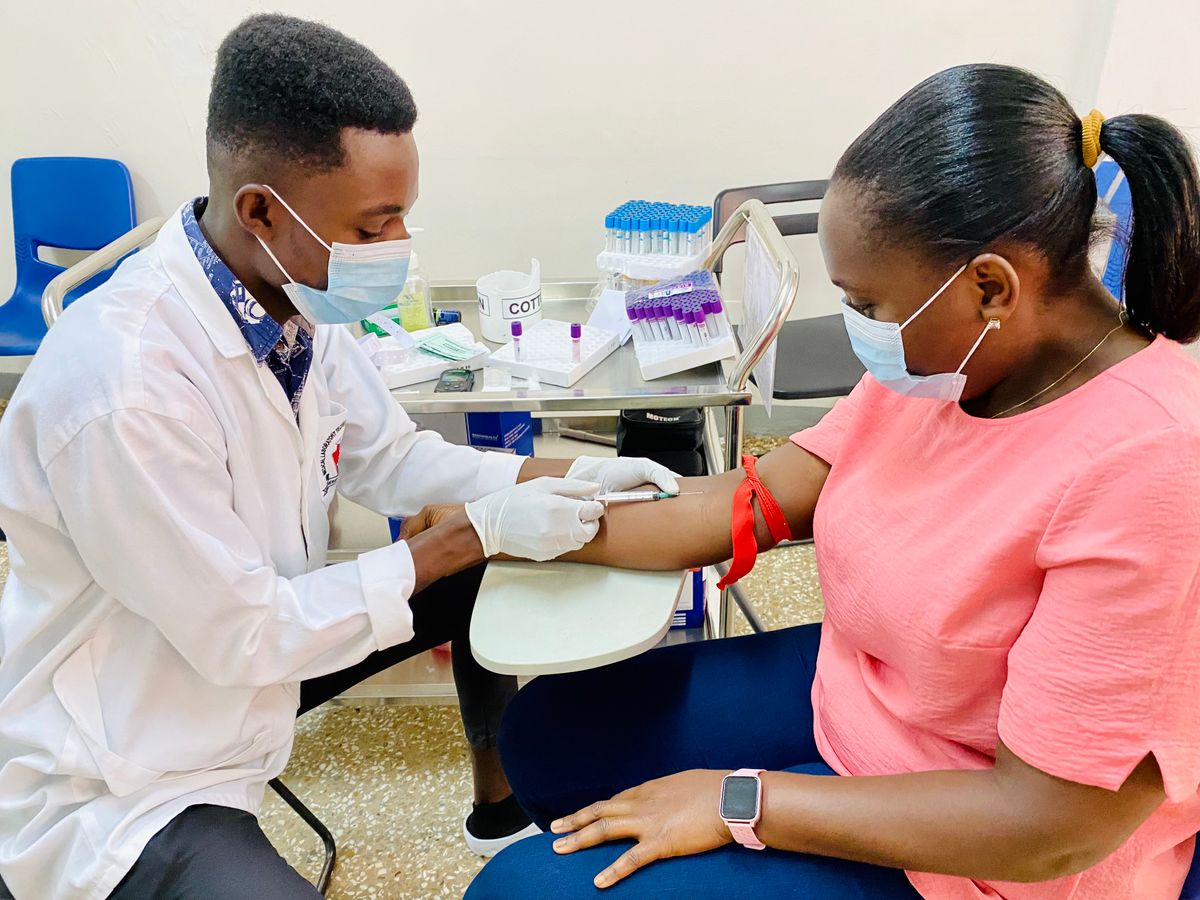
Four infections, two kinds of specimen. Chlamydia and gonorrhea are found by a nucleic acid amplification test (NAAT) run on urine or on a swab of the vagina, cervix, rectum, or throat, whichever the clinician collects. HIV and syphilis are blood tests. Everything below has to be added on purpose.
That default tracks national guidance. The US Preventive Services Task Force recommends HIV screening for everyone aged 15 to 65 (grade A), syphilis screening for people at increased risk (grade A, 2022), and chlamydia and gonorrhea screening for sexually active women 24 and under (grade B, 2021). For men it found the evidence insufficient either way. That does not mean men do not get chlamydia. It means the trials were never run, and a man asking for the works gets a thinner panel.
What it skips, and why
Herpes
Type-specific HSV blood tests are left off deliberately. The USPSTF recommends against routine herpes serology in asymptomatic adults, including pregnant people (grade D, 2023), because the tests produce too many false positives in people at low risk. CDC agrees: a false positive is far likelier here than with chlamydia. Our guide to genital herpes in Black men covers when a swab beats a blood test.
So the honest advice is not "demand an IgG." Herpes testing is a conversation with a reason behind it: genital symptoms, a partner who has told you they have HSV, or pregnancy planning. If you have a sore now, swabbing it beats blood. A low-positive antibody result should be confirmed before anyone gives you a diagnosis. It matters here because the routine panel omits a virus roughly one in three Black adults already carries. Our guide to HSV-2 in Black women covers what a positive result means.
Your throat and your rectum
The most actionable item on the list. A urine NAAT detects urethral infection and nothing else. Chlamydia and gonorrhea in the rectum or throat are separate infections needing swabs of those sites, and they are usually asymptomatic, so nothing tells you they are there.
In a CDC surveillance study of 21,994 men who have sex with men at STD clinics, more than 70% of extragenital gonorrhea and 85% of extragenital chlamydia infections occurred in people whose urethral test at that same visit was negative. On urine alone they would have gone untreated. Even in those clinics, only about half of patients were tested rectally.
Not only a question for men who have sex with men. A review of extragenital infection found rectal chlamydia in women at a median of 8.7% across studies, often in people reporting no receptive anal or oral sex. CDC tells clinicians that rectal and pharyngeal testing for women "can be considered" through shared decision-making, so it happens only if someone raises it, and clinicians often do not ask. If you have receptive anal or oral sex, say so and name those sites.
Community health centers test on a sliding scale and many charge nothing; our directory of free and charitable clinics lists centers by state. At-home kits are self-pay and are not billed to Medicaid, so if you have Medicaid the clinic route will almost always cost less. If you would rather test at home:

Everlywell
At-home STI test panels covering chlamydia, gonorrhea, HIV, herpes, and syphilis, with a mail-in sample and physician-reviewed results online.
Browse at-home STI testsAffiliate link, we may earn a commission at no extra cost to you.
Trichomonas, HPV, and M. genitalium
Trichomoniasis is common and curable, but CDC has not established a benefit to screening people without symptoms, so it is ordered only when symptoms show. Testing in men is the weak link, which is how a man carries it untreated and reinfects a partner (see trichomoniasis in Black women). HPV has no test for men at all: CDC states HPV tests belong to cervical cancer screening, are not useful for men of any age, and are not a general STI test. If you have a cervix, that runs on the schedule in our guide to cervical cancer screening. Mycoplasma genitalium has a test, but CDC does not recommend screening asymptomatic people.
A test taken too soon is a wrong test
Every test has a window period, when the infection is present but undetectable. Test inside it and the negative is false. HIV shows on a nucleic acid test 10 to 33 days after exposure, on a lab antigen/antibody test 18 to 45 days, and on an antibody-only test 23 to 90 days. Syphilis incubates 10 to 90 days, so serology drawn days after an exposure can be nonreactive, and CDC recommends repeating the nontreponemal test 2 to 4 weeks later when the history suggests recent infection. Herpes antibodies can take 16 weeks or more. For chlamydia and gonorrhea, one rule beats any number: if you were exposed to a partner with either, you get treated regardless of your result.
So give the clinician the date of the exposure and expect a repeat rather than treating one negative as final. If you test positive for chlamydia or gonorrhea, get rescreened three months later. Not because the first course failed, but because of reinfection from an untreated partner.
Why the testing gap costs Black patients more
Reported STI rates are higher in Black communities, and the reason is not different behavior. Start with what the numbers are. CDC surveillance counts diagnosed and reported cases, and CDC says in its own technical notes that reported counts rise as more people are screened even when real incidence is flat. Publicly funded clinics screen and report more completely than private practices, and Black patients are overrepresented in them, so part of the measured gap is a measurement effect of unknown size. CDC adds that racial differences cannot be read without the structural factors case reports miss, including systemic racism.
The real part is network structure. In a nationally representative survey analysis, the elevated bacterial STI rate among Black Americans persisted after controlling for individual risk factors, and the explanation was the shape of sexual networks, not anything a person does: where background prevalence in a partially segregated network is higher, a single sexual act carries more risk even for someone with one partner. A CDC review traces that to segregation, poverty, and incarceration. What follows is not caution about partners. It is speed.
How to ask, in words you can say
- "Which infections does this panel cover, and which is it not?" CDC already tells clinicians to answer this unprompted.
- "I have receptive anal and oral sex. Swab my throat and rectum for chlamydia and gonorrhea, not just urine." Name the sites. A urine sample cannot be redirected afterward.
- "Should I be tested for herpes, given my situation?" A decision, not a demand. Give the facts that drive it: symptoms, a partner with HSV, pregnancy.
- "My exposure was on this date. Am I inside the window, and when should I come back?"
Where to get tested without insurance
Health department STI clinics test and treat, often free or sliding-scale, and CDC runs a finder at gettested.cdc.gov. See our own free STD testing sites by state for the community health centers and health department clinics near you. Title X family planning clinics are the widest low-cost network: people at or below the federal poverty level pay nothing, and those between 100% and 250% of it pay on a sliding scale. Federally qualified health centers, searchable at findahealthcenter.hrsa.gov, must offer income-based discounts and can treat you, not just test you. At-home options are now FDA-authorized: the first at-home collection kit for chlamydia and gonorrhea cleared in November 2023, the first over-the-counter syphilis test in August 2024. Read FDA's caveat on the latter: a reactive result is not a diagnosis, it needs lab confirmation, and it stays positive in people treated years ago. Neither swabs your throat or rectum.
The Affordable Care Act requires most plans to cover USPSTF grade A and B screening with no copay: HIV at ages 15 to 65, syphilis for people at increased risk, chlamydia and gonorrhea for women 24 and under. It does not federally require no-cost coverage of that screening in men, of herpes serology, or of trichomonas testing. Ask the price first.
How to get care
Book the visit with those four asks on your phone, plus the date of your last exposure and the sites you need swabbed. If you want a clinician who treats sexual health as routine care, find a Black primary care clinician or OB-GYN in our directory. If anything comes back positive, ask about partner treatment in the same visit.
Frequently asked questions
Does a standard STI panel test for herpes? ▼
No. The USPSTF recommends against routine herpes serology in people without symptoms because false positives are common. Ask for it when there is a reason: symptoms, a partner with HSV, or pregnancy planning. If you have a sore, swabbing it is better.
If I gave a urine sample, was I tested for everything? ▼
No. A urine NAAT detects chlamydia and gonorrhea in the urethra only. More than 70% of extragenital gonorrhea and 85% of extragenital chlamydia occur in people whose urethral test is negative at the same visit.
How long after sex should I wait to get tested? ▼
It depends. HIV shows on a lab blood test 18 to 45 days after exposure and on a nucleic acid test 10 to 33 days. Syphilis incubates 10 to 90 days, so early serology can be negative. Herpes antibodies can take 16 weeks or more.
Why are reported STI rates higher in Black communities? ▼
Neither reason is behavior. Reported rates rise with screening intensity, and Black patients are overrepresented at publicly funded clinics that screen and report more completely, so part of the gap is measurement. The rest reflects sexual-network prevalence shaped by segregation and delayed treatment.