If you are looking at a scaly patch on your child's scalp right now, the fastest way to sort it out is to look for three things: scaling, hair loss, and hairs that are broken off instead of grown out. Scalp ringworm is curable, and children go back to school once treatment starts. What it does not do is clear on its own or respond to shampoo from the drugstore aisle.
The care system misses this infection often, and it misses it in ways you can catch. Knowing the signs and the treatment standard puts you in a position to ask for the right test and the right prescription in one visit.
What scalp ringworm looks like on a Black child
Non-inflammatory scalp ringworm shows up in three ways, and only one of them looks like the ring people expect.
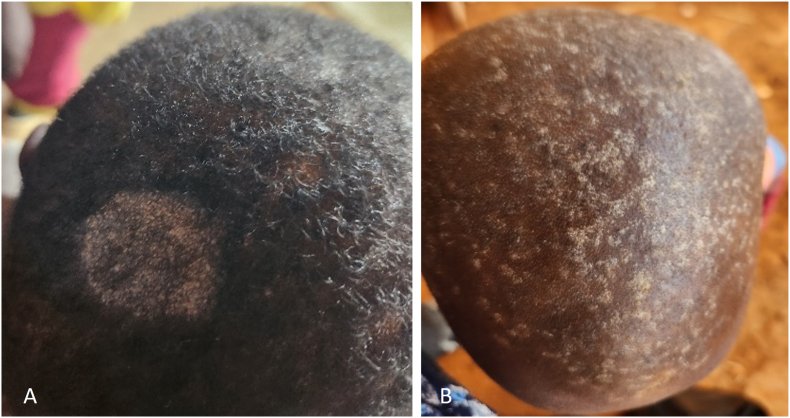
The first is fine, white, adherent scaling spread across the scalp or in patches, with only subtle hair loss. It looks like generalized dandruff or a dry scalp. That is the presentation that gets treated as dandruff for months.
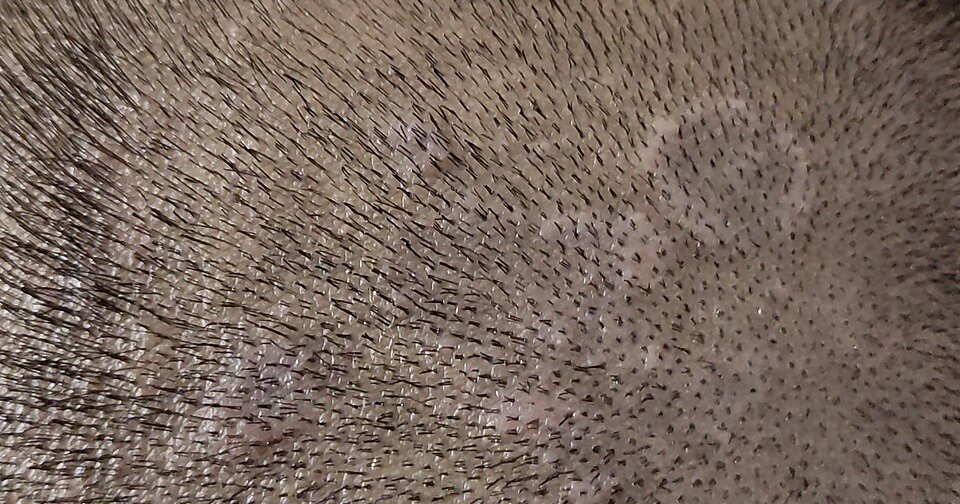
The second is one or more grey, scaly, circular patches where hair has thinned or gone.
The third is the black-dot pattern: a well-defined patch of hair loss with fine scale, studded with hairs broken off right at the scalp surface. In tightly coiled hair those broken hairs sit flush with the skin and read as dark specks inside the patch rather than stubble you can feel, so it is easy to look past on a quick glance. This is the dominant form in the United States because Trichophyton tonsurans is the dominant organism here, and it most commonly affects children of African heritage between three and nine years old.
Two more checks. Crusting on the patch points toward infection rather than dry scalp. And run your fingers along the sides and back of your child's neck: swollen lymph nodes at the neck and the back of the head usually come with scalp ringworm, though swollen nodes can also happen with scalp problems that are not fungal.
Why Black children carry the highest burden of this infection
In a national study of 4,148,385 Medicaid-enrolled children, the one-year incidence of tinea capitis among non-Hispanic Black children was 129.6 per 10,000 person-years, the highest figure in the entire study. Incidence peaked at ages 3 to 5 (118.4 per 10,000 person-years), and boys were affected more than girls (71.2 compared with 46.6).
It is also common at the community level, not rare. When researchers cultured the scalps of 10,514 elementary schoolchildren across 44 schools in the Kansas City area, 6.6% grew T. tonsurans. Among Black children the rate was 12.9%, approaching 18% in the youngest children, and rates at individual schools ran from 0% to 19.4%.
The organism spreads person to person and sits silently in households and classrooms, so once it is established in a community it keeps recirculating. The researchers who ran the Medicaid study were direct about the limits of their data: they had no information on income, housing or geography, so they could not identify the underlying causes of the difference in rates. What their data did document is a care problem, covered below: most diagnosed children were never tested, and a large share never got the medicine that works.
Kerion: the presentation that needs an appointment this week
A kerion is the inflammatory extreme of scalp ringworm. It is a delayed hypersensitivity reaction to the fungus, not a bacterial abscess, so draining it or treating it with antibiotics alone does not fix it.
What you see is a boggy, tender, raised plaque with pustules on it. It can look alarming, and it should be taken seriously.
In a review of 80 children treated for kerion celsi at a specialty pediatric dermatology center, 27.5% were left with permanent hair loss. Children who ended up with permanent hair loss had actually come in earlier on average, not later, and outcomes did not differ by which fungus was found or which antifungal was used, so delay alone does not explain the scarring. The authors suggest the host immune response and the aggressiveness of the fungus as factors future studies should examine. That was a single center outside the United States with 80 patients, so read it as what it is: the experience of children treated for kerion at a specialty clinic, not a national rate.
Drug choice also changes for kerion. Family medicine guidance directs griseofulvin unless Trichophyton has been documented as the cause, and states plainly that failing to treat a kerion promptly can lead to scarring and permanent hair loss.
Common skin conditions are treated in primary care, and community health centers charge on a sliding scale that is often $0. Our directory of free and charitable clinics lists verified centers by state. A same-day telehealth visit is self-pay and cannot be billed to Medicaid or commercial insurance, so the clinic route usually costs less. If you need a prescription sooner than the next appointment:
Affiliate
Why the cream will not work, no matter how long you use it
CDC states it directly: ringworm on the scalp usually needs prescription antifungal medication taken by mouth for 1 to 3 months, and creams, lotions or powders do not work for ringworm on the scalp.
The reason is anatomy, not strength or patience. Topical antifungals do not penetrate the root of the hair follicle deep in the dermis, which is exactly where the fungus is living. A stronger cream or a longer month of it does not change that. Topicals and medicated shampoos still have a job, but only as an add-on to the oral medicine, to cut down the spores your child sheds.
This is where care commonly goes wrong. Among 24,536 Medicaid-insured children diagnosed with tinea capitis, only 13.3% received any confirmatory diagnostic test, 15.0% were given topical antifungal therapy alone, and more than 30% never received the systemic antifungal the infection requires. Most children were treated on a look rather than a diagnosis.
The oral medicine: what it is, how long, and what to expect
Current US family medicine guidance names terbinafine as the preferred treatment for tinea capitis, with shorter courses than griseofulvin. That recommendation carries evidence rating A, the strongest rating, based on a Cochrane review of randomized controlled trials.
In that Cochrane review of 25 trials covering 4,449 children, terbinafine beat griseofulvin specifically in children infected with T. tonsurans, the organism behind most US cases: 52.1% complete cure compared with 35.4%. Griseofulvin is not obsolete. It was the better drug for Microsporum infections, and it is the directed choice for a kerion when the organism has not been confirmed. That is why the test matters: the right drug depends on which fungus it is.
On safety, so no one abandons treatment halfway: side effects were similar for the two drugs (9.2% and 8.3%), severe adverse events were rare at 0.6% in each group, and adverse events across all the oral antifungals studied were mild and reversible.
Expect 1 to 3 months of oral medication. Cure rates are not 100%, so a follow-up visit at the end of therapy is part of the plan, not an optional extra. Finish the full course even after the scalp looks normal.
Stopping it in the house: contacts, combs, and clippers
Treating only the child with the visible patch is a common reason families relapse. Among 114 household contacts of children with tinea capitis, 16% were carrying the fungus with no visible signs of infection at the first visit, and 32% of families had at least one carrier. Every carrier sample was Trichophyton tonsurans, the same organism, so the household itself is the reservoir.
Comb sharing (78%) and cosleeping (75%) were common in those households. The study was too small to show whether either practice was statistically linked to carrying the fungus, and the authors say only that these may be important factors in how it spreads.
What guidance says to do: household members should be clinically evaluated, and many experts recommend treating all close contacts who have no symptoms with a sporicidal shampoo, either 2.5% selenium sulfide or 2% ketoconazole, for two to four weeks. During treatment, combs, brushes, hats, headwraps, bonnets, pillowcases and helmets stop circulating.
Barbershops and salons come up constantly. The plausible route is shared cutting tools: clippers, guards and combs that move from head to head. No US study has measured how often this actually causes infection, so treat it as a reasonable precaution rather than a known risk. Ask your barber directly how clippers and guards are disinfected between clients, and consider bringing your child's own guards.
School, sports, and the 14-day rules
Once treatment has started, your child may return to school. Exclusion is not the standard once oral therapy has begun, and no child should lose weeks of instruction to this infection.
For 14 days after treatment starts, your child should not share combs, brushes, helmets, hats or pillowcases, and should not play sports that involve head-to-head contact, such as wrestling.
Ask the prescriber for a note stating the date oral antifungal therapy began, at the visit rather than by phone later. That date is usually what a school office needs.
Ringworm, traction alopecia, or CCCA: telling them apart
Parents often worry that a bald patch is the beginning of the permanent hair loss they have seen in adult relatives. Usually it is not, and the differences are learnable.
Scalp ringworm is an infection: scaling, hairs broken at the skin line, crusting, itch, swollen neck nodes, a patch that spreads. It is curable with oral medication.
Traction alopecia comes from styles that pull. The hairline is one of the first places you can see it, and children can get it.
Central centrifugal cicatricial alopecia (CCCA) is not contagious. It is a scarring hair loss rather than an infection: it often begins as a small, round, balding patch in the center or crown of the scalp and grows outward, destroying hair follicles and replacing them with scar tissue, which is why the loss can be permanent. It is the most frequent cause of scarring hair loss in African American women in the United States and usually begins during middle age.
They overlap in one place worth knowing: a kerion, the inflammatory form of ringworm, can itself leave permanent scarring. That is an argument for treating an infection early rather than waiting it out.
Hair care practices are not what causes tinea capitis. In a study of 201 Black girls aged 1 to 15, no hair care practice was significantly associated with tinea capitis, and there was specifically no association between how often hair was washed, or hair grease use, and tinea capitis. (That study surveyed caregivers rather than culturing each child, and included girls only.) The same study did find cornrows significantly associated with traction alopecia, a separate, non-infectious condition, in one of the two clinic groups surveyed. Braiding, greasing, or washing on a two-week cycle did not give your child this infection.
What to ask for at the appointment
Bring this list:
- A confirmatory test: fungal culture or KOH microscopy. Only 13.3% of diagnosed children in the Medicaid study got one.
- An oral antifungal, not a cream or shampoo alone.
- Which drug and why. Terbinafine is preferred first-line; griseofulvin is directed for Microsporum and for a kerion when the organism has not been confirmed.
- Medicated shampoo for the household, and an evaluation for everyone at home.
- A school note with the date oral therapy started.
- A follow-up appointment at the end of therapy.
- If the scalp is boggy, tender or oozing, ask to be seen this week and say the word kerion.
If you need a clinician, the Black Health provider directory can help you find a pediatrician or dermatologist near you.
Frequently asked questions
Can my child go to school with scalp ringworm? ▼
Yes. Once treatment has started, your child may return to school. Exclusion is not the standard once oral therapy has begun.
For 14 days after treatment starts, no sharing combs, brushes, helmets, hats or pillowcases, and no sports involving head-to-head contact such as wrestling.
Ask the prescriber for a note stating the date oral antifungal therapy began, since that is usually what a school office needs.
Why did the antifungal cream not work? ▼
Because it cannot reach the fungus. Topical antifungals do not penetrate the root of the hair follicle deep in the dermis, which is where the infection lives.
CDC states directly that creams, lotions and powders do not work for ringworm on the scalp, and that scalp ringworm usually needs prescription medication taken by mouth for 1 to 3 months. Medicated shampoo and topical antifungals still help as an add-on to the oral medicine, to reduce spore shedding.
This gap is common: 15.0% of Medicaid-insured children diagnosed with tinea capitis received topical therapy alone, and more than 30% never received a systemic antifungal. Never use an over-the-counter steroid cream on it, because steroids make ringworm worse and change how it looks, which makes later diagnosis harder.
Is it dandruff, dry scalp, or ringworm? ▼
Tinea capitis can present as diffuse or patchy fine white adherent scaling that resembles generalized dandruff with only subtle hair loss, which is exactly why it gets missed.
Signs that push it toward ringworm: hairs broken off flush at the scalp leaving black dots, a defined bald patch, crusting, and intense itch. Check for swollen lymph nodes at the neck and the back of the head, which usually come with tinea capitis, though they can occur with non-fungal scalp problems too.
Dandruff does not cause hair to snap off at the skin line. Any scaling patch with hair loss should be tested with a fungal culture or KOH microscopy rather than treated by eye.
Will my child's hair grow back? ▼
In ordinary non-inflammatory scalp ringworm the hair loss is not scarring, and hair regrows once the infection is cured with oral antifungal therapy.
Kerion is the exception. Among 80 children treated for kerion celsi at a specialty pediatric dermatology center, 27.5% were left with permanent hair loss, and failing to treat a kerion promptly can lead to scarring. A boggy, tender, pus-filled scalp swelling is a same-week visit.
Finish the full 1 to 3 month oral course even after the scalp looks clear, and keep the end-of-therapy follow-up. A patch that keeps growing after the infection is cured is a reason to be re-evaluated.
Did my child's hair care or hairstyle cause this? ▼
No. In a study of 201 Black girls aged 1 to 15, no hair care practice was significantly associated with tinea capitis, including how often hair was washed and whether hair grease was used. That study surveyed caregivers rather than culturing each child, and included girls only.
Tinea capitis is a transmissible infection with Trichophyton tonsurans. It passes person to person and through shared combs, brushes, hats and pillowcases, and it circulates in households and schools. In one household study, 16% of contacts were carrying the fungus with no visible signs and 32% of families had at least one carrier.
The same hair care study did link cornrows to traction alopecia, a separate non-infectious condition, in one of the two clinic groups surveyed. Treat those as two different questions.
Does everyone in the house need treatment? ▼
Everyone in the household should be clinically evaluated, and many experts recommend treating all close contacts who have no symptoms with a sporicidal shampoo, either 2.5% selenium sulfide or 2% ketoconazole, for two to four weeks.
The reason is silent carriage: 16% of household contacts carried the fungus with no visible signs of infection, 32% of families had at least one carrier, and every carrier sample was Trichophyton tonsurans.
Only the child with the infection needs the oral medication, unless another household member is found to be infected. Stopping shared hair tools matters alongside the shampoo.