Dandruff is a yeast problem, not a moisture problem
The regulation governing every over-the-counter anti-dandruff product sold in the United States defines dandruff as a condition involving an increased rate of shedding of dead epidermal cells of the scalp. Seborrheic dermatitis gets its own definition in the same rule: a condition of the scalp or body characterized by irritation, itching, redness, and excess shedding of dead epidermal cells.
Dermatology research treats those two as one continuous spectrum rather than separate diseases. Dandruff is the mild end: itchy, flaky, scalp only, no visible inflammation. Seborrheic dermatitis is the same process turned up, with inflamed scaly patches that can also take the eyebrows, the creases beside the nose, behind the ears, the beard and the mid-chest. The driver is a yeast. Malassezia lives on nearly everyone's skin and feeds on the lipids in sebum. In susceptible people it sets off inflammation and the scalp sheds cells faster than it should. The strongest practical evidence for that link is that both conditions improve on treatments whose only job is to knock the yeast back.
Dry scalp is a moisture problem, and the flakes give it away
Dry scalp is xerosis: plain dehydration of the skin on your head, the same thing that makes shins ashy in February. The flakes are small, white and dust-like, they fall loose instead of sticking, and the scalp feels tight with no thick greasy patches underneath. It tracks to a trigger you can name, like winter air, hot water, a sulfate-heavy shampoo or a chlorinated pool, and it settles within a week or two once the trigger stops. Notice also that the FDA monograph covers dandruff, seborrheic dermatitis and psoriasis and has no category for dry scalp. Dry scalp is a symptom, not a diagnosis with its own drug class.
The cheapest test costs nothing. For two weeks, drop the harsh cleanser and add moisture. Real dryness improves. Dandruff does not budge, or gets worse, because what you added is food.
On Black skin, seborrheic dermatitis often does not look red
Redness is the sign most people are told to look for, and on brown and Black skin it is the least reliable one. The dermatology literature on seborrheic dermatitis in skin of color describes scaly hypopigmented macules and patches in the usual places, plus arcuate or petal-shaped patches, called petaloid seborrheic dermatitis, that look nothing like the textbook photograph. Pigment change once the inflammation quiets, lighter or darker, is a feature of the condition in richly pigmented skin rather than a separate problem. In children of color the classic greasy yellow cradle cap look is often absent, and what shows up instead is flaking with lightened areas in the affected skin and folds. Judge by scale, itch and pattern. Lighter patches under the flaking are consistent with seborrheic dermatitis, not evidence against it.
Why wash-less advice and medicated-shampoo labels collide
Textured hair is washed on a longer cycle, and that is measured, not folklore. A case-control study comparing African American and white women found self-reported washing frequency differed significantly between the two groups. A survey of caregivers of 201 African American girls aged 1 to 15 found 61% washed every two weeks, 99% used hair oils or grease, 80% used hot combs and 42% used chemical relaxers.
Now read the labels. The FDA direction printed on every over-the-counter dandruff shampoo is For best results use at least twice a week or as directed by a doctor. Over-the-counter ketoconazole 1% shampoo says to use it every 3 to 4 days for up to 8 weeks, then only as needed. Twice a week on a two-week wash cycle is not a schedule. It is a contradiction, and most people resolve it by quietly giving up.
Common skin conditions are treated in primary care, and community health centers charge on a sliding scale that is often $0. Our directory of free and charitable clinics lists verified centers by state. A same-day telehealth visit is self-pay and cannot be billed to Medicaid or commercial insurance, so the clinic route usually costs less. If you need a prescription sooner than the next appointment:
Affiliate
The American Academy of Dermatology addresses this head on: If you have straight or wavy hair, you may use dandruff shampoo 2 to 3 times a week. However, if you have curly or tightly coiled hair, your dermatologist may recommend using the shampoo once a week. That is expert guidance, not a trial result. The studies behind the twice-weekly numbers never tested a once-weekly schedule on coiled hair.
Two honest limits. That same survey found no association between washing frequency and either seborrheic dermatitis or tinea capitis, so washing less is not what causes this, at least in the one cross-sectional study that asked. And the analysis usually cited for the claim that these shampoos work the same on everyone is a pooled review of seven trials, 1,114 people, run by scientists at Procter and Gamble on the company's own zinc pyrithione technology. It found no difference by gender, and the only ethnic comparison it had the numbers for was Asian against white. There was no Black subgroup in it at all, so whether these products perform identically on tightly coiled hair has not been tested.
How to use an antifungal shampoo on textured hair without wrecking it
The goal is medicine on the scalp, moisture on the hair. Two products, two jobs, one wash day.
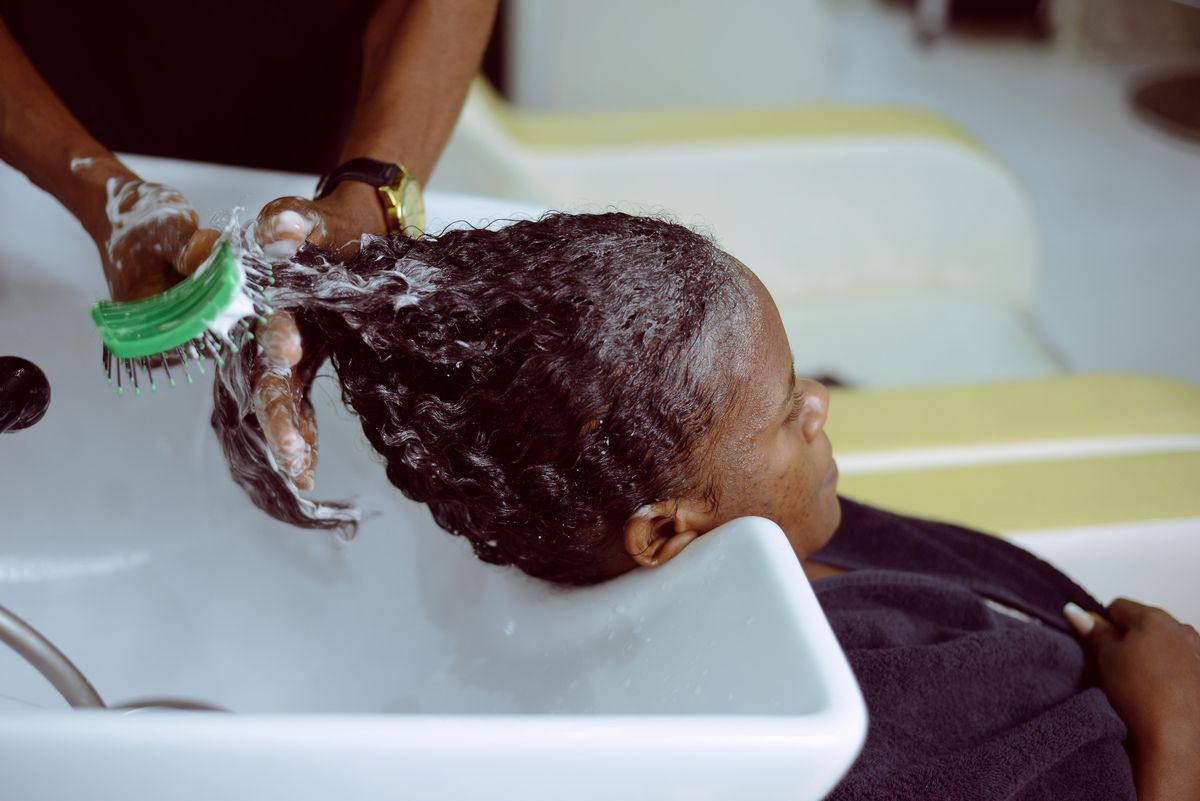
- Part in sections. Four to eight parts, and apply the medicated shampoo straight to the scalp with an applicator tip or your fingertips. The hair shaft is not what you are treating, and coating it is what makes people say medicated shampoo ruined their hair.
- Leave it on. Contact time is the active ingredient's entire opportunity. The AAD says to leave it on the scalp for as long as your dermatologist recommends. Absent a number, follow the bottle.
- Rinse, then treat the hair separately. Moisturizing or deep conditioner on the lengths and ends, kept off the scalp.
- Give it four weeks. In a trial of 331 people with severe dandruff or seborrheic dermatitis, twice-weekly shampooing for four weeks cut the total dandruff severity score by 73% with ketoconazole 2% against 67% with zinc pyrithione 1%, and recurrences were fewer.
- Then maintain, do not stop. This relapses. Keep whatever cadence held it down.
On which active: the FDA monograph recognizes pyrithione zinc (0.3% to 2% in a rinse-off product), selenium sulfide 1%, coal tar 0.5% to 5%, salicylic acid 1.8% to 3% and sulfur 2% to 5%. Ketoconazole 1% is sold over the counter under its own approval rather than the monograph. Salicylic acid works on the scale; the rest work on the yeast. A randomized comparison in 64 adults with moderate to severe scalp seborrheic dermatitis found 1% selenium disulfide and 2% ketoconazole about equal over four weeks, a 71% against 69% drop in severity, both improving by day 3. Two of that study's authors are employees of Vichy Laboratoires, which sells the selenium disulfide shampoo that finished marginally ahead, so read the result as a tie between two working actives rather than as a win for one. Check the warnings on your own bottle; they differ by product.
Product buildup is a fourth thing, and it is not dandruff
Residue from gels, dry shampoo, heavy butters and styling creams collects at the roots and lifts off in soft waxy sheets or crumbs rather than fine flakes. It rarely itches, comes off in one clarifying wash, and stays gone until the products come back.
The folk rule is that grease causes dandruff. The one dataset we found points the other way. Among those 201 African American girls, essentially everyone used hair oils or grease, and it was infrequent oil use that was associated with reported seborrheic dermatitis (adjusted odds ratio 3.69), along with hair extensions (adjusted odds ratio 2.37). Read it carefully before acting on it: cross-sectional survey, caregiver-reported diagnoses, small sample, and families already dealing with flaking may have changed what they used. Associations are not causes. It is not permission to grease a flaking scalp, since Malassezia feeds on those lipids. It is a reason to stop treating oil as the villain and start treating the yeast.
When it is psoriasis, ringworm, or hair loss instead
Scalp psoriasis. Thicker plaques with silvery or gray scale, sharply edged, often crossing the hairline onto the forehead, ears or neck. It gets mistaken for stubborn dandruff for years, and it has real treatment: in the skin-of-color cohort of the VISIBLE trial, 108 people with moderate to severe scalp psoriasis, 68% on guselkumab reached clear or almost clear scalp at week 16 against 12% on placebo.
Tinea capitis, scalp ringworm. Scaly patches with broken hairs, black dots where hairs snapped at the surface, sometimes a boggy tender swelling and swollen neck glands. In a study of 300 prepubertal children, 66 (22%) had scalp scaling and 9 of the 300 (3%) grew a dermatophyte on culture; all nine were Black children and all nine grew Trichophyton tonsurans. Adults get it too, though the published numbers are small. A review of scalp fungal cultures at one New York center identified 79 cases of tinea capitis, of which only nine were in adults, and seven of those nine were African American women, average age 46. Seven cases is the entire basis for that pattern, so treat it as a reason to ask for a scalp culture rather than as a prevalence figure. No shampoo cures it. It needs an oral antifungal, and the Cochrane review of 25 trials and 4,449 children found terbinafine beat griseofulvin specifically for T. tonsurans, 52% against 35% complete cure.
Hair loss alongside the flaking. Thinning that starts at the crown and spreads outward, or a scalp that is tender, burning or sore, is a different problem. Get it looked at rather than trying a fifth shampoo.
No improvement after four weeks of correct use. That is the warning the FDA requires on every one of these products. Prescription options exist, including ciclopirox shampoo, short-course topical steroids and topical calcineurin inhibitors.
Frequently asked questions
How do I tell dandruff from dry scalp at home? ▼
Look at the flakes and at the scalp underneath. Dry scalp gives small, white, loose flakes, a tight feeling and no thick patches, and it improves once you stop the trigger and add moisture. Dandruff gives larger, oilier scale that sticks, often on patches you can feel with a fingertip, with itch that keeps returning. If adding oil made it worse, it is dandruff.
Is once a week enough for medicated shampoo on textured hair? ▼
It may be. The American Academy of Dermatology says people with curly or tightly coiled hair may be advised to use dandruff shampoo once a week, against 2 to 3 times a week for straight or wavy hair. That is expert guidance rather than a trial result, so treat it as a starting point and ask your clinician to set your cadence. Getting the product onto the scalp and leaving it there matters more than how often you lather.
Does hair grease cause dandruff? ▼
The only survey data we could find points the other way. Among 201 African American girls, 99% used hair oils or grease, and it was infrequent oil use that was associated with reported seborrheic dermatitis. That is a cross-sectional survey with caregiver-reported diagnoses, so it proves nothing about cause. What is established is that Malassezia feeds on scalp lipids, so oil is not a treatment even if it is not the cause.
Can I get dandruff under braids, locs or a wig? ▼
Yes. The scalp is still there, still producing sebum, and now you cannot see it. In that same survey, wearing hair extensions was associated with reported seborrheic dermatitis (adjusted odds ratio 2.37), with the same study-design caveats. Use a bottle with an applicator tip so the product reaches between the braids, and do not keep a style in past the point where you can treat your own scalp.
How long does dandruff shampoo take to work? ▼
Trials measure improvement within days and full effect around four weeks. In a 64-person head-to-head of 1% selenium disulfide against 2% ketoconazole, co-authored by two employees of the company that sells the selenium disulfide shampoo, severity scores had already fallen by day 3 and both groups were down roughly 70% by day 28. Every over-the-counter product carries the FDA-required warning to see a doctor if the condition worsens or does not improve after regular use as directed.
Can dandruff make my hair fall out? ▼
Flaking on its own is not the usual cause of lasting hair loss, but scratching an inflamed, scaly scalp causes breakage. Hair loss that begins at the crown and spreads outward, especially with tenderness or burning, is a separate condition and should be evaluated by a clinician rather than treated with another shampoo.