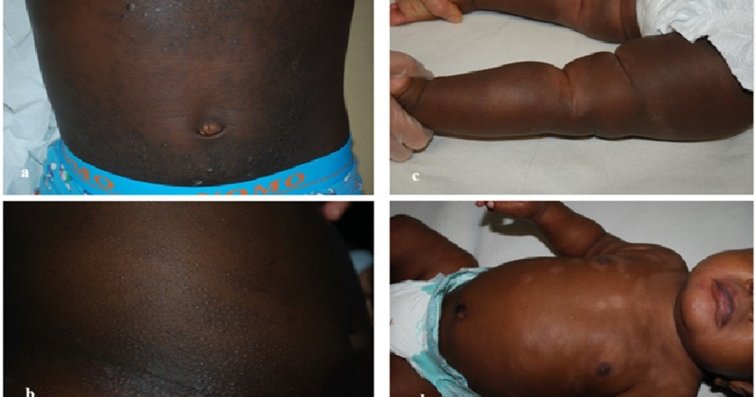
Eczema on a Black baby rarely looks red. It looks gray, violet, or a deeper brown than the skin around it, often as tiny rough bumps on the outer arms, legs, and trunk rather than smooth patches in the creases. In 2021, 14.2 percent of non-Hispanic Black children in the United States had diagnosed eczema (NHIS). The scores clinicians use to grade severity are built on redness and fail on highly pigmented skin, so a Black infant's eczema is routinely graded milder than it is and treated later than it should be.
What eczema looks like on a Black baby
Start with color. The AAD describes atopic dermatitis on darker skin tones as dark brown, purple, or grayish areas of skin and small, rough bumps that run gray to violet-brown. In a 2026 pediatric dermatology series of children with skin of color (Dondi et al., Life), erythema was often subtle or absent. If you are waiting for red before you act, you will wait too long.
Then look at pattern and place. In babies of every skin tone, eczema starts on the cheeks, forehead, and scalp and usually spares the diaper area (AAP). On dark skin it favors the outer (extensor) surfaces of the arms and legs and the trunk, and it clusters around follicles: a field of tiny bumps that feels like sandpaper. In a 2024 series of 128 children with atopic dermatitis at an Italian children's hospital (Herzum et al.), 53 had skin of color; among them, 45 percent had extensor eczema, 32 percent had prurigo-type nodules (thick, scratched-open bumps), and 40 percent had severe or extreme dryness.
The marks eczema leaves behind are part of the disease. Pityriasis alba, the pale, faintly scaly patches on the cheeks and arms, turned up in 47 percent of Herzum's children with skin of color; darker, thickened areas follow months of scratching. The AAD says it directly: after healing, skin may be lighter or darker where you had atopic dermatitis. Both fade as the inflammation is controlled.
Why it gets missed and undertreated
The severity scores clinicians use, EASI and SCORAD, grade redness as a core item. When five trained clinicians scored photographs of 18 patients across skin tones (Zhao et al., 2015), agreement between raters was poor for highly pigmented patients and the scores showed no significant correlation with the disease in that group. A longitudinal study of London children (Ben-Gashir and Hay, 2002) found the erythema item in SCORAD hid severe disease in Black children and concluded that erythema can be a misleading indicator of severity in black children. So if your baby is losing sleep, scratching until the skin breaks, or covered in sandpaper bumps and scale, that is moderate or severe eczema whether or not the score agrees.
The care system compounds the scoring problem. In the largest US cohort of children with eczema (7,522 children, 54 percent Black), Black children whose eczema was poorly controlled were treated mainly in primary care and emergency departments and were the least likely to see a dermatologist (Wan et al., 2019).
Common skin conditions are treated in primary care, and community health centers charge on a sliding scale that is often $0. Our directory of free and charitable clinics lists centers by state. A same-day telehealth visit is self-pay and cannot be billed to Medicaid or commercial insurance, so the clinic route usually costs less. If you need a prescription sooner than the next appointment:
Prescription skincare from a licensed clinician.
- Online visit and a treatment plan for your skin
- From $59 a month, shown before you book
 with Sesame Care
Affiliate link, we may earn a commission at no extra cost to you.
The care plan: what the AAP and AAD recommend
Bathe short, then moisturize within minutes
The AAP's 2025 clinical report (Schoch et al., Pediatrics) and its parent guidance agree on one routine. Bathe every day or every other day for 5 to 10 minutes in lukewarm water; no soap is needed, only a fragrance-free, non-soap cleanser on sweaty areas, hands, and feet. Put any prescribed medicine on the rash first, then moisturize the whole body while the skin is still damp; the AAD's rule is within three minutes. Use an ointment such as petroleum jelly or a thick fragrance-free cream, once or twice a day even when the skin is clear. Dress the baby in 100 percent cotton washed in fragrance-free detergent.
Topical steroids, and the light-patch myth
Prescription topical steroids are the treatment for a flare. The AAD notes that because of their safety and effectiveness, corticosteroids are commonly used to treat eczema in people of all ages, including young children; the AAP calls them very effective and safe when used appropriately, usually twice a day while the rash is active. The 2025 AAP report adds that children with recurrent flares belong on a maintenance regimen, not a stop-start cycle. Non-steroid creams such as tacrolimus and crisaborole cover the eyelids, armpits, and groin.
Many Black parents stop the steroid the moment a light patch appears, convinced the cream bleached the skin. The light patch is the eczema. Pityriasis alba and post-inflammatory hypopigmentation come from the inflammation, and stopping treatment early is what deepens and prolongs them. Ask for a written plan: which cream, where, for how many days, and what to step down to.
Wet wraps, bleach baths, and the September flare
For a stubborn flare, the AAP describes wet wraps: apply the medicine and moisturizer, dress the baby in damp cotton pajamas with dry ones on top, keep the room warm, and leave them on for at least 30 minutes or overnight. For a child who keeps getting skin infections, a diluted bleach bath (half a cup of plain household bleach in a full tub, two to three times a week) lowers the bacterial load. The AAD states that dry air, cold temperatures, and indoor heating can irritate your child's skin, causing eczema to flare, and heat and sweat are triggers too. When the heating comes on, switch to an ointment, run a humidifier if the air feels dry, and keep wool and synthetics off the skin.
Food allergy: test for the right reason, never cut foods to fix eczema
Foods do not cause eczema. The AAP's 2025 report says so directly: up to 40 percent of patients with eczema also develop food allergies, but foods typically do not cause atopic dermatitis, and overemphasis on food as the cause leads to unnecessary and potentially dangerous elimination diets that can turn a tolerated food into an allergy. The evidence review behind the 2023 allergy-society guideline (Oykhman et al.) found elimination diets produced a slight and possibly unimportant improvement alongside a signal that they raise the risk of IgE-mediated food allergy, and the guideline advises against them.
Testing has two narrow purposes. The NIAID food allergy guideline says a child under 5 with moderate to severe eczema should be considered for testing to milk, egg, peanut, wheat, and soy only if the eczema persists despite optimized skin care and topical treatment, or after a reliable immediate reaction to a specific food. In the LEAP trial, infants aged 4 to 11 months with severe eczema, egg allergy, or both who ate peanut regularly had a 1.9 percent rate of peanut allergy at age 5, against 13.7 percent in the avoidance group, so NIAID's addendum guideline recommends these infants get peanut-containing food as early as 4 to 6 months, with a peanut-specific IgE or skin prick test strongly considered first. Delaying other allergenic foods past 4 to 6 months does not prevent eczema (AAP, 2019). Our guide to food allergies in Black children covers a positive test.
How to get your child seen
Start with the pediatrician and bring evidence: photos of the skin in daylight (flash flattens the gray-violet color that matters), every product used on the baby's skin and laundry, and what you have tried and for how long. Say the words moderate or severe if the itch is costing sleep, and ask for a prescription-strength plan and a referral. If your child is on Medicaid or CHIP, the EPSDT benefit covers children under 21 for all medically necessary services needed to correct or ameliorate a diagnosed condition, whether or not the state plan otherwise covers them (42 U.S.C. 1396d(r)(5)). You can find a Black dermatologist, and our guide to managing eczema on Black skin covers the routine for older children and parents.
Frequently asked questions
What does eczema look like on a Black baby? ▼
Gray, purple, or darker brown patches rather than red, often as small rough bumps around the hair follicles on the outer arms, legs, and trunk, with very dry, ashy skin. In babies it starts on the cheeks, forehead, and scalp.
Did the steroid cream cause the light patches on my baby's skin? ▼
The light patches are a sign of the eczema, not the cream. They come from the inflammation and appear in children who have never used a steroid; the AAD notes that after healing, skin may be lighter or darker where the eczema was.
Should my baby be allergy tested because of eczema? ▼
Only for two reasons. The NIAID guideline says a child under 5 with moderate to severe eczema should be considered for milk, egg, peanut, wheat, and soy testing if the eczema persists despite optimized skin care and topical treatment, or after a reliable immediate reaction to a food. Infants with severe eczema or egg allergy should have peanut testing strongly considered before peanut is introduced at 4 to 6 months.
Does Medicaid cover a pediatric dermatologist for eczema? ▼
Yes. Medicaid's EPSDT benefit requires states to cover children under 21 for all medically necessary services that correct or ameliorate a diagnosed condition, whether or not the state plan otherwise covers them (42 U.S.C. 1396d(r)(5)). A pediatric dermatology or allergy referral and the prescriptions that follow fall under it.