How compounded GLP-1s became legal, then stopped being legal
Compounding pharmacies were allowed to make copies of these drugs because the brand versions were in shortage. That was the entire legal basis, and it was always temporary.
FDA declared the tirzepatide shortage resolved on December 19, 2024, and gave pharmacies until February 18, 2025 to wind down, with larger outsourcing facilities getting until March 19, 2025. It declared the semaglutide shortage resolved on February 21, 2025, with the same 60 and 90 day windows, ending April 22 and May 22, 2025.
Compounders sued. In both cases the court denied their request to block FDA, on March 5 and April 24, 2025. Both cases are on appeal at the Fifth Circuit, argued March 30, 2026, and undecided as of this writing. None of that has restored the shortage exception.
What FDA proposed in May, and why price is not part of the decision
On May 1, 2026 FDA published a proposal to leave semaglutide, tirzepatide and liraglutide off what is called the 503B bulks list. In plain terms, outsourcing facilities cannot compound from raw ingredient unless a substance is on that list or the drug is in shortage. Neither applies now, and this proposal would make that permanent rather than provisional.
One line in the proposal deserves attention from anyone using these drugs because of cost. FDA states that it does not treat supply problems as clinical need, and does not weigh the cost of a compounded product against the approved one. Price is legally irrelevant to this decision, however central it is to your decision.
The comment period closed on July 30, 2026. A final determination has not been published.
The marketing language FDA is citing as illegal
Across three waves of warning letters, FDA has been specific about which claims break the law. These are worth knowing because they are the exact phrases used to sell to you.
Sameness claims. One company advertised "Same ingredients as: Ozempic and Wegovy." FDA's response was that compounded drugs are not FDA-approved, and the claim implies they were evaluated for safety and effectiveness when they were not.
Generic claims. Another site called semaglutide "the generic drug delivered in Ozempic." Compounded drugs are not generics. A generic is an approved product that had to prove equivalence. A compounded drug proves nothing.
FDA-registered or FDA-licensed facility claims. One company said its products came from "FDA-licensed 503(a) outsourcing facilities." FDA replied that compounding pharmacies and outsourcing facilities are not FDA-approved or FDA-licensed entities, and that registering as a 503B facility is not approval of the facility or anything it makes.
Brand-name vials. FDA also cited companies whose product photos showed the telehealth brand's own name on the vial, implying they made the drug when a third party did.
What FDA has actually seen go wrong
Ask your primary care doctor or a community health center first: they can bill your insurance for an FDA-approved GLP-1 like Wegovy or Zepbound if your plan covers it, which costs far less than paying a telehealth service out of pocket. Our directory of free and charitable clinics lists verified centers by state. Many online weight-loss services sell compounded semaglutide or tirzepatide instead: compounded GLP-1 medications are not FDA-approved products, and the FDA does not review compounded drugs for safety, effectiveness, or quality. A same-day telehealth visit is self-pay and is not billed to Medicaid. If you still want to explore a telehealth option:

Sesame Care
Online weight-loss care with a licensed clinician. Prices are shown before you book.
Check weight-loss optionsAffiliate link, we may earn a commission at no extra cost to you.
FDA notes those numbers are almost certainly low, because state-licensed pharmacies that are not outsourcing facilities are not required to report adverse events at all. It also notes that many of the reported events look like the ones the approved drugs cause.
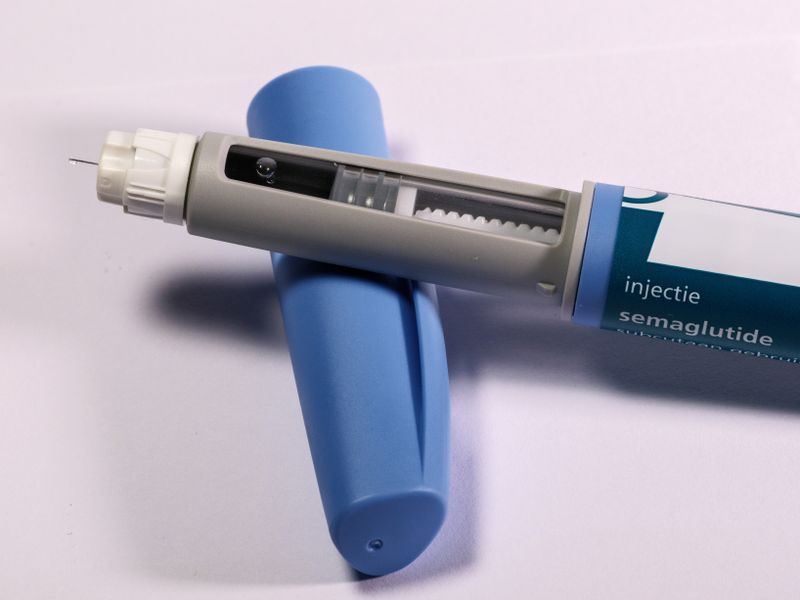
The dosing errors are a different category, and they are specific to how compounded product is delivered. Brand versions come in pens that meter the dose. Compounded versions usually come as a multi-dose vial and a syringe, which puts the arithmetic on you and your prescriber. FDA has documented patients who took five to twenty times their intended dose, driven by confusion between milliliters, milligrams and units. In one case a provider meant to prescribe 0.25 mg, which is 5 units, and wrote 25 units. In another, 20 units instead of 2, affecting three patients. Some required hospitalization, and because semaglutide has a half-life of about a week, an overdose is not something that clears by morning.
FDA has also flagged salt forms, semaglutide sodium and semaglutide acetate, as different active ingredients from the approved drug with no lawful basis for use in compounding, and has warned about products labeled with pharmacies that do not exist.
What is still legal today
Compounding is not banned. A state-licensed pharmacy can still compound a GLP-1 for an individual patient with a prescription. The limit is that it may not regularly make something that is essentially a copy of a commercially available drug, meaning the same active ingredient at the same or easily substitutable strength by the same route.
There is an exception when a prescriber documents that the compounded version contains a change producing a significant difference for a specific patient. FDA reads this narrowly. Adding vitamin B12 to semaglutide does not qualify when the strength is within ten percent of an available product.
The scale tells you what this exception is for. FDA has said it does not intend to act against a compounder filling four or fewer prescriptions of a copy per month. Four a month is a patient-by-patient accommodation, not a subscription business.
How to check the pharmacy filling your prescription
If you are buying through a telehealth brand, you may not know who actually compounds your drug. You can find out, and you should.
- Ask the company, in writing, which pharmacy compounds your prescription. A company that will not name it has answered your question.
- Check that pharmacy against your state board of pharmacy license database. FDA maintains a state-by-state directory of these databases and its guidance is blunt: if your pharmacy is not listed, do not use it.
- If they claim to be an outsourcing facility, check FDA's registered facility list. Registration lapses annually, so a name that appeared last year may not be current. Remember that being on it is not approval.
- Read the vial label. Misspellings, a wrong or missing pharmacy address, or a label naming only the telehealth brand are all documented warning signs.
- Note the beyond-use date. Once a multi-dose vial is punctured, standard practice is to discard it within 28 days unless the label says otherwise, and never past the labeled date. That window is much shorter than a manufactured pen's expiration.
If something goes wrong, report it to FDA through MedWatch. Those reports are the reason we can quote a number at all.
What the brand versions cost in cash right now
The math that made compounding attractive has changed. Both manufacturers now sell directly for cash, without insurance. These are the prices as of July 31, 2026, and they move, so check the manufacturer's page before you decide.
Zepbound (tirzepatide), through LillyDirect: $299 a month for 2.5 mg, $399 for 5 mg, and $449 for 7.5 mg and above when you refill within 45 days. Miss that window and the higher doses run $499 to $699.
Wegovy (semaglutide), through NovoCare Pharmacy: $349 a month across the standard doses, $399 for the 7.2 mg high dose, and $149 a month for the pill. New patients pay $199 for the first two monthly fills of the starting doses.
Ozempic: $349 a month for 0.25, 0.5 and 1 mg, $499 for 2 mg, with the same $199 introductory offer.
If you have commercial insurance that covers the drug, Lilly's savings program can bring Zepbound to as little as $25 for up to a three-month fill.
If you are on Medicare, there is a new $50 option
Medicare has never covered drugs used for weight loss. That exclusion is written into the statute, not a plan's choice.
As of July 1, 2026, CMS is running a temporary demonstration around it called the Medicare GLP-1 Bridge, offering certain GLP-1 medications for a flat $50 a month through December 31, 2027. The covered drugs are Foundayo, Wegovy in injection or tablet form, and Zepbound in the KwikPen only. Single-dose Zepbound vials and pens are not covered.
Eligibility runs through body mass index plus condition: BMI 35 or above; or BMI 30 or above with diastolic heart failure, uncontrolled hypertension, or chronic kidney disease stage 3a or higher; or BMI 27 or above with prediabetes, a prior heart attack or stroke, or symptomatic peripheral artery disease. You are not eligible if your Part D plan already covers GLP-1s, or if you have type 2 diabetes, moderate to severe sleep apnea, or fatty liver disease, because Part D may cover those uses directly. Prior authorization is required and your provider must certify a diet and exercise program.
Who this decision lands on
These drugs treat conditions that are common across every group in the country. In the most recent national measurements, diagnosed diabetes among adults ran 13.6% for American Indian and Alaska Native adults, 12.1% for Black adults, 11.7% for Hispanic adults, 9.1% for Asian adults and 6.9% for white adults, age-adjusted for 2019 through 2021. Obesity in the 2017 to March 2020 cycle ran 49.9% among Black adults, 45.6% among Hispanic adults, 41.4% among white adults and 16.1% among Asian adults.
Compounded versions found their market on price. That is why an enforcement story reads as an access story for a lot of households, and why the practical response is not outrage but arithmetic: know what the cash channels charge, know whether the Bridge covers you, and know who is making what you inject.
Frequently asked questions
Is compounded semaglutide illegal now? ▼
Mass-compounding it has had no shortage-based legal basis since May 22, 2025. A state-licensed pharmacy can still compound for an individual patient in narrow circumstances, but FDA's stated enforcement floor is four prescriptions per month of a drug that is essentially a copy. Large-scale telehealth supply does not fit inside that.
My telehealth company says its pharmacy is FDA-registered. Is that good? ▼
Registration is not approval. FDA has issued warning letters specifically over this framing, stating that compounding pharmacies and outsourcing facilities are not FDA-approved or FDA-licensed entities and that registering does not constitute approval of the facility or its products. Verify the pharmacy against your state board of pharmacy license database instead.
Is compounded semaglutide the same as Ozempic or Wegovy? ▼
No, and FDA has cited that exact claim as illegal marketing. Compounded drugs are not FDA-approved and are not generics. Some compounded products have also used salt forms, semaglutide sodium and semaglutide acetate, which FDA says are different active ingredients from the approved drug.
What happens if FDA finalizes the May 2026 proposal? ▼
Outsourcing facilities would have no lawful route to compound semaglutide, tirzepatide or liraglutide from bulk ingredient. The comment period closed July 30, 2026 and no final determination has been published. Nothing about your current prescription changed on that date.
What should I do if I am on a compounded GLP-1 right now? ▼
Do not stop abruptly on your own. Talk to your prescriber about moving to an approved product, and price the manufacturer cash channels first, since they now run $149 to $449 a month depending on drug and dose. If you are on Medicare, check whether you qualify for the $50 GLP-1 Bridge. In the meantime, confirm your pharmacy's state license and check your vial's beyond-use date.
Does Medicare cover Ozempic or Wegovy for weight loss? ▼
Not through the standard benefit. Federal statute excludes drugs used for weight loss from Part D coverage. The Medicare GLP-1 Bridge is a temporary demonstration running July 1, 2026 through December 31, 2027 that offers certain GLP-1s at $50 a month outside that benefit, with its own eligibility rules and no low-income subsidy.