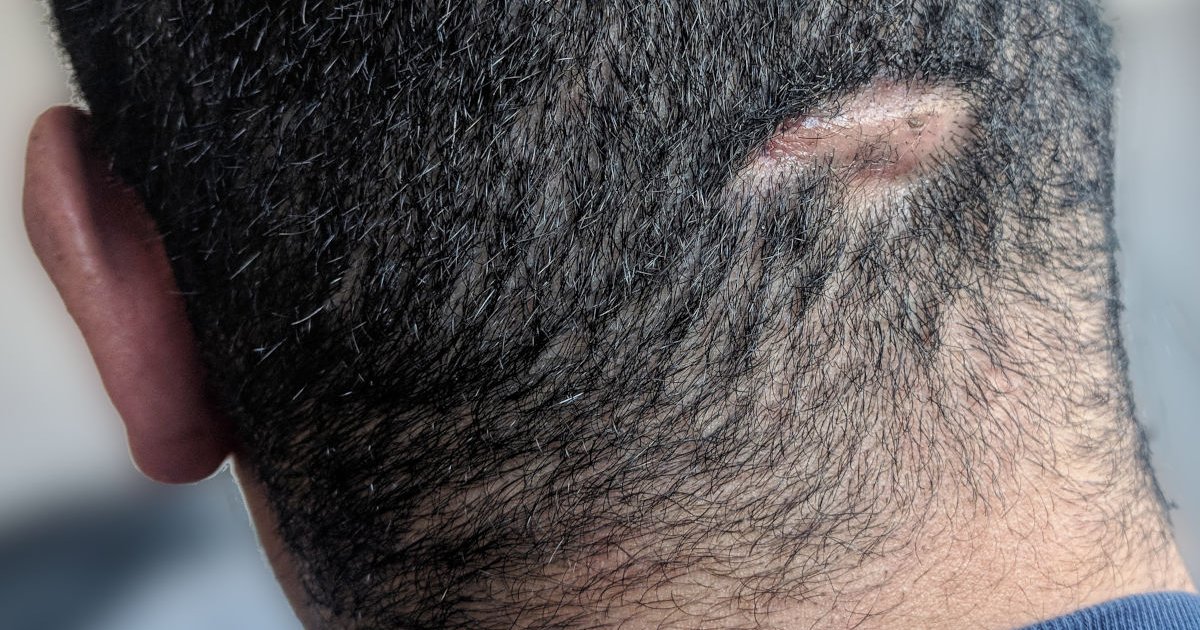
Dissecting cellulitis of the scalp is a long-lasting inflammatory condition, not an ordinary infection, that causes painful, soft, pus-filled lumps on the crown or back of the head. The lumps connect under the skin, drain, and can leave permanent bald scars (Mokos et al., 2026). In the United States it has mostly been described in African American men between 20 and 40 (Scheinfeld, 2014). The single most important thing to know: hair can often be saved only while the follicles are still inflamed, before they scar, so see a dermatologist early instead of cycling through antibiotics for "boils".
What dissecting cellulitis looks like
It usually starts as pustules and firm or soft lumps around hair follicles, most often on the vertex (crown) or the back of the head. Over time the lumps turn into abscesses that join through tunnels under the skin called sinus tracts, and the scalp over them loses hair and scars (Scheinfeld; Lee et al., 2018). A recent review describes painful nodules, abscesses and sinus tracts leading to progressive scarring hair loss (Mokos et al.).
What people notice day to day: a soft, "boggy" lump that feels like it has fluid in it, pus that leaks onto the pillow, tenderness when brushing or getting a cut, and a patch where hair stops growing. On short hair or a fade, the bald spots over old lumps become obvious. The photo above shows the typical picture: a raised, shiny, hairless lump in a patch of thinning hair.
Who gets it
The classic description is a young Black man. Scheinfeld's comprehensive review says that in the US it predominantly occurs in African American men between 20 and 40, that it occurs in other races and in women more rarely, and that it is likely under-reported (Scheinfeld). A 2023 systematic review opens the same way, describing a disease that disproportionately affects African American men (Masson et al., 2023).
Newer data complicate that picture, and it is worth saying plainly. A 2026 study of 29 patients across the Mass General Brigham system found diverse racial backgrounds, and its review of 17 published cohorts covering 710 patients found consistent male predominance but a mixed racial distribution. The authors argue the condition is better linked to male sex and metabolic health than to race (Salloum et al., 2026). A series of 66 patients in Taiwan, 63 of them men with a mean age of 24.9, makes the same point from the other side of the world (Lee et al.). The practical upshot for Black men is the same either way: it is not rare in your community, and a doctor who has never seen it may mistake it for something else.
Other conditions travel with it. In the 2026 cohort, nearly half had at least one other follicular occlusion disorder, 82.8% had at least one metabolic condition such as overweight, and 41.4% had a psychiatric diagnosis (Salloum et al.). In the Taiwan series, 29 of 45 patients examined were overweight or obese and 15 of 66 also had severe acne conglobata (Lee et al.).
Why it gets misdiagnosed
Pus makes everyone think infection. Bacteria such as Staphylococcus aureus are often grown from the lesions (Mokos et al.), so people are treated for boils or folliculitis again and again. A course of antibiotics may calm it for a while, then it returns, because the underlying problem is an inflammatory reaction in the hair follicles. Scheinfeld describes it as likely involving both follicle dysfunction and an abnormal immune response to bacteria that normally live on skin (Scheinfeld).
An over-the-counter minoxidil from any pharmacy is the same active ingredient a paid prescription service sells at a markup, and a community health center can check for an underlying cause on a sliding scale. Our directory of free and charitable clinics lists centers by state. A same-day telehealth visit is self-pay and is not billed to Medicaid, so try the pharmacy shelf and a clinic workup first. If you want a telehealth visit instead:
 Sesame Care
Talk to a clinician about hair loss.
Hair loss consult, priced up front
Start a hair loss consultIt can also be confused with other scalp problems in Black men. Acne keloidalis nuchae causes firm bumps and keloid-like scars at the back of the neck and hairline. Our guide to acne keloidalis nuchae covers it, and a 2026 case report described the two occurring together in the same patient (Umar et al., 2026). In children and teenagers, an inflamed scalp ringworm called a kerion can look almost identical; a case report described two adolescents with kerion that mimicked dissecting cellulitis (Sperling, 1991). That is one reason a dermatologist may take a fungal culture or a small biopsy. See our guide to scalp ringworm in Black children. A dermatologist may also use trichoscopy, a magnified look at the scalp, which shows patterns such as yellow areas and plugged follicles over boggy, hairless plaques (Mokos et al.).
Treatment: what the evidence shows
Expectations first. There are no specific guidelines and no treatment approved for this condition (Díez-Madueño et al.). A 2023 systematic review found 110 relevant reports covering 417 patients, and 86.4% were case reports or case series, so every option below rests on small numbers (Masson et al.). A dermatologist usually combines and sequences treatments.
Isotretinoin. The oral retinoid best known for severe acne is the most studied medicine for dissecting cellulitis. In the 2023 systematic review, it had an overall response rate of 91% (142 of 156 patients) (Masson et al.), and Scheinfeld called it the best chance at remission while noting small numbers and little follow-up past a year (Scheinfeld). In the Taiwan series, complete remission came in 37.5% of patients on isotretinoin alone (Lee et al.). Isotretinoin causes severe harm to a developing pregnancy, so in the US every prescription runs through the FDA's iPLEDGE safety program (FDA).
Antibiotics, steroid shots and drainage. Older therapies reported to help include oral antibiotics such as minocycline and tetracycline, steroid injected into the lumps, and opening and draining abscesses (Scheinfeld). Limited excision or unroofing of a painful abscess or tract can bring quick relief (Mokos et al.). For many people these control flares rather than end the disease.
Biologic drugs. TNF-alpha blockers, mostly adalimumab and infliximab, are the most reported advanced treatment. A 2026 systematic review of 46 studies and 125 patients found response rates above 80% with them, an 8.3% rate of side effects that were mostly mild or moderate, and promising early results for newer IL-17 and IL-23 blockers. Its authors suggest earlier use might prevent permanent scarring, while stressing that this is still a hypothesis (Díez-Madueño et al.).
Laser, light and surgery for stubborn disease. A systematic review of hard-to-treat cases found that biologics and laser therapy gave a better chance of remission than isotretinoin in that group, and that X-ray epilation and surgical removal had the best remission rates but can carry serious harms (Thomas and Aguh, 2021). Hair removal lasers and photodynamic therapy have also been reported to help (Scheinfeld; Masson et al.). Surgery is usually kept for people whose scalp has stopped responding or has burned-out, scarred areas (Mokos et al.).
Can the hair grow back?
It depends on timing. Case reports in the 2023 review describe hair regrowing as inflammation settled on isotretinoin (Masson et al.). Once a follicle has been destroyed and replaced by scar, it does not regrow, which is why surgery is reserved for areas with permanent follicle damage (Mokos et al.). The honest advice is to treat hard and early, while the lumps are active, and to ask your dermatologist which patches still have living follicles.
Living with it
Draining lumps on the scalp are painful and hard to hide, and the 2026 cohort found psychiatric diagnoses in 41.4% of patients (Salloum et al.). Say so at the appointment if it is affecting your sleep, work or mood. Practical steps: keep draining areas clean and covered at night, change pillowcases often, and tell your barber so clippers stay away from active lumps. If razor bumps on the face are part of the picture too, our guide to razor bumps on Black skin covers shaving changes that help.
When to see a dermatologist
Book a board-certified dermatologist if you have soft or painful lumps on the scalp that keep coming back, pus draining from the same spots, or a bald patch forming over old lumps. Bring a list of every antibiotic you have taken for it and how long each helped, and ask directly whether this could be dissecting cellulitis. You can find a dermatologist near you in our directory.
Frequently asked questions
Is dissecting cellulitis an infection? ▼
Not mainly. Bacteria are often grown from the lumps, but the disease is a chronic inflammatory reaction in the hair follicles, related to hidradenitis suppurativa. That is why short antibiotic courses help for a while and then it comes back.
What is the best treatment for dissecting cellulitis? ▼
There is no approved treatment and no head-to-head trial. Isotretinoin is the most studied and works for many people. TNF-blocking biologics such as adalimumab help many people when other treatment fails, and lasers or surgery are options for stubborn cases.
Will my hair grow back? ▼
Hair can regrow where follicles were inflamed but not destroyed, which is why early treatment matters. Areas that have already scarred do not regrow hair.
Who gets dissecting cellulitis? ▼
Mostly men in their 20s to 40s. Many US studies describe African American men, but newer cohorts find it across races and link it with being overweight and with other follicle disorders such as hidradenitis suppurativa.