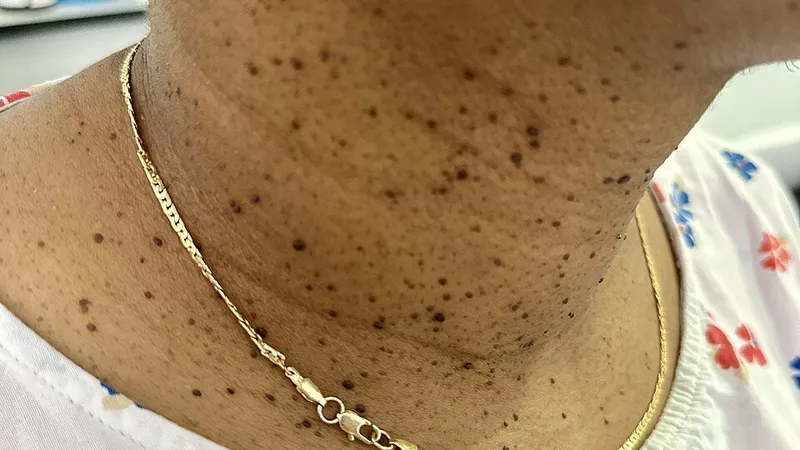
If you have soft little flaps of skin on your neck, under your arms, or along a bra line, get them looked at once, ask for an A1c blood test, and choose a removal method with your skin tone in mind. Skin tags are harmless growths, but on brown and black skin the removal method decides whether you trade a tag for a pale or dark spot that lasts for months.
What skin tags look like on brown and black skin
A skin tag, or acrochordon, is a small, soft piece of skin that hangs from a stalk. StatPearls, the NIH-hosted clinical reference, describes them as ovoid growths, usually 1 to 5 mm, that are often attached to a fleshy stalk and tend to grow where skin folds: the armpits, neck, eyelids, and groin. They are not painful, but they catch on necklaces and collars, and that friction can make them bleed or itch.
Color is the weak clue on dark skin. A 2024 review in American Family Physician describes a skin tag as pedunculated, on a short stalk, and the same color as the surrounding skin or darker shades of brown and black. So the shape is what to look for: a soft bump you can lift away from the skin on a stalk, sitting in a spot where skin rubs skin or fabric.
Skin tags or dermatosis papulosa nigra?
Many Black adults have both, and they are different conditions. Dermatosis papulosa nigra (DPN) shows up as small dark papules on the face, mostly the cheeks, temples, and forehead, often starting in adolescence. StatPearls classes DPN as a common variant of seborrheic keratosis. Skin tags live in the folds and hang on stalks. Our full guide to dermatosis papulosa nigra on Black skin covers DPN identification and treatment in depth.
Location settles most cases: bumps across the cheekbones point to DPN, soft flaps in the folds point to skin tags.
Why skin tags can be a blood sugar signal
StatPearls states that skin tags occur more commonly in people with obesity, diabetes, or metabolic syndrome, and in people with a family history of them. A Danish systematic review of skin signs of diabetes and prediabetes found an association between skin tags and diabetes in five of its included studies, and concluded that it is advisable to screen people with skin tags by measuring their glycated hemoglobin, the A1c test.
Skin tags often travel with another sign of insulin resistance. A study of patients with multiple skin tags found them independently associated with acanthosis nigricans, the dark, velvety thickening on the back of the neck and in the armpits. If you see both, read our guide to acanthosis nigricans on Black skin.
None of this means a skin tag is diabetes. It means a crop of new tags, especially on the neck with darkening skin nearby, is a cheap reason to get an A1c and a lipid panel. If the result lands in the prediabetes range, our guide to reversing prediabetes lays out the next steps.
How clinicians remove skin tags
Removal is optional. The 2024 American Family Physician review lists three standard methods for skin tags that are bothersome or that a patient wants gone for cosmetic reasons:
- Snip or shave excision. The clinician numbs the area if needed and cuts the tag at its base.
- Cryosurgery. Liquid nitrogen freezes the tag so it dies and falls off.
- Electrodesiccation. A small electric current dries and destroys the tissue.
The same review adds a point that matters for Black patients: treatment options should be individualized to skin type, and in patients with darker skin, cryotherapy should include a discussion about hypopigmentation risk.
Whatever brought you to this page, community health centers see patients regardless of insurance and charge on a sliding scale that is often $0. Our directory of free and charitable clinics lists centers by state. A same-day telehealth visit is self-pay and is not billed to Medicaid, so if you have Medicaid the clinic route will usually cost less. If you would rather see a clinician online today:

See a doctor online today.
- Same-day video visits from $34
- Price shown before you book
- No insurance needed
 with Sesame Care
Affiliate link, we may earn a commission at no extra cost to you.
The pigment risk of freezing on dark skin
A 2020 American Family Physician review of skin cryosurgery explains why. Melanocytes, the cells that make pigment, are more sensitive to cold injury, which causes hypopigmentation, especially in darker skin. The review lists dark-skinned people under "perform with caution," lists hyperpigmentation as a prolonged complication and hypopigmentation as a permanent one, and names being unable to accept the possibility of pigment changes as a reason not to freeze at all.
A controlled freeze study published in Cryobiology found that every treated spot developed a pale center with a darker rim, and that the color changes persisted for at least six months. Darker marks after skin injury, called post-inflammatory hyperpigmentation, are a known problem in skin of color: a review in the Journal of Clinical and Aesthetic Dermatology describes them as more frequent and more severe in darker skin.
Why at-home removal products are a bad bet
The FDA has been direct about removal creams and serums. In an August 2022 warning letter over skin tag and mole removers sold online, the agency wrote that there are no over-the-counter drugs that can be legally sold for mole or skin tag removal, and that FDA has safety concerns about drugs marketed directly to consumers for these uses. The same letter notes the FDA's consumer warning that products marketed for removing moles and other skin lesions can cause injuries and scarring.
The bigger risk with any home method is the diagnosis. The FDA letter warns that self-diagnosis and self-treatment of moles can delay cancer diagnosis, and once a growth is burned, frozen, or cut off at home, there is nothing left to examine. Home freezing kits also carry the same pigment risk on dark skin that an office freeze does, with no clinician choosing the freeze time. We found no guideline that endorses tying off or cutting a tag yourself.
Does insurance cover skin tag removal?
Usually not, unless the tag is causing a medical problem. Medicare's local coverage policy on removal of benign skin lesions (L35498, revision effective October 30, 2025) names skin tags directly and says removal of benign skin lesions that does not pose a threat to health or function is considered cosmetic and not covered. The same policy treats removal as medically necessary when the record documents bleeding, itching, pain, a change in appearance, recent enlargement, inflammation, real uncertainty about the diagnosis, or a spot that is repeatedly injured. If a tag catches on a bra strap or chain and bleeds, tell your clinician so it is documented.
One detail works in your favor: the policy says the visit to diagnose a benign skin lesion may be paid even when the removal itself is ruled cosmetic. Private insurers and Medicaid plans write their own policies, so call your plan before the appointment.
What removal costs, and what drives the price
We could not find a primary source that publishes a standard price, so we are not printing one. Prices vary by practice. What moves the number: how many tags you have (the billing code for skin tag removal covers up to 15 tags, with an add-on code for each additional 10), the method, whether a tag is sent to a lab, and whether your plan covers any of it. Ask for a written self-pay quote that states the number of tags included.
When to see a dermatologist
Book a visit if a growth bleeds without being caught on anything, changes color, grows fast, or looks different from your other tags, or if new tags show up alongside darkening skin on your neck. Ask for the A1c while you are there. You can find a Black dermatologist near you in our dermatology provider directory.
Frequently asked questions
Are skin tags a sign of diabetes? ▼
They can be a signal, not a diagnosis. Skin tags are more common in people with obesity, diabetes, or metabolic syndrome, and a systematic review advises checking an A1c in people who have them.
Why do I get skin tags on my neck? ▼
Skin tags form where skin rubs on skin or clothing, and the neck is one of the most common spots, along with the armpits and groin. Family history and excess weight also raise the odds.
Is it safe to remove skin tags at home? ▼
The FDA says no over-the-counter drug can legally be sold for skin tag removal, and it has warned that removal products can cause injuries and scarring. Removing a growth yourself also destroys the evidence if it was not a skin tag.
Will freezing a skin tag leave a mark on dark skin? ▼
It can. Freezing damages pigment cells, and clinical guidance flags light spots as a particular risk in darker skin. Dark marks can also follow. Ask whether snipping is an option instead.
Does insurance pay to remove skin tags? ▼
Usually only when the tag bleeds, itches, hurts, changes, gets irritated repeatedly, or its diagnosis is uncertain. Medicare calls removal for appearance alone cosmetic. Check your own plan's policy.
Are the dark bumps on my cheeks skin tags? ▼
Probably not. Small dark bumps across the cheeks, temples, and forehead are usually dermatosis papulosa nigra, a separate condition. Skin tags hang on stalks in skin folds.