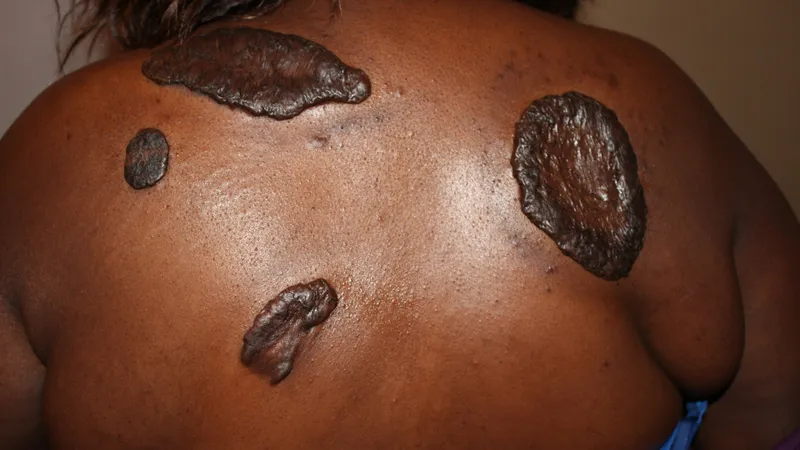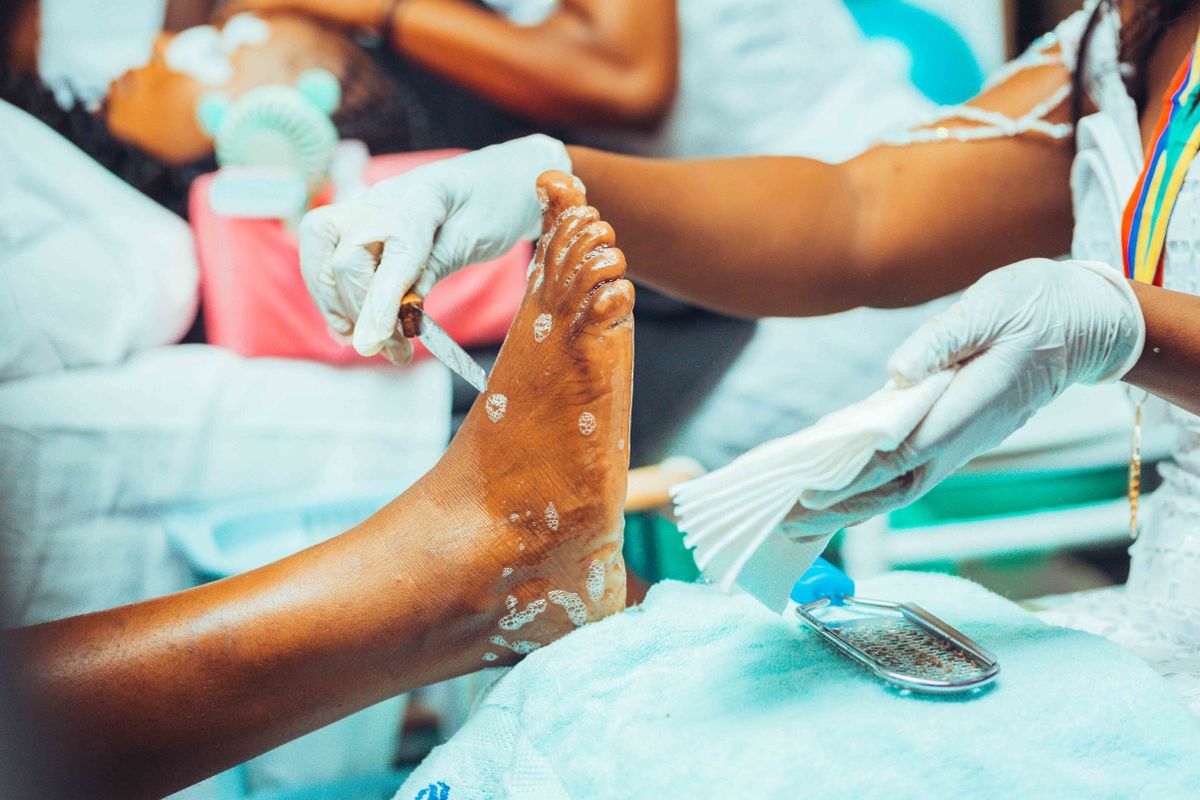
That thick, crumbly, discolored toenail is probably onychomycosis, a fungal nail infection, and creams rarely clear it. The treatment with the strongest evidence is a 12-week course of oral terbinafine, started after a lab test confirms fungus is actually there. And a dark streak running the length of a toenail is usually harmless pigment on dark skin, but a new single band can be the first sign of melanoma under the nail, the cancer that killed Bob Marley at 36.
What toenail fungus looks like on dark skin
Onychomycosis affects around 14% of adults in North America and is the most common nail disorder clinicians see. The classic picture: the nail thickens, turns brittle or crumbly at the free edge, lifts away from the nail bed, and collects soft debris underneath, with discoloration starting at the tip. On dark skin that color change often reads darker than the chalky white-yellow in textbook photos: yellow-brown, gray-brown, sometimes nearly black. Some fungi also produce pigment of their own and can paint a brown-black streak in the nail, called fungal melanonychia; Trichophyton rubrum, the most common cause of toenail fungus, is the usual culprit. Athlete's foot often travels with it.
Get the test before you treat
About half of bad-looking nails are not fungus: in a 12-center North American study of 1,832 people, onychomycosis accounted for up to 50% of nail disorders, with trauma, psoriasis, and ordinary aging causing much of the rest. That is why the FDA label for terbinafine tells prescribers to confirm the diagnosis first with a nail specimen: a KOH preparation, a fungal culture, or a nail clipping for biopsy. A 2021 US consensus panel of dermatologists and podiatrists says the same: confirm with microscopy, histology, or culture before committing to months of treatment. It matters for safety too: treating a dark nail as fungus without confirmation is how a melanoma gets a year's head start.
What works, ranked by evidence
Home remedies: weak evidence
Vicks VapoRub has real fans and thin data. The study behind the headlines followed 18 people applying it daily for 48 weeks: 5 of them (28%) reached both mycological and clinical cure, with no comparison group. Tea tree oil went head to head with clotrimazole solution in a 117-person randomized trial: after 6 months, culture cure was 18% for tea tree oil and 11% for clotrimazole, with no placebo arm to show either did much at all. Neither remedy is dangerous on intact skin, and neither reliably reaches fungus under the nail plate. If the nail is thick, painful, or spreading, or you have diabetes, skip the 48-week experiment.
Prescription topicals: modest cure rates
Prescription lacquers and solutions do better, modestly. Ciclopirox 8% lacquer, painted on daily for 48 weeks, cleared the fungus on lab testing in 29% and 36% of patients in its two US pivotal trials, against 11% and 9% for the lacquer base alone. Efinaconazole 10% solution, also daily for 48 weeks, reached mycologic cure in 53% to 55% of patients but complete cure, a fully normal nail plus negative tests, in only 15% to 18%. Topicals fit mild infections limited to part of the nail, people who cannot take oral antifungals, and maintenance after a cure.
Whatever brought you to this page, community health centers see patients regardless of insurance and charge on a sliding scale that is often $0. Our directory of free and charitable clinics lists verified centers by state. A same-day telehealth visit is self-pay and is not billed to Medicaid, so if you have Medicaid the clinic route will usually cost less. If you would rather see a clinician online today:

See a doctor online today.
- Same-day video visits from $34
- Price shown before you book
- No insurance needed
 with Sesame Care
Affiliate link, we may earn a commission at no extra cost to you.
Oral terbinafine: the most effective option
Terbinafine, 250 mg daily for 12 weeks, is the first-choice oral treatment in US consensus recommendations. In the pivotal toenail trials on its FDA label, 70% of patients reached mycological cure and 38% reached complete cure: a clear nail plus negative fungal tests. A 2017 Cochrane review of 48 randomized trials found high-quality evidence that terbinafine works, and moderate-quality evidence that it outperforms azole pills such as itraconazole. Know the tradeoffs: taste disturbance can occur and is occasionally permanent, and rare cases of severe liver injury have occurred, which is why the label advises checking liver enzymes (ALT and AST) before starting. Be patient with the mirror: the pills kill the fungus in 12 weeks, but a toenail needs 12 to 18 months to grow out clean.
If you have diabetes, toenail fungus is not cosmetic
Thick, sharp, crumbling nails break the skin around them, and in a foot with reduced sensation a small break can become an ulcer before you feel it. In the Seattle Diabetic Foot Study, which followed 1,285 adults with diabetes, onychomycosis independently raised the risk of a future foot ulcer by 58%. The infection is common in diabetes: a 550-patient clinic survey found lab-confirmed toenail fungus in 26% and projected that roughly one in three people with diabetes will develop it (a nearly all-white sample; no comparable survey of Black patients exists). Foot ulcers are how amputations start; our guide to diabetic foot ulcers and amputation risk in Black adults covers the prevention playbook. The short version, from the NIDDK: check your feet daily, trim nails straight across, let a foot doctor trim thick or yellowed nails, and bring your own tools to the nail salon.
The dark nail streak every Black adult should know about
Start with the reassuring fact: pigmented bands running the length of the nail, called longitudinal melanonychia, are a normal finding on dark skin. Nearly 100% of Black adults develop one or more by age 50. Most are simple melanocyte activation, the nail's version of a freckle, and they tend to stay stable for years and often appear in more than one nail.
The pattern that demands attention is different. Melanoma under the nail, usually the acral lentiginous subtype, typically announces itself as a new pigmented band in a single nail. Acral lentiginous melanoma is the melanoma of the palms, soles, and nail unit, skin the sun rarely touches. In Black patients it accounts for 36% of all melanomas, and an estimated 15 to 20% arise in the nail unit itself.
The warning signs, from nail-specialist reviews: a band new in adulthood and confined to one nail; a band wider than 3 mm, especially with mixed shades or blurred edges; a band that widens or darkens over months; pigment spreading onto the cuticle or surrounding skin, called the Hutchinson sign; or a nail that splits, bleeds, or ulcerates. A bruise from a stubbed toe grows out toward the tip over weeks. A melanoma band does not grow out.
Bob Marley's story is the one to remember. His acral lentiginous melanoma presented as a pigmented lesion under his right big toe. Diagnosed in 1977, he declined the recommended amputation and died of metastatic disease in May 1981, at 36. Caught early, nail-unit melanoma is treatable: five-year survival for acral lentiginous melanoma runs around 80%, and stage at diagnosis is what moves that number. It is often found late for a simple reason: nobody is looking at feet.
Fungus itself occasionally causes a dark streak (fungal melanonychia), one more reason nail changes get tested rather than guessed at. The working rule: fungus usually thickens and crumbles several nails, while melanoma paints a flat lengthwise band in one nail whose surface starts out normal. Learn the other signs of skin cancer on dark skin, and put any new band in front of a dermatologist.
How to get care
A podiatrist or a dermatologist can settle a nail question in one visit and take the specimen that confirms fungus. Nail changes are health information, not a grooming failure; clinicians look at feet all day, and yours will not surprise them. You can find a Black podiatrist or dermatologist through our provider directory. If oral treatment is on the table, expect two things at that first visit: a nail test before the prescription, and a liver enzyme check before the first pill. Both mean it is being done right.
Frequently asked questions
How long until my toenail looks normal again? ▼
Plan on 12 to 18 months from the start of effective treatment. Terbinafine is taken for 12 weeks, but the damaged nail has to grow out and be replaced from the root, and toenails grow slowly.
Is the dark line on my toenail fungus, a bruise, or melanoma? ▼
A bruise follows an injury and grows out toward the tip over weeks. Fungus usually thickens or crumbles the nail, often several nails. A melanoma band is typically new, flat, lengthwise, and confined to one nail, and may widen, darken, or spread pigment onto nearby skin. Only an exam, sometimes with a biopsy, can say for sure.
Does Vicks VapoRub cure toenail fungus? ▼
The evidence is one 18-person study with no comparison group, in which 5 people were cured after 48 weeks of daily use. For a mild, lab-confirmed infection it is a low-risk add-on, not a substitute for proven treatment. With diabetes, see a clinician instead of experimenting.
Do I really need a blood test before taking terbinafine? ▼
Yes. The FDA label advises measuring liver enzymes (ALT and AST) in all patients before starting terbinafine, because rare severe liver injury has occurred. Your prescriber should also confirm the fungus with a nail test first, since about half of abnormal nails are not fungal.