Hard, intensely itchy bumps on your arms, legs or back that keep coming back no matter what lotion you try deserve a dermatologist visit and a specific question: could this be prurigo nodularis? Black patients carry a large share of this condition. In a Johns Hopkins study of 909 adults with prurigo nodularis, 49.4% were African American. Two injectable medicines are now FDA-approved for it, so a name for those bumps can open real treatment options.
Prurigo nodularis is an itch that builds its own bumps
PN starts with itch. Scratching and rubbing that itch for weeks raises hard bumps called nodules, the nodules itch too, and the scratching continues. The American Academy of Dermatology (AAD) calls this the itch-scratch cycle and says treatment can break it. A US expert panel consensus in the Journal of the American Academy of Dermatology defines the core findings as firm nodules, itch lasting at least 6 weeks, and a history or signs of repeated scratching, picking or rubbing.
Three facts worth holding onto, all from the AAD: you cannot catch PN or give it to anyone, it is not inherited, and it can be treated but not cured. Effective treatment can stop the itch and clear the skin.
On brown and Black skin, the bumps are often dark, not red
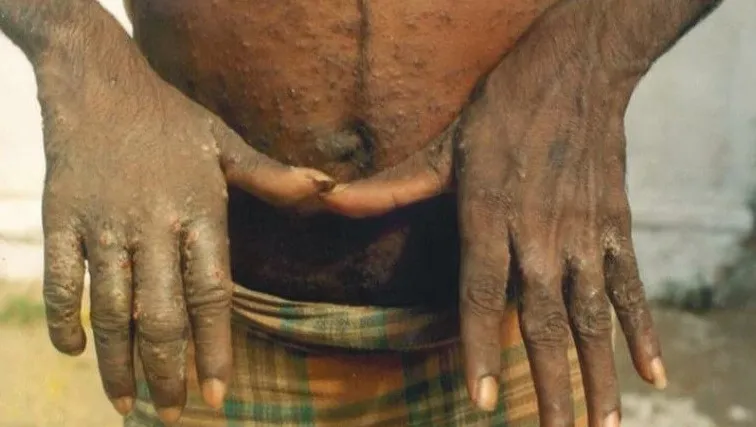
Many textbook photos show pink or red nodules. The AAD symptom guide lists a wider range: the bumps can be the color of your skin, pink, red, or brownish black. They run from the size of a pinhead to larger than a US quarter, and a person can have a few or more than 100. They usually appear evenly on both sides of the body, most often on skin that is easy to reach and scratch: arms, legs, upper and lower back, buttocks and abdomen. A 2025 review on PN in skin of color patients describes scratched bumps mostly on the outer surfaces of the arms and legs.
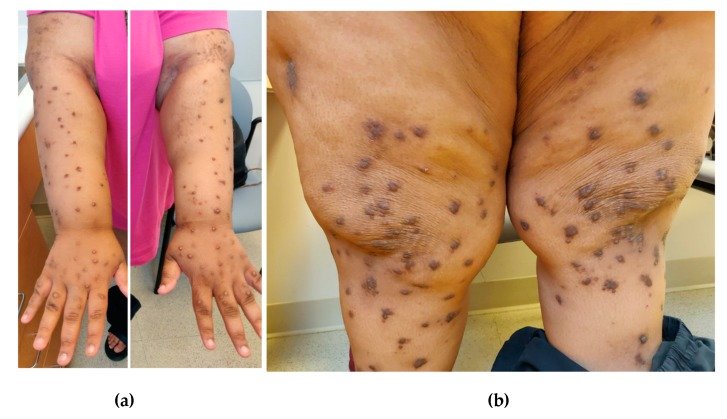
Scratching changes the skin around the bumps too. The AAD notes that dark spots can appear and the skin can turn hard and thick. As nodules clear, they can leave flat spots darker or lighter than your natural color, or scars. Those marks are part of why early treatment matters on darker skin. Our guide to dark spots on Black skin covers fading them once the itch is under control.
What the Johns Hopkins study found in Black patients
A Johns Hopkins study reviewed every adult seen for it at the Johns Hopkins Health System from December 2012 to December 2017. Of 909 patients, 49.4% were African American, in a health system where 19.0% of all patients are African American. Among the African American patients with PN, 54.6% were women. Across the study, the most common age group was 51 to 65.
Common skin conditions are treated in primary care, and community health centers charge on a sliding scale that is often $0. Our directory of free and charitable clinics lists centers by state. A same-day telehealth visit is self-pay and cannot be billed to Medicaid or commercial insurance, so the clinic route usually costs less. If you need a prescription sooner than the next appointment:
Prescription skincare from a licensed clinician.
- Online visit and a treatment plan for your skin
- From $59 a month, shown before you book
 with Sesame Care
Affiliate link, we may earn a commission at no extra cost to you.
Two limits matter. The data come from one hospital system, and the authors state that their findings show associations, not causes. Research gaps also run through the drug trials: Black participants made up 6% of the trials behind the dupilumab approval and 7% of the trials behind the nemolizumab approval, according to each FDA label. That is a shortfall in how the studies were built, not a reason to skip treatment. Both labels approve the drug for adults with PN.
Eczema, kidney disease, liver disease and HIV are linked to PN
About half of people who develop PN have or had eczema, according to the AAD. The AAD also lists diabetes, end-stage kidney disease, hepatitis C, untreated HIV, lymphoma, and anxiety or depression as conditions that raise the odds. A nationwide US study in the Journal of Investigative Dermatology names liver disease, kidney disease, HIV and cancers among PN's associated diseases. If eczema is part of your history, our guide to managing eczema on Black skin is a useful companion.
In the Johns Hopkins cohort, 27.2% of African American patients with PN had HIV, and PN in African American patients was also associated with high blood pressure and ischemic heart disease. The AAD warns that PN may be the first noticeable sign of another disease, such as lymphoma or untreated HIV. That is why a good PN visit looks past the skin.
How a dermatologist diagnoses PN
A dermatologist can often diagnose PN by examining the skin, according to the AAD. If another skin condition might be involved, they may scrape off a bit of skin or take a small biopsy during the visit. Expect questions about how the itch affects your sleep and work, and about other health conditions, since those shape the treatment plan. If your itch comes as raised welts that appear and fade rather than hard bumps, read our guide to chronic hives in Black adults before your appointment.
The treatment ladder, from creams to biologics
Skin treatments first. The AAD treatment guide lists over-the-counter anti-itch creams with menthol, phenol, pramoxine or capsaicin; prescription corticosteroid creams, sometimes applied under plastic wrap at night; medical tape coated with a corticosteroid, which also puts a barrier between your nails and the bumps; tacrolimus or pimecrolimus; and calcipotriol, a vitamin D cream that can shrink bumps. A drowsy antihistamine at bedtime can help you sleep through the itch.
Office procedures for stubborn bumps. Corticosteroid injections into a nodule, usually every 4 to 6 weeks, can quickly calm itch and flatten it, though they can leave a lighter spot. Phototherapy means 2 to 3 sessions a week of prescribed UV light, or excimer laser for a single stubborn bump; skin darkening is a possible but rare side effect. The AAD states that cryosurgery is seldom a treatment for people with darker skin tones because freezing can cause noticeable light spots, scarring, or both. If freezing is offered, ask about these alternatives first.
Dupilumab (Dupixent). The FDA label approves dupilumab for adults with PN. The first dose is 600 mg (two injections), then 300 mg every 2 weeks, which you can learn to inject at home. In the PRIME trial, 60.0% of patients on dupilumab had at least a 4-point drop in worst itch on a 10-point scale at week 24, against 18.4% on placebo. Side effects reported in the PN trials include cold symptoms, pink eye, herpes infections, dizziness, muscle aches and diarrhea.
Nemolizumab (Nemluvio). The FDA label also approves nemolizumab for adults with PN. After a 60 mg starting dose, people under 90 kg (about 198 pounds) inject 30 mg every 4 weeks, and people at 90 kg or more inject 60 mg every 4 weeks. In the OLYMPIA 2 trial in the New England Journal of Medicine, 56.3% of patients on nemolizumab had at least a 4-point drop in peak itch on a 10-point scale at week 16, against 20.9% on placebo. The most common side effects were headache and eczema.
Older pills. Methotrexate and cyclosporine have been used for years when other treatments fail. The AAD notes they are used less often now that FDA-approved options exist, and both require monitoring with blood work.
Book the dermatology visit after two weeks of itchy bumps
The AAD advice is direct: if itchy bumps last more than 2 weeks, see a dermatologist. You can search the Black Health dermatology directory by location. Bring four questions: Is this prurigo nodularis? Which blood tests do I need? Is any procedure you are offering safe for my skin tone? Am I a candidate for dupilumab or nemolizumab?
Frequently asked questions
What does prurigo nodularis look like on Black skin? ▼
Hard, raised bumps that can be brownish black, skin-colored, pink or red, ranging from pinhead size to larger than a quarter. They usually show up on both sides of the body, most often on the arms and legs, where scratching is easiest. Healed bumps can leave flat spots darker or lighter than your natural skin color.
Why are the itchy bumps on my skin not going away? ▼
With PN, scratching creates the nodules and the nodules itch, so the cycle feeds itself. Over-the-counter lotion rarely breaks it. The AAD recommends seeing a dermatologist when itchy bumps last more than 2 weeks.
Is prurigo nodularis contagious? ▼
No. You cannot catch PN or give it to anyone. It is also not inherited.
What is the best treatment for prurigo nodularis? ▼
Treatment is matched to how widespread and stubborn the bumps are. It usually starts with creams and anti-itch care, moves to steroid injections or phototherapy, and for many adults now includes one of two FDA-approved injectables: dupilumab (Dupixent) or nemolizumab (Nemluvio).
Can prurigo nodularis be a sign of HIV or kidney disease? ▼
It can. The AAD says PN may be the first noticeable sign of another disease, such as untreated HIV or lymphoma, and it is linked to kidney disease, liver disease, hepatitis C and diabetes. Ask your clinician whether blood tests, including HIV and hepatitis testing, belong in your workup.